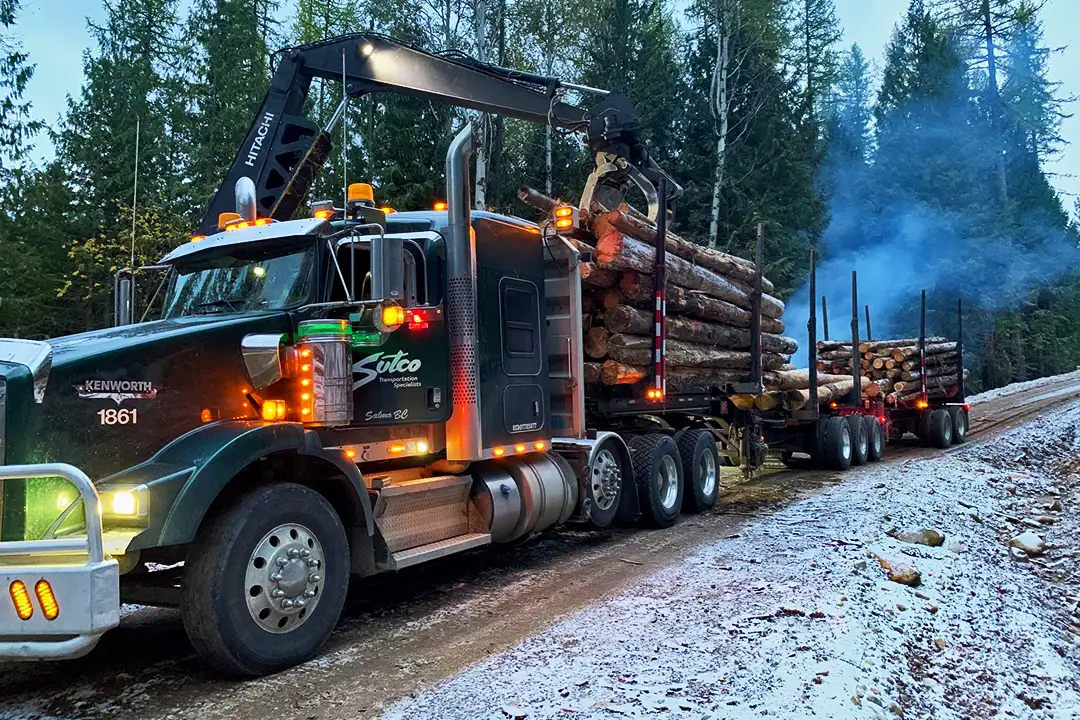

Logging truck insurance is the same set of coverages any trucking operation buys, applied to one of the hardest operations on the road: heavy loads, unpaved woods roads, steep grades and securement rules written specifically for logs. Auto liability, physical damage, general liability, and in some cases cargo and workers’ comp. The questions log haulers ask are mostly about where those coverages stop.
The log hauling insurance page covers the program as a class. This article works through the questions we hear most.
What coverages does a log hauler need?
Auto liability for injury and damage to others from operating the truck. Physical damage on the tractor and the log trailer. General liability for operations away from the road, such as work at a landing or a mill yard. Workers’ comp once you have employees on payroll.
Those four are the base. The questions that follow decide what gets added.
Do I need cargo insurance for logs?
That depends on who owns the logs while they are on your truck. Log haulers work under several arrangements. Some haul timber that belongs to a landowner or a logging contractor to a mill. Some haul for the mill itself. Some own the timber.
If the logs belong to someone else, you may be liable for them, and motor truck cargo is the coverage for that. If you own them, there is no shipper to claim against you. Ask your agent which applies to each hauling agreement, and get the answer before the first load.
What do the federal securement rules say?
The federal cargo securement rules in 49 CFR Part 393, Subpart I include commodity-specific requirements for logs, separate from the general rules for other freight. Shortwood, longwood and the way the load is contained on the trailer each have their own provisions.
Insurance does not enforce those rules, but it reads the results. A securement violation written on a roadside inspection becomes part of the carrier’s safety record. The article on whether a written warning affects your CSA score explains how that record builds.
Is the truck covered on woods roads?
Generally yes, if the policy’s territory and radius include where you run and the operation matches what you told the underwriter. The risk is a mismatch: a hauler declared as running short paved routes who is actually spending half the day on unimproved roads.
Declare the operation as it is. Underwriters price woods work knowing what it is. They are less forgiving of finding it out after a claim.
Is my loader covered?
A knuckleboom mounted on the truck may be part of the insured unit if it is listed with the truck. Ask, and get it in writing. A separate loader, skidder, feller buncher or other woods equipment is not a truck and needs its own coverage, usually an equipment or inland marine policy.
Log haulers who also run woods equipment for the logging side of the business often discover the machine on the landing was never insured at all.
Real-World Scenario: Picture a hypothetical log hauler who runs two trucks with mounted loaders and also owns a skidder used to help a logging crew. A slash fire at a landing spreads overnight and burns the skidder and damages one truck parked nearby. The truck and its listed loader are covered under physical damage. The skidder was never scheduled anywhere, because the owner assumed the truck policy covered “the equipment.” It did not.
What drives the price for log hauling?
The radius and the roads, the drivers’ experience with log loads, the age and condition of the trucks, the commodity arrangement and the loss history. Log hauling is a class some markets do not write at all, so placement matters as much as price.
The article on what drives trucking insurance premiums explains the general factors. For log haulers, the radius and road mix tend to move the number most.
What do underwriters ask a log hauler?
They ask where you run and on what roads: paved highways, gravel county roads, private woods roads and landings. They ask how far you haul, which mills you deliver to, and how many loads a day a truck makes. Heavy daily volume over rough roads wears equipment and drivers alike.
They ask about drivers: years hauling logs, motor vehicle records, and how new drivers learn the work. Log hauling is skilled driving, and an experienced crew is one of the strongest things on an application.
They will also look at your safety record, including roadside inspections. FMCSA’s Safety Measurement System methodology explains how inspection results are scored, and securement violations are a common finding on log trucks.
Does a logger need its own policy?
If the same company cuts timber and hauls it, the logging side has exposures the trucking policy does not touch: chainsaws and equipment in the woods, crew injuries, damage to the landowner’s property. Those belong on a logging contractor’s general liability and equipment coverage, and on workers’ comp for the crew. The trucks are only one part of that business.
What should you do next?
List every truck, trailer and piece of woods equipment you own, with who owns the logs on each hauling agreement. Then start a quote and send the list with your radius and the mills you deliver to. We will tell you what is insured, what is not and where cargo fits.