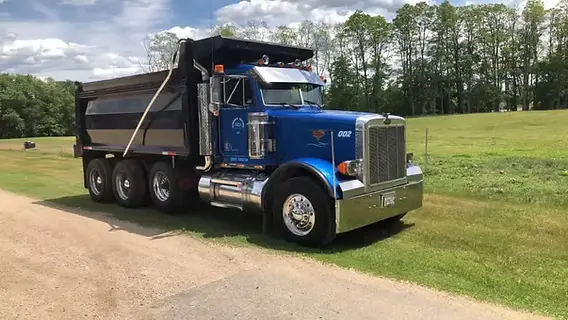
Motor carrier classes by state

Arkansas dump trucking insurance for aggregate and construction haulers

Before Arkansas lets a heavy nondivisible load onto a weight-restricted highway, it goes and measures the road. Core samples to establish the pavement and subgrade structure, Falling Weight Deflectometer tests to establish its stiffness, existing traffic data — and from that it calculates how much life the road has left and how much of the loss belongs to your trucks.

Excavator loading debris into a dump truck — Arkansas Dump Trucking Insurance from Truck Guard Insurance

Access to a posted Arkansas highway is not granted or denied. It is quantified. 27 CAR § 111-1701 builds a Roadway Maintenance Assessment out of measured pavement condition and the operator’s own projected traffic, and the number that comes out the far end is the price of the movement.

That is an engineering instrument, and it behaves like one. The inputs are physical measurements of a specific route. The output is expressed as a cost per mile where all the heavy travel follows the same path, and as a cost per site of the operator’s activity where it does not. Two operators on the same posted road can be assessed differently because their traffic patterns differ, not because their paperwork does.

The rest of the Arkansas permit rules are unusually concrete in the same way: an axle-group schedule where the per-axle sub-cap binds before the group total, a six-day county permit tied to a specific vehicle identification number and a specific serially-marked piece of equipment, an earthmoving permit that fixes a seventy-two-hour window and a front escort, and a routing rule that tells the Permit Section to choose safety over distance every time.

Working a fixed Arkansas site off a posted highway? Get the route, the entry and exit points and the load estimate into the file early. The assessment is calculated from measured pavement data before the permit exists, and the estimate you submit is what it is calculated against.

Start a Arkansas quote

Core samples, deflection tests, and what comes out of them

The process in 27 CAR § 111-1701 starts with a written request. A person who wants to move a nondivisible overweight load on a weight-restricted highway asks the Arkansas Highway Police Division of the Arkansas Department of Transportation, in writing, that an agreement be executed to allow it. Subsection (b) then fixes what the request has to contain: the county, the highway number, the location of entry to and exit from the restricted highway, the length of travel necessary on it, the estimated number and weight of the loads, and the beginning and ending dates of travel.

Subsection (c) is the measurement stage. The department collects data on the subject highway to determine the impact of the proposed operations on the condition of the route, and the rule names what the evaluation may consist of: collection of core samples along the restricted highway to determine the pavement and subgrade structure; Falling Weight Deflectometer tests to determine the stiffness characteristics of the existing pavement structure; and existing traffic data for that highway.

Subsections (d) and (e) say what the data is for. It is used to calculate the remaining life of the highway, and then — combined with the traffic loading the operator projected in the request — to calculate the additional damage that can be attributed to the operator’s heavy truck travel. Subsection (f)(1) converts that into money: using the most recent cost information available, the department calculates the cost of additional maintenance that may be needed as a result of that travel, and that figure is the Roadway Maintenance Assessment.

How the figure is expressed depends on the geometry of the work. Under subsection (g), where all the heavy truck travel follows the same path along the restricted highway, the assessment is calculated as a cost per mile. Under subsection (h), where it does not, an average length of travel to or from the site of the operator’s activity is used instead and the assessment is presented as a cost per site. Under subsection (i), where multiple activities are proposed along the same restricted route, the impact of the combined traffic loadings is used and the result is presented as an average cost per site of the individual activities. Subsection (f)(2) carries its own qualification: because of the cost involved in the department’s collection and analysis of data to determine the Roadway Maintenance Assessment, a minimum charge may apply.

  • Written request to the Arkansas Highway Police Division, naming county, highway number, entry and exit, and length of travel.
  • Core samples to determine pavement and subgrade structure.
  • Falling Weight Deflectometer tests to determine stiffness characteristics of the existing pavement.
  • Existing traffic data for the subject highway.
  • Remaining life of the route, calculated from that data.
  • Attributable damage, calculated from the remaining life and the operator’s projected loading.
  • Cost per mile where all heavy travel follows the same path; cost per site where it does not.

The estimate has to include the trips that were never overweight

The single sharpest sentence in the Arkansas rules is a subparagraph most operators would skim. Section 111-1701(b)(2)(A) requires the estimated number of loads to be transported on the restricted highway and the estimated weight of those loads. Subparagraph (B) then says: the number of loads and the weight of those loads shall include all loads, including those loads that may travel on the weight-restricted highway within the posted weight limit.

That is a deliberate design choice and it changes the arithmetic of a job. The assessment is not a fee for permission to be overweight. It is a charge for the pavement consequence of a haul, and pavement does not distinguish between a legal axle pass and an overweight one — it accumulates both. So the compliant trips count, and an operator who estimates only the permitted movements has under-declared the traffic the calculation is built on.

It also changes what has to be known before a bid. The number that determines the assessment is the total campaign of truck movements over the restricted segment, not the subset requiring a permit. A site that will see many legal loads and a handful of heavy ones is not a cheap site by that measure, and pricing the haul as though only the heavy loads mattered is how an Arkansas job goes underwater on a line item that was never quoted.

The instrument that carries all this is a defined thing. Under 27 CAR § 111-101(11), a "master agreement" means a document executed by a person wishing to transport a nondivisible overweight load on a weight-restricted highway. Section 111-1701(j) has the division forward the operator a master agreement and a Request for Access to Restricted Roads, which includes the assessment; subsection (k) processes the permit on receipt of the completed agreement, the Request for Access and the accompanying assessment; subsection (l) voids both for repeated violations of their terms and warns that it may affect the operator’s ability to obtain any Request for Access or permit in future; and subsection (m) expires the master agreement on December 31 of the year it was obtained, extendable at the department’s discretion.

One deliberate limit on what this page claims: the Arkansas material described here is drawn from the agency rules in 27 CAR Part 111. Those rules are permit rules, and a search of them is evidence about permitting rather than about the Arkansas Code, which is not reproduced here. Where a question sits in the statute layer rather than the rule layer, it should be answered from the Code and not inferred from the absence of a rule.

The sub-cap binds before the group total does

Arkansas publishes two different weight pictures, and the permitted one is not simply the legal one with bigger numbers. 27 CAR § 111-102(c) sets out the legal table the permit rules exist to exceed: 80,000 pounds gross on five or more axles, which must meet the federal bridge formula for 80,000 pounds; a single load-carrying axle at 20,000 pounds; a tandem axle group at 34,000 pounds; a tri-axle group at 50,000 pounds; a single steer or front axle at 12,000 to 20,000 pounds, with the axle required to be rated by the manufacturer for the weight; and a tandem steer or front axle at 24,000 pounds. Width is 8 feet 6 inches and height is 14 feet.

Section 111-306 then sets the permitted axle-group limits, and every one of them carries a second number that does the real work. A tandem group may not exceed 46,000 pounds, and no one axle of that group may exceed 23,000. A tridem may not exceed 60,000 pounds, and no one axle of the group may exceed 20,000. A quadrum may not exceed 68,000 pounds, and no one axle may exceed 17,000. A single load-carrying axle under permit stays at 20,000, as does a single trunnion axle.

Run the arithmetic on the quadrum and the point becomes obvious: four axles at the 17,000-pound sub-cap comes to 68,000 exactly, so the group total is only reachable on a perfectly even distribution. On the tridem, three axles at 20,000 also comes to 60,000. These are not headroom figures with a safety net underneath; they are ceilings that require even loading to reach at all, and an uneven axle in the group takes the whole group out of compliance while the group total still reads legal.

Section 111-305 caps the permitted front steering axle at 20,000 pounds single and 24,000 pounds tandem, citing Arkansas Code § 27-35-203(c)(1) and (c)(2). And § 111-302(8)(C) adds a component requirement that is easy to miss in a definitions section: a load-carrying axle shall have a minimum capacity rating of eighteen thousand pounds. All of these are qualified by an exclusion for vehicles of special design under 27 CAR § 111-401 et seq.

  • Permitted single load-carrying axle — 20,000 lb.
  • Permitted tandem group — 46,000 lb total, no single axle over 23,000 lb.
  • Permitted tridem group — 60,000 lb total, no single axle over 20,000 lb.
  • Permitted quadrum group — 68,000 lb total, no single axle over 17,000 lb.
  • Permitted single trunnion axle — 20,000 lb.
  • Permitted front steering axle — 20,000 lb single, 24,000 lb tandem.
  • Load-carrying axle capacity rating — a minimum of 18,000 lb, § 111-302(8)(C).

We place Arkansas dump, aggregate and earthmoving accounts, including operators working posted highways under a master agreement and fleets running escorted permitted movements.

Get a Arkansas quote

What a permit costs, and the publisher’s own caveat on saying so

The base figure is stated in the rule. 27 CAR § 111-203 provides at subsection (a) that no bond is required, and at subsection (b) that unless otherwise specified in the part, the fee for a permit to move an over-dimensional vehicle or load is seventeen dollars. The section’s authorities line cites Arkansas Code § 27-35-210 and Arkansas Code § 27-65-107.

That figure travels with a caveat, and the caveat is the publisher’s own, printed on the page the figure appears on: "Pursuant to Arkansas Code § 25-15-218, the Code of Arkansas Rules is a codification of the general and permanent rules of Arkansas agencies. This online searchable database constitutes the official version of the Code of Arkansas Rules and became effective on January 1, 2025. It is updated on a weekly basis and may not reflect recent rulemaking. Please check with the respective agency for information on recent rulemaking." Every Arkansas rule figure on this page sits behind that sentence, and an operator relying on any of them for a live quotation should confirm the current amount with the agency rather than with a web page.

The insurance figures in the earthmoving rules carry the same qualification and are worth stating because they are minimums rather than recommendations. Under 27 CAR § 111-1203(a), proof of liability insurance for the tow vehicle must be submitted to the Permit Section, and the minimum requirements are twenty-five thousand dollars for the first bodily injury or death, one hundred thousand dollars for bodily injury or death for each accident, and fifteen thousand dollars for property damage resulting from the accident. Proof goes to the Permit Section at the central headquarters office of the Arkansas Highway Police Division in Little Rock.

Those numbers are a filing threshold and nothing more. They are far below what a customer contract, a general contractor’s insurance requirements or a serious loss will call for on a working aggregate fleet, and no operator should read a rule minimum as a limit recommendation. What they usefully establish is that Arkansas conditions the earthmoving permit on evidence of coverage — the permit and the auto liability program are administratively linked, so a lapse is a permitting problem as well as a coverage problem.

Six days, two counties, one serial number

27 CAR § 111-107 creates a permit for repeat local movement, and then fences it in on every side. It may be issued for two or more consecutive movements or operations by one vehicle, all of which must be executed within six consecutive days, and which must be limited to two contiguous counties within the state — counties that have to be specified at the time of application.

The identification requirements are strict enough to rule out the ordinary fleet substitution. The permit is issued to a specific power unit and, if appropriate, a specific towed unit, and is not transferable. The applicant must provide the serial number or vehicle identification number of the power unit and that number is printed on the permit. The permit is valid for one specific unit of equipment or cargo, that equipment or cargo must carry an identifying number engraved or permanently attached to it, and no other equipment or cargo may be substituted and transported on the same permit.

Time is equally rigid. The permit designates the inclusive dates during which the unit may be moved, and subsection (f) states flatly that no extension of time shall be granted for this type of permit. No movement is allowed on the holidays listed in 27 CAR § 111-106(f). Continuous movement is not authorized unless width and height stay inside Arkansas Code §§ 27-35-206 and 27-35-207 and overall length does not exceed ninety feet. And it does not count as an emergency movement permit unless the equipment is being used where there is a justified need to provide extended services in life-threatening situations, or within a disaster area, or under special conditions authorized by the Director of State Highways and Transportation or a designee.

The practical effect is that a six-day county permit describes one machine doing one job in one place. It is a good fit for a plant relocation or a fixed earthmoving engagement and a poor fit for a fleet that rotates equipment between sites, because rotating the equipment means a new permit rather than an amended one — and because subsection (f) removes the option of simply running long.

Daylight only, seventy-two hours, and an escort in front

The earthmoving permit is the one written for the machine a dump operation runs alongside its trucks. 27 CAR § 111-1201, issued under Arkansas Code § 27-35-210, covers the movement of earthmoving equipment that is a tractor with dirt pan in tow — used primarily for farming operations traveling beyond a fifty-mile radius of the point of origin, or used primarily for commercial earthmoving operations for travel on state highways of any distance.

Seven conditions come with it. The permit issues only to owners primarily engaged in farming or commercial earthmoving. It is limited to daylight operation for a specified seventy-two-hour period and specifies the route of travel. No part of the movement may be on any interstate highway or fully controlled access facility. Proof of liability insurance for the tow vehicle goes to the department. The vehicle must be accompanied by a front escort vehicle with flashing amber lights, radio contact with the vehicle operator, and "Wide load" signs. Convoys may consist of no more than three vehicles with escorts at the front and rear, and must pull off the highway at sufficient intervals to allow traffic to pass. And no more than two dirt pans may be towed by one tractor.

Section 111-1203 repeats the escort and convoy conditions and adds that escorts must meet all the requirements in 27 CAR § 111-501 et seq. Read together, the two sections describe a movement that consumes a driver, an escort vehicle with a radio-equipped operator, a fixed three-day window and a specific route — which is a cost structure, not a formality.

The interstate exclusion is the one that reshapes a haul plan. An earthmoving move in Arkansas cannot use a controlled-access facility at all, so the routing runs on state and local highways by rule, which puts it into contact with exactly the posted segments that § 111-1701 governs. The two provisions are not administratively connected, but on the ground they meet constantly.

Safety beats distance, and leaving the route voids the permit

27 CAR § 111-103(d) sets out how Arkansas picks a route and then states its priority in plain terms. The Permit Section routes vehicles by considering traffic volume, the dimensions of highways, types and conditions of road surfaces, the type of transporting vehicle, the federal bridge formula, and the structural integrity of bridges and other structures between origin and destination. The routes selected will also be based on public safety, regardless of increased distance, route, or times of movement. Paragraph (3) closes it: any variance from the permitted route is a violation of the permit and may result in the permit being voided.

That is a different bargain from a system where the operator proposes a route and the state approves it. Here the state may hand back a longer route than the one requested and is expressly authorized to do so on safety grounds alone, and the operator’s only compliant response is to drive it. Fuel and hours on an Arkansas permitted move are therefore not fully under the operator’s control, and a dispatcher who reroutes around congestion has voided the instrument.

The default duration is narrow to match. Under § 111-103(b), unless otherwise specified all permits are issued for a single one-way nondiverted movement, with adequate time allowed for each one-way movement. An extension may be granted only where the request reaches the issuing agency before the permit expires and where documented inclement weather, vehicle breakdown or comparable circumstances beyond the applicant’s control prevented the trip — and the rule adds that no other provisions are made for revisions.

Subsection (g) handles the unexpected: where the permittee or its people meet a condition on the prescribed route that the permit did not contemplate, or signs or markings indicating an emergency condition that creates reasonable doubt about continuing, the operator must call the Permit Section for instructions, and failure to do so or to follow the instructions given renders the permit void. Subsection (f) makes the permit non-transferable and authorizes only the named person to engage in the movement. Subsection (h) reserves the department’s right to cancel, void or otherwise invalidate a permit at any time.

Weather, wind, holidays, and two interstates through Little Rock

27 CAR § 111-106 is a list of the times an Arkansas oversize movement is simply not happening, and it is specific enough to plan against.

There is no oversize movement through the Greater Little Rock area from 7:00 a.m. to 9:00 a.m. or from 4:00 p.m. to 6:00 p.m. on Interstate 30 between mile markers 138 and 143, on Interstate 40 between mile markers 151 and 155, or on any of Interstate 630. Permits are issued for daylight hours only, as established by the National Oceanic and Atmospheric Administration’s Weather Service. A permit is not valid when visibility is under five hundred feet or during inclement weather, including periods of extremely hard rain, freezing rain, sleet or snow, or other hazardous conditions. Movement may be restricted during strong winds or gusts exceeding twenty knots, which the rule itself converts to twenty-three miles per hour.

Holidays are handled in two tiers. No permits are issued for movement on New Year’s Day, Memorial Day, Independence Day, Labor Day, Thanksgiving Day or Christmas Day, and where one of those falls on a Monday or a Friday the adjacent weekend goes with it. A second group — Martin Luther King, Jr. Birthday and Robert E. Lee Day, George Washington’s Birthday and Presidents’ Day, Veterans’ Day, and Christmas Eve — may be moved on where the permit is obtained in advance.

The administrative hours are their own constraint. Under § 111-103(a), applications go to the Permit Section in writing, in person, by telephone, telefax, or through the online Arkansas permitting and routing system, ARPARS. The Permit Section is staffed from 6:00 a.m. until 4:30 p.m. Monday through Friday and is closed Saturdays, Sundays and major holidays — but certain types of permits for envelope vehicles may be obtained through ARPARS twenty-four hours a day, three hundred sixty-five days a year. Which of those two channels a movement depends on is a scheduling fact worth knowing before a Friday afternoon.

  • Little Rock peak windows — no oversize movement 7:00–9:00 a.m. or 4:00–6:00 p.m. on I-30 MM 138–143, I-40 MM 151–155, and all of I-630.
  • Daylight only, as established by the National Weather Service.
  • Visibility under 500 feet — the permit is not valid.
  • Winds or gusts over 20 knots (23 m.p.h.) — movement may be restricted.
  • Six no-movement holidays, plus the adjacent weekend on a Monday or Friday observance.
  • Four advance-permit holidays on which movement is possible.
  • ARPARS issues certain envelope-vehicle permits 24 hours a day, 365 days a year; the Permit Section is staffed 6:00 a.m. to 4:30 p.m. weekdays.

Where an Arkansas file is actually won or lost

An Arkansas aggregate or earthmoving account is defined by its fixed sites more than by its mileage. The Roadway Maintenance Assessment is calculated per route and per site of activity, the six-day permit is scoped to two named counties, and the earthmoving permit specifies a route and a seventy-two-hour window. Nearly every instrument in the rules attaches to a place.

That shape is what should be described in a submission. A fleet running from two pits to a handful of recurring placements on posted county highways is a very different risk from one moving equipment across the state on general freight routes, and in Arkansas the difference is visible in which permits the operator holds rather than in the loss run alone.

Three exposure clusters come out of these rules. The first is route compliance, because § 111-103(d)(3) kills the permit on a variance and § 111-103(g) kills it on a failure to phone in. The second is fixed-site work: the assessment mechanism exists for repeated heavy access to a single location, and what a crew does at that location once the trucks are parked answers to general liability rather than to an auto form. The third is equipment, because a permitted group total that is only reachable on even loading turns suspension geometry and body condition into compliance inputs — which is precisely the ground physical damage is rated on.

Movements outside the legal envelope entirely — a tractor and dirt pan under escort, a three-vehicle convoy, a loaded quadrum group — are not the same account with larger figures on it. They are a different class of work, they belong under oversized and overweight underwriting, and naming them at submission is what stops them being discovered at a claim.

  • Posted-highway sites in use, with the county, highway number and entry and exit points already on file.
  • Total projected loads per restricted segment, including the trips that stay within the posted limit.
  • Axle-group configurations in use, checked against the § 111-306 per-axle sub-caps rather than the group totals.
  • Permit classes held — single-trip, six-day county, earthmoving, or a master agreement with a Request for Access.
  • Escort capability, given the front-escort and convoy requirements in §§ 111-1201 and 111-1203.
  • Route-variance history, since a variance voids the permit under § 111-103(d)(3).
  • Weather and wind stand-down practice, given the 500-foot visibility and 20-knot thresholds in § 111-106.

Coverage lines a Arkansas dump and aggregate account usually carries

The state minimum is a licensing threshold. The program an operator actually needs is built from these lines:

  • Trucking Auto Liability — Primary liability coverage for bodily injury and property damage caused by your truck while under dispatch.
  • Physical Damage — Collision and comprehensive coverage for the tractor, trailer, and attached equipment you own or finance.
  • Motor Truck Cargo — Coverage for the freight you haul against loss or damage in transit.
  • Trailer Interchange — Coverage for non-owned trailers you pull under written interchange agreements.
  • General Liability — Coverage for premises and operations liability away from the truck — terminal yards, customer docks, and non-driving exposures.
  • Workers Compensation — Statutory coverage for driver and yard-employee injury, structured for trucking payrolls and interstate operations.
  • Non-Trucking (Bobtail) Auto Liability — Liability coverage for the tractor when operated off-dispatch — bobtailing home or running personal errands.
  • Pollution Liability — Coverage for cargo-related pollution events and upset/overturn spills not covered by standard auto liability.

Why Truck Guard Insurance for a Arkansas dump and aggregate account

We write dump and aggregate hauling as a named class rather than as an exception to general trucking, and we read each account against the weight and permit regime of the state it operates in. For a Arkansas operator that means starting from what the trucks are actually licensed and configured to carry, sizing physical damage to bodies and hoists rather than to a chassis value, and treating pit, stockpile and job-site work as its own exposure rather than an extension of the highway auto form.

If the operation also runs freight under separate authority, the Arkansas trucking insurance page covers the state’s broader motor carrier picture, and the dump trucking insurance page covers the class mechanics that apply wherever the operator runs.

Arkansas dump trucking insurance questions

How does Arkansas decide what heavy access to a posted road costs?

By measuring the road. 27 CAR § 111-1701(c) has the department collect core samples to determine pavement and subgrade structure, Falling Weight Deflectometer tests to determine stiffness, and existing traffic data. That data is used to calculate the remaining life of the route and, with the operator’s projected loading, the additional damage attributable to the operator’s heavy truck travel — from which the Roadway Maintenance Assessment is calculated.

Does the assessment count loads that are within the posted weight limit?

Yes. Section 111-1701(b)(2)(B) requires the estimated number and weight of loads to include all loads, including those that may travel on the weight-restricted highway within the posted weight limit. Compliant trips are part of the traffic loading the calculation is built on, so an estimate limited to permitted movements under-declares the basis of the assessment.

What is a master agreement in the Arkansas permit rules?

A defined instrument. 27 CAR § 111-101(11) defines "master agreement" as a document executed by a person wishing to transport a nondivisible overweight load on a weight-restricted highway. Section 111-1701(j) has the division forward it together with a Request for Access to Restricted Roads that includes the assessment, and subsection (m) expires it on December 31 of the year it was obtained, extendable at the department’s discretion.

What are Arkansas permitted tridem and quadrum axle limits?

27 CAR § 111-306 sets a tridem at 60,000 pounds with no axle in the group over 20,000, and a quadrum at 68,000 pounds with no axle over 17,000. A permitted tandem group is 46,000 pounds with no axle over 23,000. The per-axle sub-cap binds before the group total does — reaching the group figure requires even distribution across the group.

What does an Arkansas over-dimensional permit cost?

27 CAR § 111-203(b) provides that unless otherwise specified in the part, the fee for a permit to move an over-dimensional vehicle or load is seventeen dollars, and subsection (a) states that no bond is required. The publisher’s own note applies: the Code of Arkansas Rules "is updated on a weekly basis and may not reflect recent rulemaking. Please check with the respective agency for information on recent rulemaking."

What insurance does Arkansas require for an earthmoving permit?

27 CAR § 111-1203(a) requires proof of liability insurance for the tow vehicle to be submitted to the Permit Section, with minimums of $25,000 for the first bodily injury or death, $100,000 for bodily injury or death for each accident, and $15,000 for property damage resulting from the accident. Those are filing thresholds rather than adequate limits for a working fleet, and the same weekly-update caveat applies to the figures.

Can I change the route on an Arkansas permit?

No. 27 CAR § 111-103(d)(2) has the Permit Section select routes on public safety regardless of increased distance, route or times of movement, and paragraph (3) makes any variance from the permitted route a violation that may void the permit. Subsection (g) requires the operator to call the Permit Section for instructions on encountering an unanticipated or emergency condition, and failing to do so or to follow the instructions also voids it.

What are the movement restrictions through Little Rock?

27 CAR § 111-106(a) bars oversize movement through the Greater Little Rock area from 7:00 a.m. to 9:00 a.m. and from 4:00 p.m. to 6:00 p.m. on Interstate 30 between mile markers 138 and 143, Interstate 40 between mile markers 151 and 155, and all of Interstate 630. Movement is also daylight-only, invalid below 500 feet of visibility, and may be restricted above 20 knots of wind.

How long is an Arkansas six-day county permit good for?

Six consecutive days across two contiguous counties named at application, under 27 CAR § 111-107. It is issued to a specific power unit by serial or vehicle identification number, covers one specific serially-marked piece of equipment or cargo with no substitution, designates inclusive dates, and subsection (f) provides that no extension of time shall be granted for this type of permit.

Sources

Every figure on this page was read at the source below on August 11, 2026, with the effective date of the version read. Treat each as current as of that date rather than as permanent.

  • 27 CAR § 111-1701 — nondivisible overweight loads — the Roadway Maintenance Assessment: written request contents, core samples and Falling Weight Deflectometer testing, remaining-life and attributable-damage calculation, cost per mile or per site, and the minimum-charge qualification.
  • 27 CAR § 111-101 — definitions — "master agreement" as a defined instrument at paragraph (11), plus the Permit Section, permittee and vehicles-of-special-design definitions used throughout the part.
  • 27 CAR § 111-102 — introduction — the Table of Legal Dimensions and Weight Limits — 80,000 lb on five or more axles, 20,000 lb single, 34,000 lb tandem group, 50,000 lb tri-axle group, 12,000–20,000 lb manufacturer-rated steer axle, 24,000 lb tandem steer, 14 ft height.
  • 27 CAR § 111-103 — application information — application channels and ARPARS, Permit Section staffed hours, the single one-way nondiverted default, the public-safety routing rule and the route-variance voidance.
  • 27 CAR § 111-106 — movement restrictions — the Greater Little Rock peak-hour windows by interstate and mile marker, daylight-only movement, the 500-foot visibility rule, the 20-knot wind threshold, and the two holiday tiers.
  • 27 CAR § 111-107 — six-day county permits — six consecutive days, two contiguous named counties, VIN-specific issue, serially-marked equipment with no substitution, no extension of time, and the ninety-foot continuous-movement condition.
  • 27 CAR § 111-203 — bond/fee information — no bond required, and the $17.00 over-dimensional permit fee unless otherwise specified in the part; authorities Arkansas Code § 27-35-210 and § 27-65-107. Carried with the publisher’s weekly-update caveat quoted on this page.
  • 27 CAR § 111-305 — maximum weight on front/steering axle — 20,000 lb permitted single steering axle and 24,000 lb permitted tandem steering axle, citing Arkansas Code § 27-35-203(c)(1) and (c)(2); authority Arkansas Code § 27-65-107.
  • 27 CAR § 111-306 — single/tandem/tridem/quadrum axle load limits — the permitted axle-group schedule with its per-axle sub-caps — 46,000/23,000, 60,000/20,000 and 68,000/17,000 — plus the single and trunnion axle figures.
  • 27 CAR § 111-1201 — earthmoving equipment, introduction — the tractor-with-dirt-pan permit under Arkansas Code § 27-35-210: daylight only, a specified seventy-two-hour period, no interstate or fully controlled access travel, front escort, three-vehicle convoys and two dirt pans maximum.
  • 27 CAR § 111-1203 — movement requirements/restrictions — the liability insurance filing minimums of $25,000 / $100,000 / $15,000, the escort and convoy conditions, and the cross-reference to the escort requirements at 27 CAR § 111-501 et seq..

Get a Arkansas dump trucking insurance quote

Send the declared or registered weights alongside the axle configurations, and tell us where the material moves from. We will size the program against the work the trucks actually do rather than against a statutory floor.

Start a quote Call 317-942-0549