Motor carrier classes by state

California dump trucking insurance for aggregate and construction haulers

California is one of the few states whose statute books say the words “dump truck equipment.” A broker who arranges construction trucking must post a $15,000 surety bond specifically to secure the claims of a contracted motor carrier of property in dump truck equipment, and the Civil Code tells that broker exactly what day of the month the money is due.

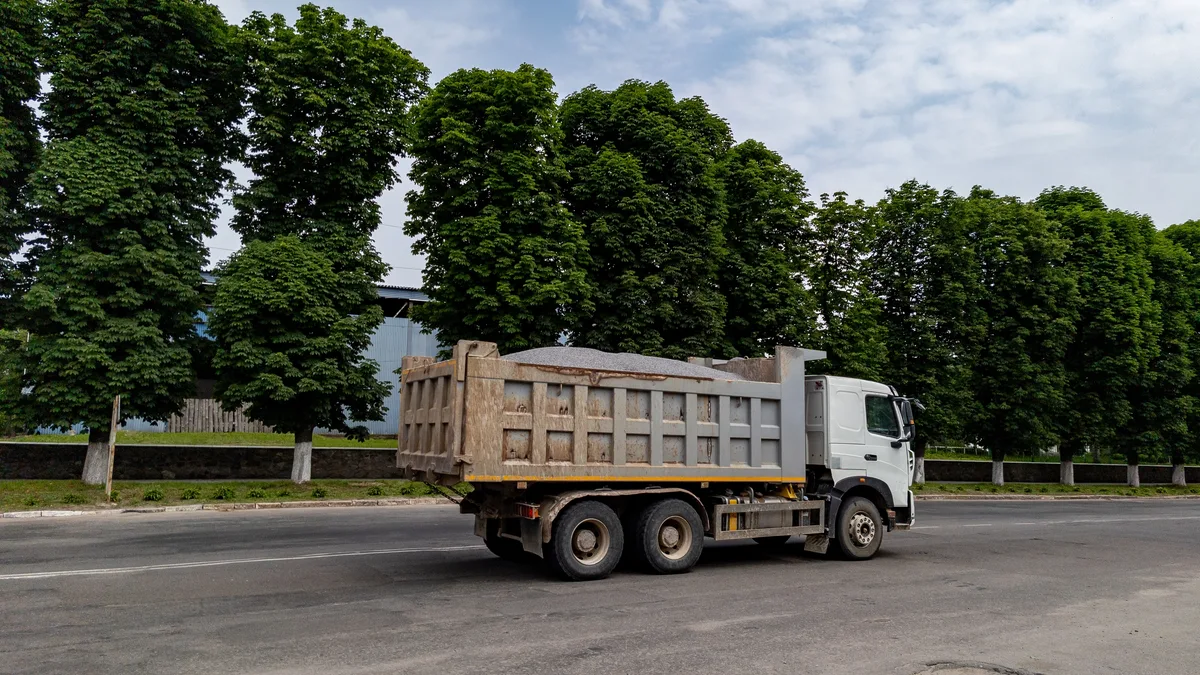
Loaded dump truck on a paved road — California Dump Trucking Insurance from Truck Guard Insurance

State law usually reaches dump operators sideways, through general weight and registration rules that happen to catch heavy short-wheelbase trucks. California reaches them directly. Cal. Veh. Code § 34510.5 and Cal. Civ. Code § 3322 together create a payment-security regime for one trade, and they name that trade in the statutory text rather than describing it.

That is a revealing piece of drafting. Nobody legislates a bond, a rebuttable presumption, a misdemeanor and a monthly interest penalty for an industry unless slow and failed payment was a chronic problem in it. For an owner-operator or a small fleet running dump equipment on California construction work, the credit exposure to the party in the middle is not incidental to the business — it is the risk the Legislature chose to address first.

None of that protection operates on its own. It hangs off the Motor Carrier Permit, and the permit hangs off a filed certificate of insurance. Lose the filing and the permit suspends; lose the permit and a broker is forbidden to engage the carrier at all. The lines running from an insurance certificate to a jobsite contract are shorter in California than almost anywhere, which is why the sections below run in that order.

Hauling California construction work under a broker? Ask us what your Motor Carrier Permit filing has to look like — in California the permit, the filing and the right to be hired are one chain.

Start a California quote

The bond the statute wrote for dump trucks

Cal. Veh. Code § 34510.5(a)(1), as amended by Stats. 2013, Ch. 76, Sec. 197 (AB 383), effective January 1, 2014, provides that “a broker of construction trucking services, as defined in Section 3322 of the Civil Code, shall not furnish construction transportation services to any construction project unless it has secured a surety bond of not less than fifteen thousand dollars ($15,000) executed by an admitted surety insurer.” The purpose clause is the part that names the trade: the bond “shall ensure the payment of the claims of a contracted motor carrier of property in dump truck equipment if the broker fails to pay the contracted motor carrier within the time period specified” in Civil Code § 3322(a)(1).

Two enforcement provisions give the bond teeth beyond its face amount. Subdivision (c) makes furnishing construction transportation services in violation of the section a misdemeanor subject to a fine of up to five thousand dollars ($5,000). And subdivision (d) shifts the burden of proof in the carrier’s favor: in any civil action brought against a broker by a motor carrier of property in dump truck equipment with whom the broker contracted during a period in which the broker had no bond, “the failure to have the bond shall create a rebuttable presumption that the broker failed to pay to the motor carrier the amount due and owing.”

That presumption is worth pausing on. It converts the hardest thing for a small hauler to prove — that the money was never paid — into something the unbonded broker must disprove. The practical incentive it creates runs in both directions: the broker is pushed toward bonding, and the carrier is pushed toward checking, because the presumption only helps a carrier who can show the broker was unbonded when the work was done.

The bond amount should be read for what it is. Fifteen thousand dollars is a floor written as “not less than,” executed by an admitted surety insurer, and it stands behind the claims of every carrier the broker uses. On a busy season it is a first line rather than a full indemnity, which is why the transparency requirements in the next section matter as much as the bond itself.

Who is a broker here, and who is carved out

Both statutes borrow their definitions from Civil Code § 3322(b), and both definitions are narrower than the ordinary words suggest. A “broker of construction trucking services” means any person, excluding a licensed contractor, that as a principal or agent arranges for transportation services to be provided by an independent contractor motor carrier of property in dump truck equipment, and who is responsible for paying the transportation charges of that carrier. A “motor carrier of property in dump truck equipment” means a motor carrier of property permitted by the Department of Motor Vehicles that hauls any type of construction commodity or material in dump truck equipment.

Note the two conditions buried in the first definition. A licensed contractor is expressly excluded, so the general contractor who hires trucks directly is not a broker for this purpose. And the arranger must be the party responsible for paying the carrier — an intermediary who arranges without payment responsibility falls outside. In the second definition, the carrier must already hold a DMV permit, which links the whole regime to the Motor Carrier Permit discussed below.

Vehicle Code § 34510.5(e) then carves out a category of arranger entirely, on a four-part test that has to be satisfied in full. The section does not reach a facility that arranges for transportation services of its product, primarily handles raw materials to produce a new product, is a rock product operation — the statute offers “aggregate” operation as its own example — or a hot mixing asphalt plant, or a concrete, concrete product, or Portland cement product manufacturing facility, and does not accept a fee for the arrangement. A pit or plant scheduling trucks to move what it makes, without charging for the scheduling, is not a broker.

Where the section does apply, it requires the bond to be visible. Subdivision (a)(2)(A) requires a broker annually to provide written evidence of a valid surety bond either to a third-party nonprofit organization related to the industry that regularly maintains a published database of bonded brokers, or to post a current copy of the bond on the broker’s own website. Subparagraph (B) requires the broker to notify that organization, or remove the posted copy, if at any time the bond is canceled or has expired; subparagraph (C) forbids the nonprofit from charging for the posting or limiting it to members. Subdivision (b) adds a direct disclosure: before work commences each calendar year, the broker must give written evidence of the bond both to whoever hired the broker and to the hired motor carrier. Subdivision (f) defines what counts — a copy of the bond, a certificate of insurance, a continuation certificate, or similar documentation originally issued by the surety showing the surety’s and broker’s names, the bond number, and the effective and expiration dates.

  • Arranges transportation by an independent contractor motor carrier of property in dump truck equipment — as principal or agent.
  • Is responsible for paying that carrier’s transportation charges.
  • Is not a licensed contractor, who is expressly excluded from the definition.
  • Is not a qualifying material facility — a rock product or aggregate operation, hot mix asphalt plant, or concrete, concrete product or Portland cement product plant that arranges transport of its own product and takes no fee for doing so.

The 25th of the following month, and what a dispute may hold back

Civil Code § 3322 was added by Stats. 2004, Ch. 518, Sec. 1, effective January 1, 2005, and its first subdivision is a prompt-payment rule with a date rather than a period. Under § 3322(a)(1), a broker of construction trucking services “shall pay all transportation charges submitted by a motor carrier of property in dump truck equipment by the 25th day following the last day of the calendar month in which the transportation was performed, if the charges, including all necessary documentation, are submitted by the fifth day following the last day of the calendar month in which the transportation was performed.”

The conditional matters as much as the deadline. The broker’s obligation is triggered by a complete submission — charges including all necessary documentation — made by the fifth. A carrier that invoices late, or invoices without the tickets, has not started the clock, and the protection that follows does not attach. Billing discipline is a legal precondition here, not an administrative preference.

The same paragraph allows a partial withholding on a stated basis: where there is a good faith dispute over a portion of the charges claimed, the broker may withhold payment of an amount not to exceed 150 percent of the estimated cost of the disputed amount. That is a ceiling on the withholding rather than a license for it — a dispute over one load does not justify holding a month.

Then the consequences. Paragraph (a)(2) provides that a broker who violates paragraph (1) “shall pay to the motor carrier of property in dump truck equipment a penalty of 2 percent per month on the improperly withheld amount.” Paragraph (a)(3) provides that in an action for the collection of moneys not paid in accordance with paragraph (1), the prevailing party is entitled to attorney’s fees and costs. A monthly penalty plus fee-shifting changes the economics of a small collection claim entirely, and it is the reason a California dump carrier’s receivables risk is structurally different from the same carrier’s risk in a state without the provision.

We place California dump and aggregate accounts, including owner-operators and small fleets working construction projects under brokers of construction trucking services.

Get a California quote

The permit is the condition under everything else

The Motor Carriers of Property Permit Act is Division 14.85 of the Vehicle Code, commencing at Section 34600 and added by Stats. 1996, Ch. 1042, Sec. 53. Everything above rests on it, and Cal. Veh. Code § 34620 supplies the mechanism.

Subdivision (a) prohibits a motor carrier of property from operating a commercial motor vehicle on any public highway in California unless it has complied with the carrier identification requirements of § 34507.5, registered its carrier identification number with the Department, and holds a valid motor carrier permit. Under § 34601(c)(1) the definition of commercial motor vehicle for this division reaches “any motortruck of two or more axles that is more than 10,000 pounds gross vehicle weight rating,” which takes in essentially any working dump truck.

Subdivision (b) is the one that closes the loop with the broker regime. A person shall not contract with or otherwise engage the services of a motor carrier of property unless that carrier holds a valid permit — and a motor carrier of property or broker of construction trucking services “shall not contract or subcontract with, or otherwise engage the services of, a motor carrier of property, until the contracted motor carrier of property provides certification in the manner prescribed by this section, of compliance with subdivision (a).” The certification must include a provision requiring the contracted carrier to notify the hiring party immediately if its permit is suspended or revoked, and a copy of the permit must accompany the certificate.

The record-keeping obligation runs on both sides. The certificate or a copy must be maintained by each involved party for the duration of the contract or period of service plus two years, and presented for inspection at the location each carrier has designated under § 34501.10 immediately upon request of an authorized employee of the Department of the California Highway Patrol. In practice a California dump carrier working under brokers is generating a paper trail whose retention period outlives the job by two years, and a broker who cannot produce it has an exposure independent of anything that happened on the road.

The insurance filing is what keeps the permit alive

Cal. Veh. Code § 34630(a), as amended by Stats. 2007, Ch. 58, Sec. 2, provides that a motor carrier permit shall not be granted until there is filed with the Department proof of financial responsibility — a currently effective certificate of insurance issued by a company licensed to write that insurance in California or by a nonadmitted insurer subject to Insurance Code § 1763, a surety bond from a company licensed to write surety bonds in the state, or written evidence of self-insurance using a Department-granted self-insured number. The certificate must provide coverage with respect to the operation, maintenance or use of any vehicle for which a permit is required, even though the vehicle may not be specifically described in the policy.

Subdivision (b) sets two conditions that matter to a broker at the same time as to the carrier. Proof of financial responsibility shall be continued in effect during the active life of the permit, and “the certificate of insurance shall not be cancelable on less than 30 days’ written notice from the insurer to the department,” except on cessation of operations as a permitted carrier.

Subdivision (c) is what makes a lapse serious rather than merely irregular. Where the Department determines or is notified that a carrier’s certificate or bond will lapse or terminate, “the department shall suspend the carrier’s permit effective on the date of lapse or termination” unless the carrier provides evidence of valid coverage. Reinstatement requires a fee under § 34623.5 and fresh proof before on-highway operations resume — though the fee is waived where the carrier’s evidence demonstrates that no lapse in coverage actually occurred.

The minimum that the filed policy must meet is set by Cal. Veh. Code § 34631.5(a)(1): every motor carrier of property, except those in the specified lighter and hazardous categories, must provide and continue in effect protection against liability in a combined single limit of not less than seven hundred fifty thousand dollars ($750,000) for bodily injury or death and for damage to or destruction of property other than property being transported. A separate route to suspension sits in § 34623 — the permit may be suspended for a consistent failure to maintain vehicles in safe operating condition or to comply with Title 13 of the California Code of Regulations, or for failure to enroll all drivers in the pull-notice system required by § 1808.1.

Chained together, these provisions mean that a California dump carrier’s ability to be hired at all depends on a certificate staying on file. That is a stronger link between an insurance transaction and a revenue stream than exists in most states, and it is the reason renewal timing and cancellation notice on a California auto liability program deserve more attention here than the premium difference usually justifies.

An alternative axle regime, and the steering-axle cap dump trucks escape

California’s baseline axle rule is Cal. Veh. Code § 35550: gross weight on any one axle may not exceed 20,000 pounds, and gross weight on any one wheel or wheels supporting one end of an axle may not exceed 10,500 pounds. Subdivision (c) then adds a tire rule computed as the lesser of two things — the load limit established by the tire manufacturer as molded on at least one sidewall, or 620 pounds per lateral inch of tire width as determined by the manufacturer’s rated tire width molded on the sidewall, for all axles except the steering axle, where the molded limit alone applies.

Combinations get a choice. Cal. Veh. Code § 35551.5, added by Stats. 1980, Ch. 784, Sec. 4, applies only to combinations of vehicles that contain a trailer or semitrailer, and provides that each vehicle in such a combination, and the combination itself, shall comply with either § 35551 — the general distance-and-axle table — or with subdivisions (b), (c) and (d) of § 35551.5. It is an election between two complete schemes rather than an exception carved out of one.

The alternative scheme is tighter at the axle and looser along the length. Subdivision (b) sets 18,000 pounds on any one axle and 9,500 pounds on any one wheel or wheels supporting one end of an axle — both below the § 35550 baseline — and caps the front steering axle of a motor vehicle at 12,500 pounds. Subdivisions (c) and (d) then run their own distance tables, reaching 73,280 pounds at 42 feet and holding there through 51 feet before rising again to 76,800 pounds at 56 feet or over. Subdivision (f) states that these limits include all enforcement tolerances, and subdivision (h) records that the Legislature did not intend the section to allow statutory weights any greater than existed before January 1, 1976.

The dump-specific detail is in the exemption list, and it is narrower than it first appears. Subdivision (b) exempts thirteen categories of vehicle “from the front axle weight limits specified in this subdivision” — not from the whole scheme — and item (3) on that list is “Dump trucks.” Item (6) covers transit mix concrete or cement trucks and trucks that mix concrete or cement at or adjacent to a jobsite, and items (1), (2), (4), (5) and (7) through (13) reach vehicle transporters, livestock haulers, cranes, buses, non-commercial vehicles, utility vehicles, trucks with a set-back front axle, garbage and refuse trucks, fifth-wheel-equipped trucks towing semitrailers, tank trucks of at least 1,500 gallons capacity, and bulk grain or livestock feed haulers. What a dump truck escapes, therefore, is the 12,500-pound cap on the front steering axle — which is exactly the limit a heavy-front-axle dump chassis would otherwise strike first.

The declared weight is a fee band and a decal on the door

California charges commercial weight fees on a declared gross vehicle weight, and for a truck registering today the operative schedule is the one in Cal. Veh. Code § 9400.1(c)(1), which governs initial or original registrations occurring on or after December 31, 2003 and renewals expiring on or after that date. Its fourteen weight codes run from $332 at a declared gross vehicle weight of 10,001 to 15,000 pounds, through $801 at code E for 30,001 to 35,000, $1,431 at code J for 55,000 to 60,000, and up to $2,064 at code N for 75,001 to 80,000 pounds. Subdivision (d)(1) adds a Cargo Theft Interdiction Program fee of three dollars ($3) at initial registration and each renewal for vehicles subject to weight fees.

The part that produces a verifiable artifact is subdivision (f). The Department, in consultation with the California Highway Patrol, designs and makes available distinctive weight decals reflecting the declared gross combined weight or gross operating weight reported at initial registration, at renewal, or when a weight change is reported under § 9406.1, and a new decal issues on each renewal or reported change. The decal must be in sharp contrast to its background and of a size, shape and color readily legible during daylight hours from a distance of 50 feet, and must be displayed on both the right and left sides of the vehicle. The Department may charge a fee not to exceed ten dollars ($10) for the actual cost of producing and issuing each set.

Then the sentence that makes it enforceable: “A person may not display upon a vehicle a decal issued pursuant to this subdivision that does not reflect the declared weight reported to the department.” The truck carries its own declared weight, in legible form, on both flanks.

For an underwriter that is unusually convenient. A California dump fleet’s declared weights can be read off the equipment, reconciled against the § 9400.1(c)(1) fee band the operator is actually paying, and compared with what the operator says the trucks haul. Where those three disagree, the disagreement is worth resolving before the physical damage schedule and the liability rating are set, because a unit worked consistently above its declared weight is an exposure neither one has seen.

Checking the California compliance chain end to end

A California dump submission is a compliance-chain document as much as an equipment document, and the chain is short enough to check end to end.

  • Motor Carrier Permit status and the certificate on file with the Department, since § 34630(c) suspends the permit on the date an insurance filing lapses.
  • Broker exposure by name, and whether written evidence of each broker’s § 34510.5 bond was received before work commenced this calendar year.
  • Invoicing practice against the fifth of the month, because the § 3322(a)(1) protection is conditional on a complete submission including all necessary documentation by that date.
  • Aged receivables by broker, given the 2 percent per month penalty and the fee-shifting in § 3322(a)(2) and (a)(3).
  • Certification records under § 34620(b), which must be retained for the contract period plus two years and produced at the § 34501.10 location on CHP request.
  • Declared gross vehicle weight per unit against the § 9400.1(c)(1) band paid and against the decal displayed on both sides of the truck.
  • Whether any unit runs in a trailer or semitrailer combination, which is the entry condition for the § 35551.5 election and where the front-axle exemption for dump trucks becomes relevant.
  • Jobsite, pit and plant operations, which fall outside a highway auto form and belong in the general liability conversation, alongside the cargo terms that govern short, wet and contaminated loads.

Coverage lines a California dump and aggregate account usually carries

The state minimum is a licensing threshold. The program an operator actually needs is built from these lines:

  • Trucking Auto Liability — Primary liability coverage for bodily injury and property damage caused by your truck while under dispatch.
  • Physical Damage — Collision and comprehensive coverage for the tractor, trailer, and attached equipment you own or finance.
  • Motor Truck Cargo — Coverage for the freight you haul against loss or damage in transit.
  • Trailer Interchange — Coverage for non-owned trailers you pull under written interchange agreements.
  • General Liability — Coverage for premises and operations liability away from the truck — terminal yards, customer docks, and non-driving exposures.
  • Workers Compensation — Statutory coverage for driver and yard-employee injury, structured for trucking payrolls and interstate operations.
  • Non-Trucking (Bobtail) Auto Liability — Liability coverage for the tractor when operated off-dispatch — bobtailing home or running personal errands.
  • Pollution Liability — Coverage for cargo-related pollution events and upset/overturn spills not covered by standard auto liability.

Why Truck Guard Insurance for a California dump and aggregate account

We write dump and aggregate hauling as a named class rather than as an exception to general trucking, and we read each account against the weight and permit regime of the state it operates in. For a California operator that means starting from what the trucks are actually licensed and configured to carry, sizing physical damage to bodies and hoists rather than to a chassis value, and treating pit, stockpile and job-site work as its own exposure rather than an extension of the highway auto form.

If the operation also runs freight under separate authority, the California trucking insurance page covers the state’s broader motor carrier picture, and the dump trucking insurance page covers the class mechanics that apply wherever the operator runs.

California dump trucking insurance questions

Does a California construction trucking broker have to be bonded?

Yes. Cal. Veh. Code § 34510.5(a)(1) provides that a broker of construction trucking services may not furnish construction transportation services to any construction project unless it has secured a surety bond of not less than $15,000 executed by an admitted surety insurer, to ensure payment of the claims of a contracted motor carrier of property in dump truck equipment. Operating without one is a misdemeanor subject to a fine of up to $5,000 under subdivision (c).

What happens if the broker who owes me money was not bonded?

The burden shifts. Cal. Veh. Code § 34510.5(d) provides that in a civil action brought against a broker by a motor carrier of property in dump truck equipment with whom the broker contracted during a period in which it had no bond, the failure to have the bond creates a rebuttable presumption that the broker failed to pay the amount due and owing. That is why checking a broker’s bond before working is worth the few minutes it takes.

When is a California construction trucking broker required to pay?

By the 25th day following the last day of the calendar month in which the transportation was performed, provided the charges — including all necessary documentation — were submitted by the fifth day following the last day of that month. Cal. Civ. Code § 3322(a)(1) sets both dates, and the payment obligation is conditional on the carrier meeting the earlier one.

How much can a broker withhold over a disputed load?

Where there is a good faith dispute over a portion of the charges claimed, Cal. Civ. Code § 3322(a)(1) permits the broker to withhold an amount not to exceed 150 percent of the estimated cost of the disputed amount. Improper withholding carries a penalty of 2 percent per month under paragraph (a)(2), and the prevailing party in a collection action is entitled to attorney’s fees and costs under paragraph (a)(3).

Do I need a Motor Carrier Permit for a dump truck in California?

Almost certainly. Cal. Veh. Code § 34620(a) bars a motor carrier of property from operating a commercial motor vehicle on a public highway without a valid permit, and § 34601(c)(1) defines commercial motor vehicle for that division to include any motortruck of two or more axles that is more than 10,000 pounds gross vehicle weight rating. Section 34620(b) then bars anyone — including a broker of construction trucking services — from engaging a carrier that does not hold one.

What happens to my permit if my insurance filing lapses?

It suspends automatically. Cal. Veh. Code § 34630(c) directs the Department to suspend the permit effective on the date of lapse or termination unless the carrier provides evidence of valid coverage, with a reinstatement fee under § 34623.5 and fresh proof required before resuming on-highway operations. Subdivision (b) also requires that the certificate not be cancelable on less than 30 days’ written notice from the insurer to the Department.

Are dump trucks exempt from California’s 12,500-pound front axle limit?

From that particular limit, yes. Cal. Veh. Code § 35551.5(b) sets a 12,500-pound cap on the front steering axle within the alternative weight scheme available to combinations containing a trailer or semitrailer, and then exempts thirteen listed vehicle categories from the front axle weight limits — item (3) is “Dump trucks.” The exemption reaches the front axle limits only; the section’s other limits and tables continue to apply.

Sources

Every figure on this page was read at the source below on August 11, 2026, with the effective date of the version read. Treat each as current as of that date rather than as permanent.

Get a California dump trucking insurance quote

Send the declared or registered weights alongside the axle configurations, and tell us where the material moves from. We will size the program against the work the trucks actually do rather than against a statutory floor.

Start a quote Call 317-942-0549