Motor carrier classes by state

Florida dump trucking insurance for aggregate and construction haulers

Florida measures a single-unit dump truck by the width of its tires and then puts a hard roof over the whole vehicle: 550 pounds per inch of tire surface, and 70,000 pounds gross including the truck itself. No axle spacing, no bridge measurement, no formula. Rubber on the ground, and a ceiling nothing gets over.

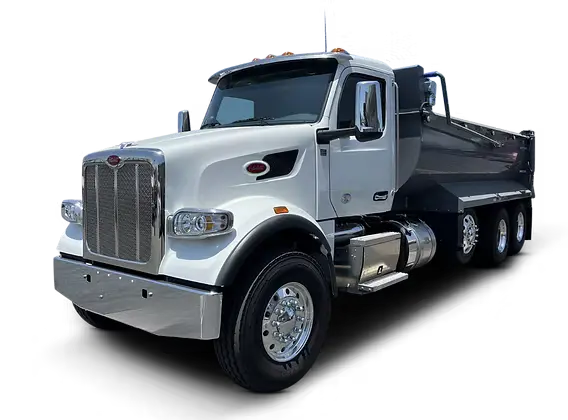
Dump truck raising its bed to unload gravel — Florida Dump Trucking Insurance from Truck Guard Insurance

Fla. Stat. § 316.535(6), in the Florida Legislature’s Online Sunshine text as last amended by s. 6, ch. 2002-20, does something few weight statutes do: it names a short list of vehicle types and writes them a rule of their own. Dump trucks, concrete mixing trucks, trucks engaged in waste collection and disposal, and fuel oil and gasoline trucks — “designed and constructed for special type work or use, when operated as a single unit” — are handed a limit built from tire width rather than wheelbase, and a gross weight ceiling that does not move.

That is a deliberate trade rather than a favor. The paragraph relieves these trucks of the axle spacing requirements that constrain everything else on a Florida highway, which is what makes a short, heavy, tight-wheelbase truck workable at all. In exchange it replaces the spacing constraint with a footprint constraint and caps the whole vehicle at 70,000 pounds, a number that no configuration change, no permit and no additional axle will lift.

Two other things follow from being inside that paragraph, and one of them is a genuine disadvantage. Being named in § 316.535(6) is also how Florida identifies which trucks do not get the weight allowances it gives every other commercial vehicle for idle-reduction and alternative-fuel equipment. Being outside the axle-spacing regime turns out to have a price on both sides of the ledger.

Running single-unit dump trucks in Florida? Send the tire sizes with the equipment schedule — Florida computes these trucks’ legal weight from tire surface, not from wheelbase.

Start a Florida quote

550 pounds per inch, and a roof at 70,000

The operative sentence of § 316.535(6) is dense, so it is worth unpacking clause by clause. A named vehicle operated as a single unit “need not conform to the axle spacing requirements of this section provided that such vehicle shall be limited to a total gross load, including the weight of the vehicle, of 20,000 pounds per axle plus scale tolerances and shall not exceed 550 pounds per inch width tire surface plus scale tolerances.” The paragraph then closes the ceiling: “No vehicle operating pursuant to this section shall exceed a gross weight, including the weight of the vehicle and scale tolerances, of 70,000 pounds.”

The 550-pound figure is the one that actually governs how a Florida dump truck is loaded, because it is the constraint that varies with the truck. A per-axle limit is fixed and easy to remember. A per-inch-of-tire-surface limit changes every time a fleet respecs a tire, and it is what determines whether a given axle can be worked to its axle limit at all. An operator running narrower rubber on a tandem is not merely wearing tires faster — the legal capacity of that axle is lower than the axle limit suggests.

The 70,000-pound roof is absolute in a way the axle numbers are not. It is written to include the weight of the vehicle and scale tolerances, and it applies to “any vehicle operating pursuant to this section.” There is no configuration that reaches past it while staying inside the paragraph and no combination of axle allowances that adds up above it. That makes the tare weight of the truck a direct claim on payload: every pound of body, hoist, tarp system and liner is a pound the roof does not leave for stone.

The qualifier “operated as a single unit” is the entry condition and it excludes the obvious workaround. Pull a trailer and the vehicle is no longer a single unit, the paragraph no longer applies, and the truck returns to the ordinary axle-spacing regime with its own tables. Florida’s special dump rule is a straight truck rule.

  • 20,000 pounds per axle, plus scale tolerances, including the weight of the vehicle.
  • 550 pounds per inch of width of tire surface, plus scale tolerances.
  • 70,000 pounds gross, including the weight of the vehicle and scale tolerances — a hard ceiling.
  • No axle spacing requirement, which is what the other three limits are purchased with.
  • Single unit only — attach a trailer and the paragraph stops applying.

What the ordinary Florida truck gets instead

The value of the § 316.535(6) trade only shows against the regime it replaces. Subsection (3) of the same section runs Florida’s general distance table, measured longitudinally between the first and last axle of the vehicle or combination to the nearest foot, and it is unusually flat at the short end: 40,000 pounds at every distance from four through eight feet, 44,140 pounds at nine feet, and then a step for each additional foot up to 66,610 pounds at 36 feet, where the table stops.

A single-unit dump truck is a short vehicle. Under the general table its wheelbase would put it far down the left side of that chart, nowhere near the top figure, no matter how many axles it carried or how heavy those axles were rated. The special paragraph is what makes a short heavy truck legal at all — and at 70,000 pounds it permits more gross weight than the general table permits at any distance.

Subsections (4) and (5) then cap everything above by formula: the federal bridge formula applies on the Interstate Highway System and, in materially identical terms, on highways not in the Interstate system, and in each case the overall gross weight “may not exceed 80,000 pounds, including all enforcement tolerances.” So Florida’s weight structure has three ceilings stacked — 66,610 at the far end of the general distance table, 70,000 for the named single-unit vehicles, and 80,000 overall by formula.

Subsection (7) supplies the last structural piece and it matters more than it looks: the Department of Transportation “shall adopt rules to implement this section, shall enforce this section and the rules adopted hereunder, and shall publish and distribute tables and other publications as deemed necessary to inform the public.” Florida legislates the limits and delegates the tables, which is why the tolerance question in the next section is answered in the publication rather than in the arithmetic.

Two weight credits Florida takes back from these trucks

Every commercial vehicle in Florida gets some relief for the hardware that alternative-fuel and anti-idling equipment adds. These trucks do not, and the exclusion is written twice.

Fla. Stat. § 316.545(3)(b) provides that for a vehicle equipped with fully functional idle-reduction technology, an overweight fine is calculated by reducing the actual gross vehicle weight or the internal bridge weight by the certified weight of the technology or by 550 pounds, whichever is less, on the operator presenting written certification of that weight and demonstrating or certifying that the equipment is fully functional at all times. Then the paragraph ends: “This calculation is not allowed for vehicles described in s. 316.535(6).”

Paragraph (3)(c)1 does the same for alternative fuel, allowing the fine to be calculated by reducing actual gross vehicle weight by the certified weight difference between a natural gas tank or electric battery system and fueling system and a comparable diesel tank and fueling system, on written certification from the manufacturer or the installer. Subparagraph (3)(c)2 caps the actual gross vehicle weight of such vehicles at 82,000 pounds excluding the idle-reduction allowance. And subparagraph (3)(c)3 shuts the door on the same class: “This paragraph does not apply to those vehicles described in s. 316.535(6).”

This is a live equipment-specification issue rather than a curiosity. A Florida fleet weighing a compressed natural gas or battery-electric dump chassis is weighing one that carries the hardware penalty with no statutory offset and no route to the 82,000-pound figure other vehicles can reach. The same is true of an auxiliary power unit fitted for driver comfort on long job-site waits. Neither decision is wrong, but in Florida both cost payload against a 70,000-pound roof that does not move to accommodate them.

We place Florida dump and aggregate accounts, including single-unit trucks operating under § 316.535(6) and contractors running designated-route permits off the interstate system.

Get a Florida quote

The tolerance is inside the published table, by statutory command

Florida’s scale tolerance is not an enforcement custom and it is not an evidentiary presumption. It is a printing instruction to the Department of Transportation, written into § 316.545(2)(a): “to facilitate compliance with and enforcement of the weight limits established in s. 316.535, weight tables published pursuant to s. 316.535(7) shall include a 10-percent scale tolerance and shall thereby reflect the maximum scaled weights allowed any vehicle or combination of vehicles.” The same paragraph defines the term: “scale tolerance means the allowable deviation from legal weights established in s. 316.535.”

That construction has a specific consequence. Because the tolerance is required to be built into the published tables, the number printed in the Department’s table is already the maximum scaled weight — the tolerance is not an additional allowance to be applied on top of what the table shows. An operator who reads a published figure and then adds ten percent has added it twice.

The same subsection gives a driver two defenses that are worth training on because both are available at the roadside. First, notwithstanding any other provision of the weight law, where a vehicle does not exceed the gross, external bridge or internal bridge weight limits and the driver can comply by shifting or equalizing the load on all wheels or axles, and does so when requested by the proper authority, the driver “shall not be held to be operating in violation of said weight limits.” Second, where a citation is issued on the basis of portable scales, the driver may request to proceed to the nearest fixed scale at an official weigh station or a certified public scale for verification — the officer who issued the citation must escort the driver at all times and must attend the reweighing, and if the vehicle is then found in compliance, “the citation is void.”

For a dump operator that second right is unusually valuable, because portable scales and uneven ground are the normal conditions at a job site or a haul road. A fleet whose drivers do not know the reweigh right is absorbing citations it might not owe.

Overweight is priced by the pound, and the presumption is conclusive

Section 316.545(3)(a) opens with a sentence that decides most of the argument before it starts: “A person who violates the overloading provisions of this chapter is conclusively presumed to have damaged the highways of this state by reason of such overloading.” Conclusively — there is no evidence to be led on the point.

The fine then follows a short schedule. Ten dollars if the weight in excess of the maximum allowed is 200 pounds or less. Five cents per pound for each pound of excess above 200 pounds. And where the gross weight of the vehicle or combination does not exceed the maximum allowable gross weight, the maximum fine for the first 600 pounds of unlawful axle weight is $10 — which is a real concession to a truck that is legal overall but distributed badly, and exactly the failure mode a loaded dump body produces.

Two operational provisions sit alongside. Under § 316.545(2)(a), any gross weight over and beyond 6,000 pounds beyond the maximum “shall be unloaded and all material so unloaded shall be cared for by the owner or operator of the vehicle at the risk of such owner or operator.” And under § 316.545(2)(b) the officer inspects the license plate or registration certificate against the declared gross vehicle weight; where actual exceeds declared, the penalty is 5 cents per pound on the difference between the two weights. Where a registration has not been expired for more than 90 days, the penalty imposed under that paragraph may not exceed $1,000.

The declared-weight check is the one worth building a control around, because it is a documentation failure rather than a loading failure. Florida’s registration fee steps with declared gross vehicle weight under Fla. Stat. § 320.08(4) — $916 flat for 55,000 to under 62,000 pounds, $1,080 flat for 62,000 to under 72,000, and $1,322 flat at 72,000 and above — and a truck declared into a band below the one it works in is generating a per-pound penalty on every weighing, indefinitely, for a saving of a few hundred dollars a year.

Permits, and the roads a notice can close

A dump load is not the kind of freight an overweight permit is designed for, but two provisions of Fla. Stat. § 316.550 reach aggregate work directly.

Subsection (4)(a) authorizes the Department or a local authority to issue permits allowing commercial vehicles at the weights of § 316.535(5) plus the § 316.545(2) scale tolerance to operate off the interstate highway system on a designated route specified in the permit, and requires that such permits “shall be issued within 14 days after receipt of the request.” Paragraph (4)(b) requires the designated route to avoid any bridge the Department determines cannot safely accommodate those weights, and (4)(c) provides that a vehicle exceeding the authorized weights shall be unloaded, with the material cared for by the owner or operator. A statutory turnaround commitment on a route permit is genuinely useful to a contractor bidding work on a schedule.

Subsection (6) sets the commercial terms: the Department or local authority may promulgate rules concerning permit issuance and charge a fee, with a minimum fee for issuing any permit of $5. The Department may issue blanket permits for not more than 36 months and may charge an annualized fee for blanket permits not to exceed $500. Subsection (1) states the underlying rule plainly — an oversize or overweight vehicle or load may not enter onto or be operated on a public road unless the owner or operator has first obtained the special permit from the appropriate governing jurisdiction.

Local weight reductions run through Fla. Stat. § 316.555, which lets the Department for state roads and local authorities for their own highways prescribe lower loads, weights and speed limits by notice where a road, bridge or culvert is liable to damage by reason of design, deterioration, rain or other climatic or natural causes. The notice or its substance must be posted at conspicuous places at terminals of all intermediate crossroads and road junctions with the affected section, and the section is explicit that it is the posting that creates the offense: “After any such notice has been posted, the operation of any motor vehicle or combination contrary to its provisions shall constitute a violation of this chapter.” The section also forbids a county or municipality from establishing a limitation that would interfere with or interrupt authorized traffic over state roads, including officially established detours.

The liability minimum steps with the truck’s weight

Florida is one of the states that writes a commercial auto liability minimum directly into its insurance code and indexes it to gross vehicle weight, which puts most working dump trucks in the top band by a wide margin.

Fla. Stat. § 627.7415, last amended by s. 12, ch. 2022-175, requires commercial motor vehicles operated on Florida roads to carry combined bodily injury and property damage liability insurance, in addition to any other insurance requirement, of $50,000 per occurrence at a gross vehicle weight of 26,000 pounds or more but less than 35,000; $100,000 per occurrence at 35,000 or more but less than 44,000; and $300,000 per occurrence at 44,000 pounds or more. Subsection (4) adds that vehicles subject to 49 C.F.R. part 387, subparts A and B must be insured at the minimum levels of financial responsibility set by those regulations.

A single-unit dump truck operating anywhere near the § 316.535(6) ceiling is in the third band, and a violation of the section is a noncriminal traffic infraction punishable as a nonmoving violation under chapter 318. The figures are statutory floors and not a placement recommendation — no realistic Florida aggregate account is written at $300,000 combined single limit, and contract requirements from general contractors, public owners and material suppliers routinely run far above the statute.

The reason to know the floor anyway is that it establishes the compliance baseline against which a lapse is measured, and lapses on this class of account are usually administrative rather than deliberate. Between the § 627.7415 requirement, the declared-weight registration under § 320.08(4) and the permit conditions in § 316.550, a Florida dump operator has three separate documents that have to stay current, and the underwriting conversation about auto liability, general liability and physical damage is better had with all three in front of it.

Reading a Florida dump submission

Because Florida computes these trucks’ capacity from equipment rather than from geometry, the submission that prices well is the one that describes the equipment.

  • Tire size by axle, since § 316.535(6) limits the vehicle to 550 pounds per inch of width of tire surface and that limit moves with the tire.
  • Tare weight of each unit as bodied, because the 70,000-pound ceiling includes the weight of the vehicle and every pound of body and hoist comes out of payload.
  • Whether any unit ever pulls a trailer, which takes it out of the single-unit paragraph and back into the axle-spacing regime.
  • Alternative-fuel or APU equipment, which carries hardware weight with no statutory offset for vehicles described in § 316.535(6).
  • Declared gross vehicle weight on each registration against the weight the truck actually works at, given the 5-cents-per-pound penalty on the difference under § 316.545(2)(b).
  • Driver awareness of the reweigh right after a portable-scale citation, and of the shift-or-equalize provision, both in § 316.545(2)(a).
  • Any § 316.550(4) designated-route permits in force, and whether the routes on them still match the work.
  • Job-site, pit and yard operations, which sit at the edge of a highway auto form and are where a large share of aggregate claims — and the cargo disputes over short and contaminated loads — actually originate.

Coverage lines a Florida dump and aggregate account usually carries

The state minimum is a licensing threshold. The program an operator actually needs is built from these lines:

  • Trucking Auto Liability — Primary liability coverage for bodily injury and property damage caused by your truck while under dispatch.
  • Physical Damage — Collision and comprehensive coverage for the tractor, trailer, and attached equipment you own or finance.
  • Motor Truck Cargo — Coverage for the freight you haul against loss or damage in transit.
  • Trailer Interchange — Coverage for non-owned trailers you pull under written interchange agreements.
  • General Liability — Coverage for premises and operations liability away from the truck — terminal yards, customer docks, and non-driving exposures.
  • Workers Compensation — Statutory coverage for driver and yard-employee injury, structured for trucking payrolls and interstate operations.
  • Non-Trucking (Bobtail) Auto Liability — Liability coverage for the tractor when operated off-dispatch — bobtailing home or running personal errands.
  • Pollution Liability — Coverage for cargo-related pollution events and upset/overturn spills not covered by standard auto liability.

Why Truck Guard Insurance for a Florida dump and aggregate account

We write dump and aggregate hauling as a named class rather than as an exception to general trucking, and we read each account against the weight and permit regime of the state it operates in. For a Florida operator that means starting from what the trucks are actually licensed and configured to carry, sizing physical damage to bodies and hoists rather than to a chassis value, and treating pit, stockpile and job-site work as its own exposure rather than an extension of the highway auto form.

If the operation also runs freight under separate authority, the Florida trucking insurance page covers the state’s broader motor carrier picture, and the dump trucking insurance page covers the class mechanics that apply wherever the operator runs.

Florida dump trucking insurance questions

How heavy can a Florida dump truck legally be?

70,000 pounds gross, including the weight of the vehicle and scale tolerances. Fla. Stat. § 316.535(6) sets that ceiling for dump trucks, concrete mixing trucks, waste collection trucks and fuel oil and gasoline trucks operated as a single unit, alongside limits of 20,000 pounds per axle plus scale tolerances and 550 pounds per inch of width of tire surface plus scale tolerances.

Why does tire width appear in a Florida weight limit?

Because § 316.535(6) trades the axle spacing requirement for a footprint requirement. These vehicles need not conform to the section’s axle spacing rules, and in exchange the statute limits them to 550 pounds per inch of width of tire surface. The practical effect is that an axle’s legal capacity depends on the rubber under it, so a tire respec changes what the truck may lawfully carry.

Can adding an axle get a Florida dump truck past 70,000 pounds?

Yes. The ceiling is written to catch “any vehicle operating pursuant to this section,” not any particular configuration, so no additional axle lifts it. What does take a vehicle outside the paragraph is attaching a trailer, because the rule applies only to these vehicles “when operated as a single unit” — at which point the ordinary axle spacing regime and its tables apply instead.

Can a Florida dump truck claim the natural gas or idle-reduction weight allowance?

No. Fla. Stat. § 316.545(3)(b) ends with “This calculation is not allowed for vehicles described in s. 316.535(6),” and § 316.545(3)(c)3 states that the alternative-fuel paragraph “does not apply to those vehicles described in s. 316.535(6).” Both allowances, and the 82,000-pound figure in subparagraph (3)(c)2, are closed to the named single-unit vehicles.

Do I add the 10 percent tolerance to the published weight table?

No — it is already in it. Fla. Stat. § 316.545(2)(a) directs that weight tables published under § 316.535(7) “shall include a 10-percent scale tolerance and shall thereby reflect the maximum scaled weights allowed any vehicle or combination of vehicles.” The published figure is the maximum scaled weight, so applying the tolerance again on top of it double-counts.

My driver was cited on portable scales. Is there a remedy?

There is a statutory one. Under Fla. Stat. § 316.545(2)(a), a driver cited for exceeding weight limits as determined by portable scales may request to proceed to the nearest fixed scale at an official weigh station or a certified public scale for verification. The officer who issued the citation must escort the driver at all times and must attend the reweighing, and if the vehicle is found in compliance at the fixed scale, the citation is void.

What liability limits does Florida require on a dump truck?

Fla. Stat. § 627.7415 sets combined bodily injury and property damage minimums by gross vehicle weight — $50,000 per occurrence from 26,000 to under 35,000 pounds, $100,000 from 35,000 to under 44,000, and $300,000 at 44,000 pounds and above — in addition to any other insurance requirement, with vehicles subject to 49 C.F.R. part 387 insured at the federal levels. These are statutory floors, and contract requirements on construction work commonly run well above them.

Sources

Every figure on this page was read at the source below on August 11, 2026, with the effective date of the version read. Treat each as current as of that date rather than as permanent.

Get a Florida dump trucking insurance quote

Send the declared or registered weights alongside the axle configurations, and tell us where the material moves from. We will size the program against the work the trucks actually do rather than against a statutory floor.

Start a quote Call 317-942-0549