Motor carrier classes by state

Georgia dump trucking insurance for aggregate and construction haulers

Georgia caps a loaded truck at 56,000 pounds on every public road of a county road system — the whole network, not a posted segment — unless the truck is making a pickup or delivery on that road. For an aggregate hauler, that one subsection does more to decide a route than the 80,000-pound figure everybody quotes.

Dump truck raising its bed to unload gravel — Georgia Dump Trucking Insurance from Truck Guard Insurance

Georgia’s weight statute is unusual in how much of it is arithmetic rather than declaration. The single-axle maximum is not written as a number; it is written as a base figure plus a percentage, and the product is 20,340 pounds rather than the round 20,000 most states publish. Gross weight off the Interstate is not primarily a bridge-formula outcome either; for most of the range it is a multiplication, taking the single-axle maximum and multiplying by how many axles the vehicle has.

Those two derivations produce numbers that look wrong to anyone importing assumptions from a neighboring state. A tandem at 40,680 pounds, a four-axle truck with a gross ceiling of its own that sits below the general limit, and a county road system carrying a flat cap that has nothing to do with axles at all.

Aggregate does get relief, and it is better relief than the general reading suggests. Georgia maintains a list of commodities that may exceed the section’s weight limitations without a permit, on any public road that is not an interstate highway, and construction aggregates appear on it in terms broader than the quarry-to-plant language the list opens with.

The enforcement architecture is worth reading alongside the limits, because Georgia has built its penalties as a recompense schedule tied to how far over the truck is, with separate bands for gross weight, single axle and tandem axle, and a distinct schedule for a posted bridge. Being modestly over and being badly over are priced very differently.

Hauling aggregate on Georgia county roads? Send the axle configurations and which counties the routes run through — the 56,000-pound county cap and the local truck route resolutions are checked together.

Start a Georgia quote

Fifty-six thousand pounds across an entire county system

Subsection (f) of O.C.G.A. § 32-6-26 provides that on any public road of a county road system, the maximum total gross weight of a vehicle and load shall not exceed 56,000 pounds unless the vehicle is making a pickup or delivery on such road.

The scope is the thing to absorb. This is not a posted road, a bridge, a segment or a designated route. It is every public road of a county road system in Georgia, carrying one number, by default. A loaded aggregate truck that would be perfectly legal on a state route becomes overweight the moment it turns onto county pavement, unless the errand it is running is a pickup or a delivery on that specific road.

The pickup-or-delivery carve-out is doing the same work Georgia’s neighbors accomplish with haul-road permits, and it is narrower than it sounds. It attaches to the road being used, not to the trip. A truck delivering stone to a site on County Road A is within the exception on County Road A; the same truck cutting through County Road B on the way there is not making a pickup or delivery on County Road B.

That distinction is where a Georgia aggregate operation actually lives, because pits and job sites sit on county roads and the state network is what connects them. The lawful shape of a haul is a county leg at each end and state routes in between — and a driver who takes a county shortcut to save eight minutes has changed the legal character of the load without changing anything about it.

Subsection (g)(1) confirms the reading by exclusion. When it opens the permit-free exceedance discussed below, it does so “except the limitation in subsections (f) and (h) of this Code section.” The county cap and the posted-bridge rule are carved out of the relief. Georgia will let certain commodities run heavy on a state route without a permit; it will not let them run heavy across a county system.

Subsection (j) repeats the same carve-out when it aligns semitrailer and trailer weight limits and axle definitions with federal law governing interstate highways: except as provided in subsections (f) and (h). Whatever else moves, the county cap and the bridge posting stay fixed.

The way out is a county resolution, and then a sign

Subsection (f) does supply an escape, and it has three components rather than one. A county road may carry the higher non-interstate limits if it is constructed to the same standards as those Georgia highways which are interstate highways, and is authorized as a designated local truck route pursuant to official resolution of the county. The county then notifies the department of any roads it has designated as a local truck route within 90 days of the designation.

So the route exists because a county built the road to interstate standards and then passed a resolution saying so. It is a deliberate act of local government, recorded, and reported upward on a clock. An operator can therefore find out whether a given road is a designated local truck route — it is not a judgment call made at the wheel.

What happens next is the part worth knowing, because Georgia has made the signage a condition of the enforcement rather than of the designation. House Bill 189, as passed by the House and Senate in the 2023 session and effective on approval by the Governor, revised O.C.G.A. § 32-6-27 to set out an asymmetry in subsection (a.1).

Where a county road is a designated local truck route under subsection (f) of § 32-6-26 and signs have been placed and maintained as required under § 32-6-50(c)(2), the Department of Public Safety and local law enforcement are authorized to issue a citation to the owner or operator of a vehicle in violation of the maximum weight limit. Where the road is a designated local truck route but signs have not been placed or maintained, they are authorized to issue a warning upon the first such violation, and a citation for a subsequent one.

A missing or unmaintained sign therefore buys a driver exactly one warning, not immunity. The second time, the citation issues regardless of the sign. That is a meaningfully different rule from the states where an unposted restriction simply does not bind, and it means an operator cannot build a compliance posture around what the roadside does or does not display.

The same bill extended the parallel structure to bridges — citation where signs have been placed and maintained under § 32-4-41(3) or § 32-4-91(a.1), warning then citation where they have not — with local law enforcement’s citation authority over bridges limited to bridges located within a county road or municipal street system. HB 189 also broadened enforcement itself, revising § 32-6-29 and § 32-6-30 so that law enforcement responsibility sits with the Department of Public Safety and with any local law enforcement officer authorized to enforce motor vehicle and traffic laws on the road or bridge being traveled, provided that officer has been properly trained on commercial motor vehicle weight and load equivalent to the training given to certified officers in the Motor Carrier Compliance Enforcement Section.

Section 6 of HB 189 provided that those enforcement provisions in Sections 2 through 5 of the Act “shall stand repealed on July 1, 2025,” as did the new agricultural variance paragraph the Act added at § 32-6-26(g)(5). An operator relying on any of the enforcement or variance language introduced by that Act should confirm the current text before acting on it. The 56,000-pound county cap in subsection (f) was not part of the repealed material.

Twenty thousand three hundred forty, and where that comes from

Georgia does not state a single-axle maximum as a figure. Subsection (b) of § 32-6-26 states a base and a tolerance, and the maximum is what you get when you apply one to the other.

For a vehicle equipped with low pressure pneumatic tires — which is every modern highway truck — the section provides that no such vehicle operated upon any public road of this state shall carry a load on any wheel which exceeds 9,000 pounds by more than 13 percent, or a load on any single axle which exceeds 18,000 pounds by more than 13 percent. Eighteen thousand plus 13 percent is 20,340. Nine thousand plus 13 percent is 10,170 per wheel.

The section carries a second, older line for vehicles equipped with high pressure pneumatic, solid rubber or cushion tires, at 8,000 pounds per wheel and 16,000 pounds per single axle, each plus 13 percent. It is a legacy provision, and the low-pressure line is the operative one for a working dump truck.

The tandem figure follows from the same arithmetic. Subsection (c)(1)(A) sets the maximum load on any tandem axle at 40,680 pounds on all Georgia highways which are not national highways — precisely twice 20,340. Georgia has doubled its derived single-axle number rather than adopting the federal 34,000.

On national highways, subsection (d)(1)(B) sets the tandem maximum at 34,000 pounds, with two consecutive sets of tandems permitted 34,000 each where the overall distance between the first and last axles is 36 feet or more. But it then adds a carve-back: except for vehicles and combinations exceeding 55 feet in length, the maximum gross weight authorized on a tandem axle for a vehicle or combination carrying a gross weight of less than 73,280 pounds shall be 40,680 pounds.

That is worth reading twice, because it is the opposite of the usual pattern. A shorter, lighter truck gets the higher tandem number even on a national highway. A straight dump truck under 55 feet running below 73,280 pounds gross is in the 40,680 world; the same tandem under a long combination at higher gross is in the 34,000 world. Length and gross weight, not the road alone, decide which tandem figure applies.

  • 10,170 pounds per wheel — 9,000 plus 13 percent, for low pressure pneumatic tires.
  • 20,340 pounds on a single axle — 18,000 plus 13 percent.
  • 40,680 pounds on a tandem on Georgia highways which are not national highways.
  • 34,000 pounds on a tandem on national highways — except that a vehicle or combination not exceeding 55 feet and carrying less than 73,280 pounds gross keeps 40,680.
  • 80,000 pounds gross as the general ceiling on and off the national system.

We place Georgia aggregate and dump accounts, including quad-axle fleets working against the four-axle gross ceiling and operators running county-road pit approaches.

Get a Georgia quote

Off the national system, gross weight is a multiplication

Subsection (c)(1)(A) sets out how Georgia computes maximum gross weight on highways which are not national highways, and the method is not the bridge formula. Subject to two subparagraphs, “the maximum total gross weight authorized for any vehicle and load shall be the maximum load authorized on any single axle multiplied by the number of axles with which the vehicle is equipped,” with the whole thing not exceeding 80,000 pounds.

Multiply 20,340 by the axle count and read the result against the 80,000 ceiling. Three axles computes to 61,020. Four computes to 81,360, which the ceiling trims to 80,000. Five and above are all held at 80,000. The method rewards axles in a way that saturates quickly, and it means the useful range of the multiplication for a dump operation is at the low end of the axle count.

Subparagraph (B) then hands part of the range back to a formula. For vehicles and loads with an actual total gross weight between 73,280 pounds and 80,000 pounds, the maximum authorized gross weight shall be determined by applying the state bridge formula — which subsection (a)(5) defines in the standard form, with L measured between the first and last axles of the vehicle or combination and N the number of axles on the vehicle or combination. So the top 6,720 pounds of the range is governed by axle spread rather than by axle count, and a short truck cannot simply add an axle to reach 80,000.

Subparagraph (C) is the provision most likely to catch an aggregate fleet by surprise: “For any vehicle equipped with four axles, the maximum total gross weight authorized for the vehicle and load shall be 70,000 pounds.” A quad-axle dump — a common heavy configuration in the Southeast — has a gross ceiling of 70,000 pounds off the national system, ten thousand pounds below the general limit and eleven thousand below what the multiplication would have produced.

Georgia carries that four-axle number into its penalties as well. Subsection (i)(2)(B) provides that for vehicles equipped with four axles, fines for violations of the subsection (c) gross weight limitations shall be based on the amount by which the actual weight exceeds 70,000 pounds. The 70,000 is the reference point for the penalty calculation, not merely the limit.

Two further limits round out the section. Subsection (a)(2) defines a lift axle as any axle on a vehicle manufactured after July 1, 1978 which may be raised or lowered with respect to the horizontal plane of the vehicle, and subsection (c)(3) provides that after April 1, 1988 no lift axle may be used in computing maximum total gross weight. And subsection (i)(1) provides a genuine safe harbor: a vehicle which can be made to comply by shifting the load, and which is then loaded to comply, shall not be held to be in violation.

Construction aggregate gets a permit-free exceedance

Subsection (g)(1) is the relief provision, and it is written as a list of hauls rather than a list of trucks. The weight limitations of the section — except the limitations in subsections (f) and (h) — may be exceeded on any public road within the state which is not an interstate highway, or when making a pickup or delivery on any public road of a county road system, without a permit, when the load on any single axle does not exceed 23,000 pounds, the load on any tandem axle does not exceed 46,000 pounds, and the maximum total gross weight of the vehicle and load does not exceed 80,000 pounds.

Those three numbers are a package. All three conditions must hold; exceeding any one of them takes the haul outside the relief entirely rather than merely to the edge of it. And the relief is permit-free, which is what distinguishes it — no application, no fee, no route approval, no annual renewal.

The commodity list that unlocks it includes forest products from the forest where cut to the first point of marketing or processing; live poultry or cotton from a farm to a processing plant; feed from a feed mill to a farm; solid waste or recovered materials from points of generation to a solid waste handling facility or other processing facility; freshly mixed and unhardened concrete for delivery to a customer; and poultry waste from the point of origin to a farm.

The entry that matters here is the mineral one. As reproduced in the Georgia General Assembly’s own 2023 drafting of House Bill 189, which quotes the then-current subsection in full, subparagraph (g)(1)(D) covers “Hauling granite, either block or sawed, or any other naturally occurring raw ore or mineral for further processing, from the quarry or stockpile area to a processing plant located in the same or an adjoining county and construction aggregates hauled to any point, unless otherwise prohibited.”

Read the two halves separately, because they are not the same rule. The first half is geographically bounded: raw ore or mineral moving for further processing, from a quarry or a stockpile area, to a processing plant in the same or an adjoining county. The second half is not bounded that way at all — construction aggregates hauled to any point, subject only to “unless otherwise prohibited.”

That is a broad allowance for exactly the delivery pattern an aggregate hauler runs: crushed stone, base and sand going from a plant to whatever job site bought it, without a county-adjacency requirement and without a permit, at 23,000 single, 46,000 tandem and 80,000 gross. The qualifier does real work, though — it preserves subsections (f) and (h), the county cap and the posted bridge, and it preserves anything else that prohibits the movement. This section raises weight limits; it does not open roads.

Subsection (g)(2) attaches an equipment condition. Any vehicle carrying a load as authorized in the subsection at night shall be equipped with lights clearly visible for a distance of not less than 300 feet from the front and rear of the vehicle. And no lift axle may be used in computing maximum total gross weight under the subsection, which is the same exclusion that applies to the general computation.

The recompense schedule reads in three bands

Georgia does not describe an overweight fine as a fine. Section 32-6-27(a) provides that a person who violates the load limitation provisions of § 32-6-26 “shall be conclusively presumed to have damaged the public roads, including bridges, of this state by reason of such overloading” and shall recompense the state according to a schedule. The presumption is conclusive, which removes proof of damage from the question entirely.

As revised by HB 189 in 2023, the schedule runs three parallel ladders. On total gross weight: five cents per pound for all excess weight over the allowed limitations, including any applicable variances, where the total gross weight is less than or equal to 93,000 pounds; ten cents per pound where it is greater than 93,000 but less than 100,000; and fifteen cents per pound where it is equal to or greater than 100,000.

On a single axle the bands are 25,520 and 27,450 pounds — five cents per pound at or below 25,520, ten cents above 25,520 but below 27,450, fifteen cents at or above 27,450. On a tandem axle without a lift axle the bands are 51,000 and 54,880 pounds, at the same five, ten and fifteen cent rates.

Note what the bands are measured against. They are not measured by how far over the limit the truck is; they are measured by the truck’s actual weight. The rate is set by where the vehicle lands on the scale, and it is then applied to the excess. A truck 2,000 pounds over at 94,000 pounds gross pays double the per-pound rate of a truck 2,000 pounds over at 90,000.

The bridge schedule works the other way and is measured by the overage. Where a vehicle exceeds the posted maximum on a bridge signed under § 32-4-41, § 32-4-91 or § 32-6-50, recompense runs at five cents per pound where the excess is 7,500 pounds or less, ten cents where it is more than 7,500 but less than 15,000, and fifteen cents where it is 15,000 pounds or more — all in addition to any other applicable fine. Subsection (h) of § 32-6-26 states the underlying prohibition plainly: no vehicle or combination shall be operated over any bridge with a posted limit which is less than the total gross weight of the vehicle and its load.

Two multipliers sit above the schedules. For a vehicle authorized to exceed the § 32-6-26 limits by a permit issued under § 32-6-28, damages for excess weight are assessed at 125 percent of the rate imposed on offending vehicles operating without a permit, with “excess weight” meaning the weight exceeding what the permit allowed. For a superload or superload plus permit, excess weight means any single axle weight exceeding the permitted single axle weight, and all weight greater than 150,000 pounds where the gross exceeds the permitted gross or any axle spacing is less than specified.

Subsection (b) then prevents double recovery. The schedules apply separately to the excess weight of the gross load and to the sum of the excess weights of any axle or axles, but where both gross and axle limits are exceeded, the owner or operator recompenses the state only for the largest of the money damages imposed. And a vehicle using idle reduction technology has its penalty calculated by reducing from the actual weight the manufacturer’s certified weight of the unit or 550 pounds, whichever is less, on production of written certification and a demonstration that the technology is fully functional.

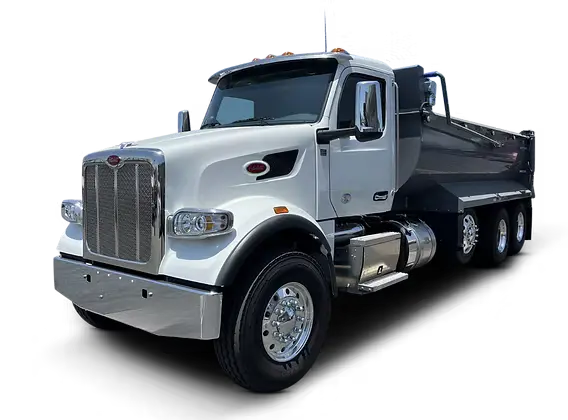
Where the Georgia exposure actually concentrates

Put the pieces together and the shape of a Georgia aggregate operation is fairly specific. Payload is generous on state routes for a commodity that is named in the relief provision, tight on the county system by a flat cap that ignores axles, and computed by methods that produce unfamiliar numbers at both ends.

That produces a route-driven rather than a weight-driven risk profile. The truck that gets an operator in trouble in Georgia is usually not the one that is grossly overloaded; it is the one that is loaded to a lawful 80,000 for a state route and is then on a county road it is not delivering to. The load did not change. The road did.

The second concentration is at the four-axle configuration. A quad-axle dump is a natural answer to a payload problem, and in Georgia it walks into a 70,000-pound gross ceiling under subsection (c)(1)(C) that is also the reference point for its penalties. An operator who specified quad-axle equipment on the assumption of an 80,000-pound ceiling has a structural mismatch between what the truck can carry and what it may.

The third is at the bridge. Subsection (h) overrides everything else in the section, the recompense schedule for bridges is measured by overage rather than by weight class, and it applies in addition to any other applicable fine. A posted county bridge on a pit approach is the single most expensive place in Georgia to be wrong.

And the fourth is at the job site and the pit, which is where much of an aggregate operator’s loss actually happens and where the highway auto form has the least to say. Backing, dumping, spotting, elevated bodies near overhead lines, and the interface with a customer’s site crew sit at the boundary of auto liability and general liability, and how that boundary is drawn is worth settling before a claim tests it.

The questions below follow from the statute rather than from a generic checklist, and they are the ones that produce different answers in Georgia than they would across a state line.

  • Axle count per unit against configuration, since four-axle vehicles carry a 70,000-pound gross ceiling under § 32-6-26(c)(1)(C) while the general limit is 80,000.
  • Which counties the routes cross, and whether any leg uses a county road for anything other than a pickup or delivery on that road.
  • Whether any route relies on a designated local truck route, and whether the county resolution and the departmental notification exist.
  • Posted bridges on pit approaches, since § 32-6-26(h) overrides the section and the bridge recompense schedule stacks on other fines.
  • Whether the commodity actually falls within § 32-6-26(g)(1), and whether the 23,000 / 46,000 / 80,000 package is holding on all three numbers rather than two.
  • Night operation under the exceedance, which requires lights visible for not less than 300 feet from the front and rear.
  • Lift axle use, which cannot be counted in computing maximum total gross weight and is excluded from the tandem band in the penalty schedule.

Coverage lines a Georgia dump and aggregate account usually carries

The state minimum is a licensing threshold. The program an operator actually needs is built from these lines:

  • Trucking Auto Liability — Primary liability coverage for bodily injury and property damage caused by your truck while under dispatch.
  • Physical Damage — Collision and comprehensive coverage for the tractor, trailer, and attached equipment you own or finance.
  • Motor Truck Cargo — Coverage for the freight you haul against loss or damage in transit.
  • Trailer Interchange — Coverage for non-owned trailers you pull under written interchange agreements.
  • General Liability — Coverage for premises and operations liability away from the truck — terminal yards, customer docks, and non-driving exposures.
  • Workers Compensation — Statutory coverage for driver and yard-employee injury, structured for trucking payrolls and interstate operations.
  • Non-Trucking (Bobtail) Auto Liability — Liability coverage for the tractor when operated off-dispatch — bobtailing home or running personal errands.
  • Pollution Liability — Coverage for cargo-related pollution events and upset/overturn spills not covered by standard auto liability.

Why Truck Guard Insurance for a Georgia dump and aggregate account

We write dump and aggregate hauling as a named class rather than as an exception to general trucking, and we read each account against the weight and permit regime of the state it operates in. For a Georgia operator that means starting from what the trucks are actually licensed and configured to carry, sizing physical damage to bodies and hoists rather than to a chassis value, and treating pit, stockpile and job-site work as its own exposure rather than an extension of the highway auto form.

If the operation also runs freight under separate authority, the Georgia trucking insurance page covers the state’s broader motor carrier picture, and the dump trucking insurance page covers the class mechanics that apply wherever the operator runs.

Georgia dump trucking insurance questions

What is the weight limit on a Georgia county road?

56,000 pounds across the whole system. O.C.G.A. § 32-6-26(f) provides that on any public road of a county road system, the maximum total gross weight of a vehicle and load shall not exceed 56,000 pounds unless the vehicle is making a pickup or delivery on such road. The exception attaches to the road being used rather than to the trip, so a county road used as a connector is not covered by a delivery being made elsewhere.

Why is Georgia’s single axle limit 20,340 pounds?

Because the statute states a base and a tolerance rather than a figure. Section 32-6-26(b)(2) provides that a vehicle equipped with low pressure pneumatic tires may not carry a load on any single axle which exceeds 18,000 pounds by more than 13 percent, or a load on any wheel which exceeds 9,000 pounds by more than 13 percent. That produces 20,340 pounds per single axle and 10,170 per wheel, and the tandem figure of 40,680 is exactly double the axle number.

Can a Georgia dump truck haul aggregate over the weight limit without a permit?

Within a specific package, yes. Section 32-6-26(g)(1) allows the section’s weight limitations — except those in subsections (f) and (h) — to be exceeded without a permit on any public road that is not an interstate highway, or when making a pickup or delivery on a county road, provided the single axle does not exceed 23,000 pounds, the tandem does not exceed 46,000 pounds, and total gross does not exceed 80,000 pounds. All three conditions must hold together.

Does the Georgia exceedance list cover construction aggregates?

It does, and in broader terms than the granite language it opens with. As reproduced in the Georgia General Assembly’s 2023 drafting of House Bill 189, subparagraph (g)(1)(D) covers hauling granite, either block or sawed, or any other naturally occurring raw ore or mineral for further processing, from the quarry or stockpile area to a processing plant in the same or an adjoining county, “and construction aggregates hauled to any point, unless otherwise prohibited.” The second half carries no county-adjacency limit.

What is the gross weight limit on a four-axle dump truck in Georgia?

70,000 pounds off the national system. Section 32-6-26(c)(1)(C) provides that for any vehicle equipped with four axles, the maximum total gross weight authorized shall be 70,000 pounds — ten thousand below the general ceiling. Section 32-6-26(i)(2)(B) then makes 70,000 the reference point for calculating fines on those vehicles, so the figure governs both the limit and the penalty.

How does Georgia calculate gross weight off the Interstate?

By multiplication for most of the range. Section 32-6-26(c)(1)(A) provides that on highways which are not national highways, the maximum total gross weight shall be the maximum load authorized on any single axle multiplied by the number of axles the vehicle is equipped with, capped at 80,000 pounds. Between 73,280 and 80,000 pounds, subparagraph (B) switches to the state bridge formula, and no lift axle may be counted in the computation.

How is recompense for road damage assessed in Georgia?

It is calculated as recompense for road damage, and § 32-6-27(a) makes the damage a conclusive presumption. As revised by HB 189 in 2023, the rate is five cents per pound of excess where total gross weight is 93,000 pounds or less, ten cents where it is above 93,000 but below 100,000, and fifteen cents at or above 100,000, with parallel bands for single axle at 25,520 and 27,450 pounds and tandem at 51,000 and 54,880 pounds.

What happens if a Georgia county road is not signed as a truck route?

It buys one warning. Under § 32-6-27(a.1) as revised by HB 189, where a county road is a designated local truck route under § 32-6-26(f) and signs have been placed and maintained under § 32-6-50(c)(2), a citation may issue. Where signs have not been placed or maintained, a warning issues on the first violation and a citation on a subsequent one. Section 6 of that Act repealed its enforcement provisions on July 1, 2025, so the current text should be confirmed.

Sources

Every figure on this page was read at the source below on August 11, 2026, with the effective date of the version read. Treat each as current as of that date rather than as permanent.

Get a Georgia dump trucking insurance quote

Send the declared or registered weights alongside the axle configurations, and tell us where the material moves from. We will size the program against the work the trucks actually do rather than against a statutory floor.

Start a quote Call 317-942-0549