Motor carrier classes by state

Idaho dump trucking insurance for aggregate and construction haulers

Idaho puts a 129,000-pound ceiling on reducible loads and then makes registration a condition of reaching it. Aggregate is reducible by definition, so the number that matters to an Idaho gravel fleet is not a permit weight for a machine on a lowboy — it is a statutory allowance for the ordinary loaded body, conditioned on what the owner registers and pays for.

Excavator loading debris into a dump truck — Idaho Dump Trucking Insurance from Truck Guard Insurance

The exposures that make dump and aggregate work difficult to underwrite travel with the class rather than with the state — the short-cycle trip count, the pit and job-site work that sits at the boundary of a highway auto form, the hoist and body losses that a physical damage schedule rarely anticipated. Those are set out on the dump trucking insurance page and are not restated here.

What Idaho adds is a weight architecture that behaves differently from the one most operators carry in their heads. In most places the statutory ceiling is low, additional capacity is rented from a permit office, and the highest numbers belong to machinery that cannot be broken down. Idaho writes a high ceiling for loads that can be broken down, publishes a commodity table that names sand and gravel outright, and then attaches conditions to the ceiling that live in the registration chapter rather than the weight chapter.

The practical consequence is that an Idaho aggregate hauler makes three separate decisions that most operators make as one. It picks a weight table and is bound to it exclusively. It registers at a declared maximum gross weight on a schedule that prices by annual mileage as well as by pounds. And it depends on a route network that a city, county or highway district controls outright, subject to almost no state override.

Every figure below was read from the section of Idaho Code that sets it, on the Legislature’s own site, together with that section’s own History line. Where a statute publishes a hedge or a closed window, the hedge is carried with the figure. The site states that Idaho Statutes are updated to the website July 1 following the legislative session.

Registering Idaho units above 105,500 pounds? Send the declared gross weights, the axle counts and last year’s Idaho mileage together — in Idaho those three numbers set both the fee and the legal ceiling.

Start a Idaho quote

The ceiling applies to loads that can be broken down

Idaho Code § 49-1001 opens with four numbers rather than one. The maximum single axle gross weight is twenty thousand pounds. The maximum single wheel gross weight is ten thousand pounds. The maximum gross vehicle or combination weight is one hundred five thousand five hundred pounds. And on United States federal interstate and defense highways, that gross falls to eighty thousand pounds except as permitted under § 49-1004.

The single-wheel cap is the one an equipment specification has to answer for, because it is not a limit most states publish at all. Ten thousand pounds on any one wheel constrains how load is allowed to sit across a dual, and it is enforced by arithmetic rather than by inspection: § 49-1002(2) determines the weight carried on a single tire by dividing the weight on an axle or group of axles by the number of wheels on it.

Then § 49-1001(1)(c) does the thing that separates Idaho from the states around it. Vehicles may operate with reducible loads at gross weights greater than 105,500 pounds but not exceeding 129,000 pounds on noninterstate highways, in accordance with § 49-1004. A reducible load is one that could be split into smaller loads. Sand, gravel, crushed rock, fill and spoil are reducible in every meaningful sense, which is why this subsection reaches an ordinary loaded dump body and not merely a machine on a trailer.

The allowance is conjunctive, and the conditions are worth reading as a set rather than a formality. The vehicle must comply with the weight formula in subsection (1); it must have registered and paid the registration fees specified in § 49-434; and it must comply with the length restrictions in § 49-1010(7). Two of those three sit outside the weight chapter entirely. A truck that satisfies the axle formula but is registered for less does not hold the allowance — it holds a violation.

  • 20,000 lb maximum single axle gross weight.
  • 10,000 lb maximum single wheel gross weight — a control few states state at all.
  • 105,500 lb statewide maximum gross vehicle or combination weight.
  • 80,000 lb on federal interstate and defense highways, except as permitted under § 49-1004.
  • 129,000 lb for reducible loads on designated noninterstate routes, subject to three conjunctive conditions.

Registration is a condition of the weight, and it is priced by miles

Because § 49-1001(1)(c) conditions the reducible allowance on having registered and paid under § 49-434, that section stops being an administrative chore and becomes part of the weight law. Its History line closes at am. 2026, ch. 9, sec. 8, p. 71.

Up to a maximum gross weight of 60,000 pounds, § 49-434(1) runs two columns — noncommercial and farm vehicles on one side, commercial vehicles and wreckers on the other. The commercial column reads $48.00 for 8,001 to 16,000 pounds, $143.40 for 16,001 to 26,000, $223.80 for 26,001 to 30,000, $291.60 for 30,001 to 40,000, $360.00 for 40,001 to 50,000 and $515.40 for 50,001 to 60,000, with an additional registration fee of twenty-five dollars imposed on top.

Above 60,000 pounds the design changes shape. Section 49-434(2) sends all commercial vehicles, irrespective of body type, to the schedule in subsection (8), and that schedule is a grid rather than a line. The rows are declared maximum gross weight in 2,000-pound bands from 60,001 up to a final band of 128,001 to 129,000 pounds. The columns are total miles driven in the preceding year on Idaho state, county, city and highway district systems: 1 to 7,500, 7,501 to 20,000, 20,001 to 35,000, 35,001 to 50,000, and over 50,000. A unit declared at 78,001 to 80,000 pounds pays $480 in the lowest mileage column and $3,360 in the highest. A unit declared at the top band pays $837 against $5,860. The same twenty-five dollar additional fee applies.

That the top row of a registration schedule stops at exactly 129,000 pounds is not a coincidence. Idaho built the fee table and the weight ceiling to meet, so the paperwork that proves a truck is entitled to the allowance is a registration document with a declared weight on it — not a permit book. For an underwriting file that is unusually good evidence, because a declared gross weight is the owner’s own statement of what the unit is licensed to carry, and it can be read directly against the axle configuration, the equipment schedule and what the operator says the trucks actually haul. Where those disagree, resolve the disagreement before binding: a unit licensed low and loaded high is an exposure that physical damage and auto liability pricing never saw.

Two provisions inside the same section change the arithmetic for genuinely local pit work. Section 49-434(8)(e) sets a flat annual registration fee of two hundred fifty-five dollars for any commercial or farm vehicle registered for more than 60,000 pounds and up to 106,000 pounds that travels fewer than 2,500 miles a year on Idaho roads. And § 49-434(10) lets an owner pay at least one quarter of the annual fee at registration and the remainder in three equal installments on dates billed by the department.

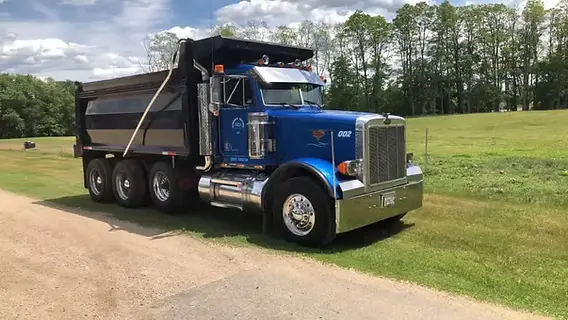
Three weight tables, and a statute that forbids blending them

Idaho publishes three separate allowable-load tables inside one section, and § 49-1001(4) states the rule that governs all of them: a vehicle or combination of vehicles must comply exclusively with the weight limitations in either subsection (1), (2) or (9). There is no averaging, no best-of, and no arguing a favorable row out of one table while sitting under another.

Subsection (1) is the bridge-formula table, running from 34,000 pounds at four feet out to 129,000 pounds at 101 feet across as many as thirteen axles, with the familiar allowance that two consecutive sets of tandem axles may each carry 34,000 pounds where the overall distance between the first and last axles of those sets is thirty-six feet or more.

Subsection (2) is the one written for this industry. It provides that the subsection (1) limits do not apply where a greater weight would be permitted under the table in subsection (2), except that with regard to transportation on the federal interstate and defense highways of the state, the subsection (2) table applies only to vehicles engaged in the transportation of logs, pulp wood, stull, rough lumber, poles or piling; or to any such vehicle engaged in the transportation of “ores, concentrates, sand and gravel and aggregates thereof, in bulk”; or to any such vehicle engaged in the transportation of agricultural commodities, including livestock. Aggregate is named in the weight statute, by commodity, with a dedicated table that reaches the Interstate system.

The subsection (2) table runs by axle spacing across two vehicle classes — three or four axles, and five or more. Both classes read 37,800 pounds from three through twelve feet, 56,470 at thirteen feet, and on up through 65,450 at twenty feet. At twenty-one feet the three-or-four-axle column flattens at 66,000 pounds and stays there, while the five-or-more column continues to 66,330 at twenty-one feet, 69,150 at twenty-five, 72,050 at thirty, and finally 79,000 pounds at forty-three feet and over.

Subsection (9) is the same spacing ladder for all highways except the federal interstate and defense highways, and it is not commodity-gated. It is identical row for row until the last one, where it reads 80,000 pounds at forty-three feet and over rather than 79,000. That thousand-pound difference is the price of the Interstate access that subsection (2) buys, and because § 49-1001(4) makes the election exclusive, it is a genuine choice rather than a rounding difference.

Both commodity tables carry the same two cut-offs, and both are stated as operator conduct rather than as enforcement discretion. The weight allowances do not apply if the total gross weight of the vehicle or combination is intended to exceed the table maximum as declared by the operator; and where the subsection applies, exceeding the weights specified in that table is itself a violation of the subsection. A fleet that elects the aggregate table has elected its ceiling as well as its allowance.

Working out how an Idaho aggregate fleet should be scheduled? The declared registration weights, the elected weight table and the designated routes each change the answer, and they are worth reading together rather than one at a time.

Get a Idaho quote

Nonreducible movement is priced by the mile, and either issuer can sell it

Section 49-1004(1) is unusual before it reaches any number, because it names two issuers on equal footing. Application is made in writing to “the department or local authorities in charge of or having jurisdiction over a highway,” and either “may in their discretion issue a special permit.” Permits may be hard copy or digital, may limit the time of use and the highways and bridges traversed, and may require any undertaking or other security the department or local authority deems necessary.

Subsection (1)(b) then adds a provision that matters on a Monday morning when a load is already on the trailer: the owner or operator must obtain a permit or establish intent to obtain one by contacting a permit office and receiving a permit number before moving the vehicle. The permit, or the evidence of intent, must be carried in the vehicle and delivered on demand to any peace officer, authorized agent of the board or local authority, or any officer or employee charged with the care of the highways.

For nonreducible loads above the § 49-1001 limits, subsection (2) prices by the mile off a two-column table keyed to axle count. Column 1 starts at 40,001 pounds for two axles, 54,001 for three, 68,001 for four, 80,001 for five, 97,001 for six and 114,001 for seven. Column 2 begins at 131,001 pounds for five axles, 148,001 for six and 165,001 for seven. Beyond seven axles the table extends by adding seventeen thousand pounds to the last listed weight in both columns for each added axle.

The rates themselves are stated in cents per mile. Column 1 fees start at four cents per mile and increase four cents per mile for each additional two-thousand-pound increment up to the weight indicated in column 2. Column 2 fees start at one dollar and two cents per mile and increase seven cents per mile for each additional two-thousand-pound increment. Vehicles operating below the column 1 starting weight for their axle configuration are charged four cents per mile. Where axles are wider than eight feet six inches, or carry more than four tires, the fee may be reduced by the board or other proper authority.

Two related instruments belong in the same conversation. Section 49-1002(2)(b) sets a fifty-dollar fee for the travel authorization issued to a vehicle stopped at a port of entry with a load deemed unsafe or impractical to bring into compliance where it sits, allowing movement to the nearest place of safe unloading or legalization. And § 49-434(12) adds an additional use fee of 2.1 mills per mile for each two thousand pounds or fraction of maximum gross weight above the § 49-1001 limits, for nonreducible haulers weighing less than the column 1 starting weights. A mixed fleet that runs both aggregate and machinery is buying from two different price lists, and the machinery side is described on the oversized and overweight trucking page.

One published condition has to travel with any figure for the annual administrative permit fee on the 129,000-pound network. Section 49-1004(5) fixes that cap with the words “Effective July 1, 2019, until June 30, 2021, the annual administrative permit fee shall not exceed fifty-five dollars ($55.00) per vehicle.” That window has closed on its face and the section as published carries no replacement figure, so the fifty-five dollar cap should never be quoted as a current state fee without the window attached to it.

Who the cover rule exempts is more useful than what it requires

Idaho Code § 49-613 is captioned for glass and injurious materials, and an operator scanning a table of contents will walk straight past it. The load rules are inside, and they are layered.

Subsection (4) is the general duty: no vehicle shall be operated on any public highway unless the vehicle’s load is secured to prevent the load from becoming loose, detached or a hazard to other users of the highway. Subsection (6) adds the dirt, sand and gravel rule — a load of that description susceptible to being dropped, spilled, leaked or otherwise escaping must be covered so as to prevent spillage, with covering not required if six inches of freeboard is maintained.

Subsection (5) is the one that gets missed, and it is the one that produces claims. It extends the securement duty to the covering itself: no person may operate any vehicle with any load unless the load is secured and such covering as is required by subsection (6) is securely fastened to prevent the covering or load from becoming loose, detached or a hazard. A tarp that leaves the body at highway speed is a violation of the securement rule in its own right, independent of whether anything under it escaped, and the resulting third-party damage is an auto liability question rather than a housekeeping one.

The section then writes three exemption classes, and for planning purposes they are the operative content. Subsections (5) and (6) do not apply to a government, quasi-government, their agents or employees or contractors thereof, in performance of maintenance or construction of a highway. Subsections (4), (5) and (6) do not apply to vehicles owned by canal companies, irrigation districts, drainage districts or their boards of control, lateral ditch associations, water districts or other irrigation water delivery or management entities performing construction, operation or maintenance of facilities. And subsections (4), (5) and (6) do not apply to vehicles transporting unprocessed agricultural products, byproducts, materials or inputs.

Read the first exemption against the third and the shape becomes clear. The highway contractor hauling dirt in performance of highway maintenance or construction sits outside the cover duty; the private aggregate hauler running the same material out of the same pit the following day sits inside it. Note also that the highway-work exemption reaches only subsections (5) and (6) — the general securement duty in subsection (4) still binds the contractor, while the irrigation and agricultural exemptions reach all three. The same truck can move between two different legal duties depending on whose contract it is working under that week, which is a real operational fact and a poor one to discover after a windshield claim.

The section’s own History line closes at “am. 2015, ch. 208, sec. 5, p. 643.” The six-inch freeboard exception is current Idaho law as published.

The route network is barred from becoming a through corridor

Idaho did not join a regional weight arrangement to handle its 129,000-pound traffic. It wrote a single sentence into § 49-1004(4) instead, and the sentence is unusually direct: “No local public highway agency shall approve a route which provides a thoroughfare for interstate carriers to pass through the state.”

The rest of subsection (4) explains why that sentence has to exist. The annual special route permit authorizes operation between 105,501 and 129,000 pounds; routes on nonstate and noninterstate highways are determined by the local authority for roads under its jurisdiction; and state routes designated by the department and by local authorities are identified together on one statewide map entitled “Designated Routes up to 129K.” Without the prohibition, a chain of individually reasonable local designations would assemble itself into a heavy corridor that no single authority ever approved.

State-side additions run through § 49-1004A. The department may designate routes within its jurisdiction for the same 105,501 to 129,000 pound band, using criteria it establishes based on road and bridge structural integrity engineering standards as well as public safety engineering standards. For every request that a new route be designated, the department must analyze safety and feasibility. And before designating, modifying or deleting a designation, the department must publish notice and conduct a public hearing.

The commercial reading is that Idaho’s heavy network is legally an intrastate network. A fleet whose economics depend on running heavy from an Idaho pit to an out-of-state plant is planning against a rule that exists specifically to prevent that pattern, and a haul-rate assumption built on it is built on something the statute forecloses rather than something a permit office might approve.

The local authority holds the jurisdiction, and the statute says so in terms

Section 49-1004B(1) lets local authorities, by resolution on their own initiative or pursuant to written request, designate and revoke routes for combinations between 105,501 and 129,000 pounds. It then removes any doubt about who decides: “Nothing in this section shall limit the exclusive jurisdiction of local authorities to authorize or decline to designate such routes.” Routes authorized under the section and effective on July 1, 2019 remain in effect unless revoked under the section’s own procedures.

The breadth is real but the procedure is disciplined, and the deadlines are what a hauler can actually plan against. Within one hundred fifty days of a written request, the governing board must determine both whether it designates routes at all and, if it does, whether to approve the specific route at issue. In exercising that jurisdiction the authority must analyze the long-term physical and safety consequences of the traffic, using Idaho Transportation Department standards or the Idaho Standards for Public Works Construction “or a successor publication.” The authority adopts its map by resolution of its governing board, updates it within thirty days of an authorization or revocation, and submits each designation or update to the department for the statewide map.

Permitting is delegated as well. Section 49-1004B(2) makes issuance an administrative action that can be carried out by the primary administrative officer of the jurisdiction or a designee, requires the map or the authorizing resolution to state whether a permit is required on a designated route, and requires the authority to issue a permit or a written denial within thirty days of a written request — with the denial obliged to explain why the permit was denied. A written permit must clearly state all conditions for travel on the designated route.

The fee is capped and partly redistributed. Section 49-1004B(2)(c) sets an annual administrative permit fee not to exceed a maximum of fifty-five dollars per vehicle, set by the local authority, with five dollars of each fee submitted to the local authority technical analysis fund. That fund is created by subsection (4) as a grant fund in the state treasury to help local authorities meet the cost of the technical review the statute requires of them, with grants not to exceed ten thousand dollars per route.

There is an appeal, and it has its own clock. Under subsection (3), after a written decision — or where the authority has not acted within the required time — an applicant may request to be heard by the governing body, which must provide that opportunity at a public meeting within forty-five days of the request, and must render a final decision setting forth the factual and legal reasons no fewer than fifteen days after the conclusion of the meeting at which the appeal was first heard.

Local control does not stop at route designation either. Section 49-1001(1)(a) allows a public highway agency to limit the application of the authorized weights on certain highways within its jurisdiction that it determines have limited structural capacity of pavements, bridges or other appurtenances, and in designating such highways it may specify a minimum wheelbase for combinations operated on them, and may designate specific highways or portions on which combinations of seven through thirteen axles are subject to specified lesser allowable gross weights. A minimum wheelbase requirement is an equipment condition attached to a road, which is a different instrument from a weight posting and needs to be checked separately.

Security runs toward the highway, and also toward the challenger

Idaho does not maintain a standalone haul bond schedule. It puts the requirement inside the permit power at § 49-1004(1)(a), where a special permit may require “any undertaking or other security as the department or local authority shall deem to be necessary to protect the highways and bridges from injury, or provide indemnity for any injury to highways and bridges or to persons or property resulting from such operation.” The discretionary phrasing is load-bearing, and note again that a local authority holds the same power as the department.

The section then adds an instrument pointed the other way, which has no obvious counterpart elsewhere in the class. Under § 49-1004(6)(a), in any action brought to set aside a special permit in which a party seeks a stay, temporary restraining order or preliminary injunction, the court may require bond as provided in Rule 65(c) of the Idaho Rules of Civil Procedure, in an amount not to exceed ten percent of the shipper’s or transporter’s insured value of the product or material to be transported under the permit. Attorney’s fees or costs awarded to the department or another state actor may be satisfied from that bond, and awarded amounts are paid to the state highway account established in § 40-702. Subsection (6)(b) allows a court, on final judgment against the party who brought such an action, to determine the actual damages the action caused and award up to that amount.

The bond is measured against insured value, which makes an insurance number an input to a litigation posture rather than only a claims number. That is worth knowing before a schedule is set on a contract likely to be challenged.

One disclaimer belongs alongside all of it. Section 49-1002(2)(a) provides that neither the state of Idaho nor its employees, nor any authority and its employees in charge of or having jurisdiction over a highway, shall be held liable for personal injury or property damage resulting from the requirements of § 49-1001(8) — the provision that stops a materially overweight vehicle at a port of entry and requires it to be brought into compliance before continuing. The cost and the risk of complying at the scale sit with the operator, which is a cargo and downtime question as much as a compliance one.

The seasonal number is a permit condition, not a published table

Operators arriving from states with a published frost program look for an Idaho equivalent and do not find one in the weight chapter. What Chapter 10 does contain is a delivery mechanism rather than a schedule: § 49-1004B(2) provides that a local authority that designates routes may issue permits for travel on them and “may use such permits to designate conditions for travel, including possible seasonal restrictions or other time, place, or manner limitations.”

That places the seasonal restriction inside a permit issued by a highway district, county or city — not inside a statewide program with dates and percentages. No statewide frost-law zone list, start or end date, or percentage reduction was located in Idaho Code Title 49, Chapter 10, and nothing in this section should be read as a statement about material outside that chapter.

The publishable content is the procedure that surrounds the restriction, and it is more useful to a haul plan than a table would be. The authority must indicate on its route map, or in its authorizing resolution, whether a permit is required on a designated route. It must issue or deny within thirty days of a written request. A denial must explain itself. A permit must state all of its conditions clearly and in writing. And the appeal route in subsection (3) has fixed deadlines attached to it.

For a seasonal contract that means the right question is not what the reduction is, but which authority holds the road and what its resolution and map say this year. That is a per-jurisdiction inquiry with a documented answer, and it is worth making before pricing a spring schedule rather than after a truck is turned around.

Coverage lines a Idaho dump and aggregate account usually carries

The state minimum is a licensing threshold. The program an operator actually needs is built from these lines:

  • Trucking Auto Liability — Primary liability coverage for bodily injury and property damage caused by your truck while under dispatch.
  • Physical Damage — Collision and comprehensive coverage for the tractor, trailer, and attached equipment you own or finance.
  • Motor Truck Cargo — Coverage for the freight you haul against loss or damage in transit.
  • Trailer Interchange — Coverage for non-owned trailers you pull under written interchange agreements.
  • General Liability — Coverage for premises and operations liability away from the truck — terminal yards, customer docks, and non-driving exposures.
  • Workers Compensation — Statutory coverage for driver and yard-employee injury, structured for trucking payrolls and interstate operations.
  • Non-Trucking (Bobtail) Auto Liability — Liability coverage for the tractor when operated off-dispatch — bobtailing home or running personal errands.
  • Pollution Liability — Coverage for cargo-related pollution events and upset/overturn spills not covered by standard auto liability.

Why Truck Guard Insurance for a Idaho dump and aggregate account

We write dump and aggregate hauling as a named class rather than as an exception to general trucking, and we read each account against the weight and permit regime of the state it operates in. For a Idaho operator that means starting from what the trucks are actually licensed and configured to carry, sizing physical damage to bodies and hoists rather than to a chassis value, and treating pit, stockpile and job-site work as its own exposure rather than an extension of the highway auto form.

If the operation also runs freight under separate authority, the Idaho trucking insurance page covers the state’s broader motor carrier picture, and the dump trucking insurance page covers the class mechanics that apply wherever the operator runs.

Idaho dump trucking insurance questions

What lets an Idaho combination run at 129,000 pounds?

Idaho Code § 49-1001(1)(c) permits reducible loads above 105,500 pounds and up to 129,000 pounds on noninterstate highways in accordance with § 49-1004. The allowance is conjunctive: the vehicle must comply with the bridge formula in subsection (1), must have registered and paid the registration fees specified in § 49-434, and must comply with the length restrictions in § 49-1010(7). Off that network the statewide maximum gross is 105,500 pounds, and on federal interstate and defense highways it is 80,000 pounds except as permitted under § 49-1004.

Does Idaho name aggregate in its weight statute?

Yes. Section 49-1001(2) provides that on the federal interstate and defense highways of the state, its table of allowable weights applies only to named commodities, and one of them is “ores, concentrates, sand and gravel and aggregates thereof, in bulk.” That table runs by axle spacing across two vehicle classes and ends at 79,000 pounds at forty-three feet and over. Section 49-1001(4) makes the election exclusive: a vehicle must comply with subsection (1), (2) or (9), never a mixture.

Why does an Idaho registration fee depend on mileage?

Above 60,000 pounds, § 49-434(2) sends commercial vehicles irrespective of body type to the schedule in subsection (8), which is a grid of declared maximum gross weight against total miles driven in the preceding year on Idaho state, county, city and highway district systems. The mileage columns run 1 to 7,500, 7,501 to 20,000, 20,001 to 35,000, 35,001 to 50,000 and over 50,000. A vehicle registered for more than 60,000 pounds and up to 106,000 pounds that runs fewer than 2,500 Idaho miles a year pays a flat $255 under § 49-434(8)(e). The section’s History line closes at am. 2026, ch. 9, sec. 8, p. 71.

Does an Idaho dump body have to be tarped?

Section 49-613(6) requires a load of dirt, sand or gravel susceptible to being dropped, spilled, leaked or otherwise escaping to be covered so as to prevent spillage, and states that covering is not required if six inches of freeboard is maintained. Subsection (5) separately requires the covering itself to be securely fastened. Three exemption classes are written into the section: highway maintenance and construction work by government, quasi-government, their agents, employees or contractors is outside subsections (5) and (6); named irrigation and water-delivery entities are outside subsections (4), (5) and (6); and unprocessed agricultural products, byproducts, materials and inputs are outside all three. The section’s History line closes at am. 2015, ch. 208, sec. 5, p. 643.

Who decides whether a heavy route exists in an Idaho city or county?

The local authority does, and § 49-1004B(1) says so expressly: nothing in the section limits the exclusive jurisdiction of local authorities to authorize or decline to designate such routes. The authority must determine a written request within one hundred fifty days, analyze the long-term physical and safety consequences using Idaho Transportation Department standards or the Idaho Standards for Public Works Construction or a successor publication, adopt its route map by resolution, and update the map within thirty days of an authorization or revocation. Permits are issued or denied in writing within thirty days, and a denial must explain why.

Can an Idaho 129,000-pound route be used to run through the state?

No. Section 49-1004(4) provides that no local public highway agency shall approve a route which provides a thoroughfare for interstate carriers to pass through the state. Idaho routes at that weight are legally an intrastate network, and department-side additions under § 49-1004A require published notice and a public hearing before a designation is made, modified or deleted.

Sources

Every figure on this page was read at the source below on August 11, 2026, with the effective date of the version read. Treat each as current as of that date rather than as permanent.

Get a Idaho dump trucking insurance quote

Send the declared or registered weights alongside the axle configurations, and tell us where the material moves from. We will size the program against the work the trucks actually do rather than against a statutory floor.

Start a quote Call 317-942-0549