Motor carrier classes by state

Kansas dump trucking insurance for aggregate and construction haulers

Kansas wrote a paragraph into its gross weight statute that turns the bridge table off. Not raises it, not permits around it — switches it off, for a truck tractor and dump semitrailer combination hauling a named list of materials to a construction site. Almost everything commercially interesting about hauling aggregate in Kansas follows from the shape of that one paragraph and from what a court did to its last clause.

Excavator loading debris into a dump truck — Kansas Dump Trucking Insurance from Truck Guard Insurance

The Kansas weight statute opens the way most do, with a long distance-and-axle table that runs from 34,000 pounds at four feet to 85,500 at sixty. Then K.S.A. 8-1909(a)(3) — in the Kansas Office of Revisor of Statutes text, the section having last been amended by L. 2016, ch. 44, § 3 — says that the table “shall not apply” to a defined kind of dump combination doing a defined kind of work.

That is a categorically different instrument from a permit. A permit is discretionary, priced, route-designated and carried in the cab. A disapplication is none of those things: it is a statutory statement that the constraint was never engaged, available to any operator whose vehicle and haul match the description, with no application and no fee. It also has no counterpart in the neighboring states, which is why an operator moving into Kansas from Missouri or Oklahoma tends to under-read it.

The paragraph is not open-ended, though, and its limits are not all in its own text. One of them is in a 1983 Court of Appeals decision that read the phrase “construction site” far more narrowly than the words invite, and it is carried as an annotation on the revisor’s own page for the section. An operator relying on the disapplication without knowing what a court did to the destination clause is relying on a wider rule than Kansas actually has.

Running dump semitrailers in Kansas? Tell us what the trailers haul and where the loads go — the answer to both decides which weight regime the fleet is actually operating under.

Start a Kansas quote

One paragraph switches the table off

K.S.A. 8-1909(a)(3) provides that the table in the section “shall not apply to truck tractor and dump semitrailer or truck trailer combination when such are used as a combination unit exclusively for the transportation of sand, salt for highway maintenance operations, gravel, slag stone, limestone, crushed stone, cinders, coal, blacktop, dirt or fill material, when such vehicles are used for transportation to a construction site, highway maintenance or construction project or other storage facility.”

Read that as three conditions stacked, because each one can independently take an operator outside it. The first is equipment: a truck tractor with a dump semitrailer, or a truck trailer combination, used as a combination unit. The second is commodity, and it is a closed list rather than a general description of bulk material — the statute names sand, salt for highway maintenance operations, gravel, slag stone, limestone, crushed stone, cinders, coal, blacktop, and dirt or fill material, and the word governing the whole clause is “exclusively.” The third is destination: transportation to a construction site, a highway maintenance or construction project, or another storage facility.

The statute also stops to define its own subject. “As used in this paragraph (3), the term ‘dump semitrailer’ means any semitrailer designed in such a way as to divest itself of the load carried thereon.” That is a design test, not a nameplate test, and it turns on the discharge mechanism rather than on what the trailer is called on a title. A belt trailer, an end dump and a bottom dump all divest themselves of the load; a hopper that must be excavated does not.

Then comes the clause that keeps the paragraph from being a blank check: such vehicles “shall not be exempted from any application of the table as may be required to determine applicable axle weights for triple and quad axles as defined in K.S.A. 8-1908.” The gross weight constraint falls away. The axle-group arithmetic for the very configurations aggregate haulers actually run does not.

  • Equipment — truck tractor and dump semitrailer, or truck trailer combination, used as a combination unit.
  • Commodity — a closed statutory list, used exclusively: sand, salt for highway maintenance operations, gravel, slag stone, limestone, crushed stone, cinders, coal, blacktop, dirt or fill material.
  • Destination — to a construction site, a highway maintenance or construction project, or other storage facility.
  • Carve-back — the table still governs where it is needed to determine applicable axle weights for triple and quad axles under K.S.A. 8-1908.

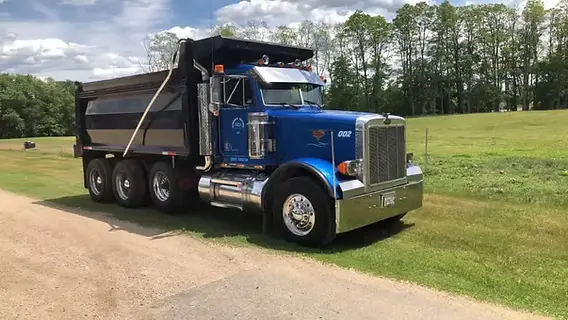
A 1983 decision narrowed the destination clause

The words “a construction site” read, on their face, as any construction site — a subdivision, a commercial pad, a warehouse floor. The Kansas Court of Appeals did not read them that way. The case annotations carried on the revisor’s page for K.S.A. 8-1909 record the holding directly: the exemption of vehicles when used for “transportation to a construction site” was construed to mean only a highway construction or maintenance site. State v. Shouse, 8 Kan. App. 2d 483, 660 P.2d 970 (1983).

That is a substantial narrowing, and it is invisible to anyone reading the statute alone. Under Shouse the disapplication tracks public roadwork rather than construction generally, which aligns it with the commodity list — salt is qualified in the statute itself as salt “for highway maintenance operations,” and blacktop, cinders and crushed stone are highway materials before they are anything else. The destination clause and the commodity clause were evidently drafted to point at the same industry.

The commercial consequence is a fleet-mix question rather than a legal one. A Kansas dump operator whose work is split between state and county roadwork and private site development is running the same trailers under two different weight regimes depending on the job, and the paperwork that distinguishes them is the delivery ticket. Where a contract mix shifts season to season, so does the effective legal payload.

Two further annotations on the same page are worth knowing for context rather than for planning. State v. Moore, 237 Kan. 523, 701 P.2d 684 (1985), discussed the weight exemptions in holding them constitutionally permissible, and City of Overland Park v. McLaughlin, 238 Kan. 637, 714 P.2d 939 (1986), found a rational basis for the exceptions in K.S.A. 8-1909 against due process and equal protection challenges. The structure has been tested and it has held.

Triple and quad axles are defined terms, and they survive the exemption

Because the carve-back sends the reader to K.S.A. 8-1908 for triple and quad axles, the definitions in that section become load-bearing for exactly the fleets the exemption was written for. Subsection (d)(3) defines triple axles as three or more consecutive axles, arranged in tandem and articulated from a common attachment or individually attached, spaced more than 96 inches and not more than 132 inches apart. Subsection (d)(4) defines quad axles the same way at more than 120 and not more than 150 inches. Those definitions entered the section by L. 2017, ch. 50, § 2.

The spacing windows are the operative detail. A multi-axle spread on a dump semitrailer either falls inside the defined range and is treated as a triple or quad group, or it falls outside and is not — and a few inches of suspension geometry decides which. This is one of the rare places where a trailer specification decision has a direct legal weight consequence, and it is a specification most operators inherit from a builder rather than choose.

The rest of 8-1908 continues to apply whether or not the table does. Subsection (a) caps gross weight on any one wheel at 10,000 pounds. Subsection (b) caps gross weight on any one axle, including any one axle of a group, at 20,000 pounds. Subsection (e) caps tandem axles at 34,000 pounds. And subsection (d)(1) defines gross weight on any one axle as the total load on all wheels whose centers fall within two parallel transverse vertical planes not more than 40 inches apart.

So the picture for a qualifying Kansas dump combination is not “no weight limit.” It is a per-wheel limit, a per-axle limit, a tandem limit, and triple and quad group arithmetic — with the distance-based gross weight table lifted out of the middle. That is a meaningfully different underwriting object from a permitted overweight operation, because nothing about it is discretionary or revocable.

We place Kansas dump and aggregate accounts, including tractor and dump semitrailer combinations working highway construction and maintenance contracts across the state.

Get a Kansas quote

An axle off the ground is not an axle

K.S.A. 8-1908(c) contains two rules in three lines, and both of them bite on multi-axle dump equipment specifically. The first: any axle located within seven feet of any adjacent axle shall, when the wheels of that axle are in contact with the road surface, carry its proportionate part of the load permitted on those axles. The second: an axle shall not be used to determine the lawful axle weight under 8-1908, or the gross weight under 8-1909, when the wheels of that axle are not in contact with the road surface.

Lift axles are standard equipment on Kansas aggregate trailers, and this is the provision that governs them. A raised axle is not merely unhelpful — it is legally absent, excluded from both the axle-weight computation and the gross weight computation. A driver who lifts an axle to tighten a turn in a yard and forgets to drop it before the scale has, in the eyes of the statute, changed the vehicle’s axle configuration.

The seven-foot proportionate-load rule is the complement. Where axles sit close together and all are down, the statute will not let a load be concentrated on one of them and counted as if spread across the group; each is required to carry its proportionate part. Between the two rules, Kansas has written a load-distribution requirement rather than merely a load-magnitude one.

For an account with an overload or axle-weight citation history, this is usually where the story actually is. Gross weight violations on aggregate equipment are frequently distribution failures rather than tonnage failures, and they read differently on a loss run once you know that. They also correlate with the tire, brake and suspension wear that eventually shows up on the physical damage side rather than the liability side.

The financial responsibility floors, and the twenty-five-vehicle door

K.S.A. 66-1,128, last amended by L. 2008, ch. 45, § 4, sets the intrastate motor carrier insurance requirement, and it does so in an unusual two-layer way. Subsection (a) directs that no certificate, permit or license issue to a public or private motor carrier of property until a liability insurance policy approved by the Kansas Corporation Commission is on file, in such reasonable amounts as the Commission determines by rules and regulations. Then it puts a floor under the Commission’s discretion: those amounts “shall not be less than $100,000 for personal injury or death to any one person in any one accident, $300,000 for injury or death to two or more persons in any one accident and $50,000 for loss to property of others in any one accident.”

Those are statutory minima, not the operative limits — the Commission sets the operative amounts by regulation and the statute only prevents them falling below the floor. An operator who reads the three numbers as the requirement has read the wrong half of the sentence, and in any event a carrier hauling in interstate commerce is separately inside the federal financial responsibility regime.

Subsection (c) opens a self-insurance route on a fleet-size test rather than a net-worth test. A public or private motor carrier of property “in whose name more than 25 motor vehicles are registered” may qualify as a self-insurer by obtaining a certificate of self-insurance from the commissioner of insurance, who may issue it on being satisfied that the carrier is and will continue to be able to pay any judgment arising out of the ownership, operation, maintenance or use of any vehicle registered in its name. Subsection (d) makes the certificate revocable on reasonable grounds after notice and hearing, and states that failure to pay a final judgment within 30 days is itself reasonable grounds.

The sentence that most often surprises operators sits at the end of subsection (b): “No other or additional bonds or licenses than those prescribed in this act shall be required of any motor carrier by any city or town or other agency of the state.” A Kansas aggregate hauler working across several municipalities is not exposed to a patchwork of local bonding requirements layered on top of the state one. That is a genuine administrative saving on a business whose work is inherently local and multi-jurisdictional, and it is worth knowing before a municipal contract clause asks for something the statute says a city may not require.

Kansas ties permit validity to the power unit

For the loads that do not qualify under 8-1909(a)(3) — the wrong commodity, a private site, a single unit rather than a combination — Kansas issues special permits under K.S.A. 8-1911. The section contains one condition that operators discover late and expensively.

Subsection (c): “A permit shall be valid only when the registration on the power unit is equal to or exceeds the total gross weight of the vehicle. When the gross weight of the vehicle exceeds the upper limit of the available registration, the maximum amount of registration must be purchased.” A permit does not stand alone in Kansas. It is an overlay on a registered weight, and a permit written above the power unit’s registered weight is not a partly valid permit — it is not valid.

The registered weight itself is a declaration. Under K.S.A. 8-143(b)(1), an applicant registering a truck or truck tractor declares as part of the application the maximum gross weight the owner desires to be applicable to the vehicle, and the annual license fee follows the declared band — running up to $2,070 for a gross weight of more than 80,000 pounds and not more than 85,500 pounds. The statute also offers a sworn low-mileage alternative: an applicant who states under oath, on a form prescribed by the director of vehicles, that the vehicle will not be operated more than 6,000 miles in the registration year may license it as a local truck, subject to paying the difference if the mileage is exceeded.

Permit fees are set in 8-1911(f)(2) for permits issued on and after January 1, 2020, at $40 for each single-trip permit and $200 for each annual permit, with $200 for a single-trip permit for a large structure or a superload as defined by rules and regulations. And subsection (g) draws the jurisdictional line: a local authority’s permit powers never extend to a state highway, to a city street designated by the secretary as a connecting link in the state highway system, or to any interstate highway. A fleet whose Kansas work regularly runs on those permits is closer to the oversized and overweight side of the market than to a straight aggregate account, and it should be presented that way.

Local weight restrictions run on a ninety-day budget

K.S.A. 8-1912(a) lets local authorities prohibit operation or impose weight restrictions on highways under their jurisdiction whenever the highway would be seriously damaged by deterioration, rain, snow or other climatic conditions — but for a total period not to exceed ninety days in any one calendar year.

The ninety-day cap is the part worth planning around. It is an annual budget, spent by the local authority rather than by the operator, and it means a county road cannot be under a climatic weight restriction for a whole spring and again for a whole fall. It also means that where a road has been restricted heavily early in a year, the authority has less room later in the same year. Kansas does not administer this as a season.

Subsection (c) gives local authorities a broader standing power to prohibit trucks or limit weight or size on designated highways by ordinance or resolution, signed accordingly, and attaches two protections that matter to a hauler. Adjacent premises to such restricted streets may still be served — a restriction cannot cut a delivery off from its own destination. And no such restriction applies to any street that is a connecting link of the state highway system unless a satisfactory alternate route is provided and has been approved by the secretary of transportation. Subsection (d) gives the secretary the same restriction authority over highways under state jurisdiction.

So a Kansas restriction is a local instrument with a state backstop, and the through-route protections keep it from severing the network. For an operator, the dispatch question is which authority owns the segment; for an underwriter, the useful question is whether a seasonal contract was priced against roads that can be closed to weight for up to a quarter of the year.

What a Kansas aggregate submission should show

Because the Kansas rule turns on what a vehicle is and what it hauls rather than on a permit that can be produced, the submission questions are about operations rather than paperwork.

  • Combination versus single unit, since 8-1909(a)(3) reaches a truck tractor and dump semitrailer or truck trailer combination used as a combination unit, and nothing else.
  • The commodity mix against the statutory list, and whether the qualifying use is genuinely exclusive rather than predominant.
  • The job mix between public roadwork and private site development, given the narrowing of “construction site” in State v. Shouse.
  • Trailer axle spacing, because the triple and quad definitions in 8-1908(d)(3) and (d)(4) survive the exemption and turn on inches.
  • Lift axle practice and driver training on it, since a raised axle is excluded from both the axle-weight and gross weight computations under 8-1908(c).
  • Declared registered gross weight per power unit, which caps what any 8-1911 permit can lawfully authorize.
  • Whether the fleet exceeds 25 registered vehicles, which is the threshold for the self-insurance route in 66-1,128(c) and a useful marker of where an account sits structurally.
  • Pit, stockpile and job-site operations, which fall on the general liability side of the line rather than the auto liability side, and are where a large share of aggregate claims originate.

Coverage lines a Kansas dump and aggregate account usually carries

The state minimum is a licensing threshold. The program an operator actually needs is built from these lines:

  • Trucking Auto Liability — Primary liability coverage for bodily injury and property damage caused by your truck while under dispatch.
  • Physical Damage — Collision and comprehensive coverage for the tractor, trailer, and attached equipment you own or finance.
  • Motor Truck Cargo — Coverage for the freight you haul against loss or damage in transit.
  • Trailer Interchange — Coverage for non-owned trailers you pull under written interchange agreements.
  • General Liability — Coverage for premises and operations liability away from the truck — terminal yards, customer docks, and non-driving exposures.
  • Workers Compensation — Statutory coverage for driver and yard-employee injury, structured for trucking payrolls and interstate operations.
  • Non-Trucking (Bobtail) Auto Liability — Liability coverage for the tractor when operated off-dispatch — bobtailing home or running personal errands.
  • Pollution Liability — Coverage for cargo-related pollution events and upset/overturn spills not covered by standard auto liability.

Why Truck Guard Insurance for a Kansas dump and aggregate account

We write dump and aggregate hauling as a named class rather than as an exception to general trucking, and we read each account against the weight and permit regime of the state it operates in. For a Kansas operator that means starting from what the trucks are actually licensed and configured to carry, sizing physical damage to bodies and hoists rather than to a chassis value, and treating pit, stockpile and job-site work as its own exposure rather than an extension of the highway auto form.

If the operation also runs freight under separate authority, the Kansas trucking insurance page covers the state’s broader motor carrier picture, and the dump trucking insurance page covers the class mechanics that apply wherever the operator runs.

Kansas dump trucking insurance questions

Does Kansas really exempt dump combinations from its weight table?

For a defined subset, yes. K.S.A. 8-1909(a)(3) states that the table does not apply to a truck tractor and dump semitrailer or truck trailer combination used as a combination unit exclusively for a named list of materials moving to a construction site, highway maintenance or construction project, or other storage facility. It is a statutory disapplication rather than a permit, so there is no application and no fee — but the axle limits in K.S.A. 8-1908 still apply.

Which materials are on the list?

Sand, salt for highway maintenance operations, gravel, slag stone, limestone, crushed stone, cinders, coal, blacktop, and dirt or fill material. The list is closed and the statute requires the combination to be used “exclusively” for that transportation, so a mixed-commodity operation should not assume the paragraph reaches it.

Does “construction site” mean any construction site?

No. The case annotation carried on the revisor’s page for K.S.A. 8-1909 records State v. Shouse, 8 Kan. App. 2d 483, 660 P.2d 970 (1983), construing the exemption for transportation “to a construction site” to mean only a highway construction or maintenance site. That reading aligns the destination clause with the commodity list, which itself qualifies salt as salt for highway maintenance operations.

What is a “dump semitrailer” for this purpose?

The statute defines it in the same paragraph: any semitrailer designed in such a way as to divest itself of the load carried thereon. It is a design test based on how the trailer discharges, not a nameplate or title description, so the question is whether the equipment sheds its own load rather than what a dealer called it.

Do lift axles count toward Kansas axle weights?

Only when they are down. K.S.A. 8-1908(c) provides that an axle shall not be used to determine the lawful axle weight under that section, or the gross weight under 8-1909, when its wheels are not in contact with the road surface. The same subsection requires any axle within seven feet of an adjacent axle to carry its proportionate part of the load permitted on those axles when its wheels are down.

Can a Kansas city require its own bond on top of the state requirement?

The statute says no. K.S.A. 66-1,128(b) provides that “no other or additional bonds or licenses than those prescribed in this act shall be required of any motor carrier by any city or town or other agency of the state.” The state-level requirement in subsection (a) rests on amounts set by the Kansas Corporation Commission by rule, subject to statutory floors of $100,000, $300,000 and $50,000.

Why was my Kansas overweight permit treated as invalid?

Most often because the power unit’s registration did not carry the weight. K.S.A. 8-1911(c) provides that a permit is valid only when the registration on the power unit equals or exceeds the total gross weight of the vehicle, and that where the gross weight exceeds the upper limit of the available registration, the maximum amount of registration must be purchased. The permit is an overlay on the registered weight, not a substitute for it.

Sources

Every figure on this page was read at the source below on August 11, 2026, with the effective date of the version read. Treat each as current as of that date rather than as permanent.

Get a Kansas dump trucking insurance quote

Send the declared or registered weights alongside the axle configurations, and tell us where the material moves from. We will size the program against the work the trucks actually do rather than against a statutory floor.

Start a quote Call 317-942-0549