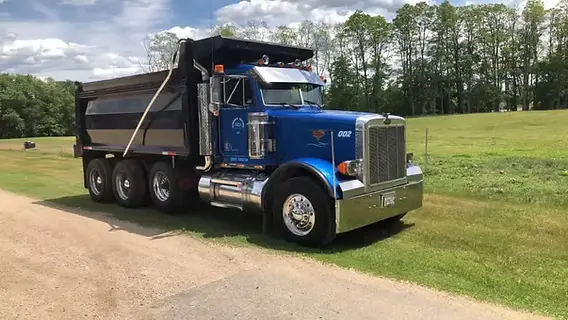
Crushed stone is written into the statute, and the test is where the load is going
KRS 189.2226 is the provision an aggregate hauler should read first, because it is the one place in Kentucky law where the cargo is enumerated rather than inferred. Subsection (1)(b) defines “building materials” as equipment or materials associated with new home construction, home remodeling or home maintenance, “including but not limited to” a twelve-item list: agriculture products; asphalt; concrete; crushed stone; excavation equipment; fill dirt and rock; glass; landscaping materials; lumber or other wood products; minerals; roofing materials; and steel products.
Crushed stone, fill dirt and rock, concrete, asphalt, minerals and landscaping materials are the working cargo of a dump fleet, and they are named in the statute rather than reached through a general formula. The relief that follows is substantial. Subsection (2) opens “Other statutes to the contrary in this chapter notwithstanding” and provides that any vehicle hauling building materials to a home “shall be allowed ... to travel on any state road without a permit and without being subject to a fine, if the weight of the vehicle is within the limits of the registration issued to the vehicle and within the axle limits for the vehicle, even if the vehicle’s gross weight or length, including vehicle and load, exceed the limits prescribed by this chapter.”
The condition is the destination, not the commodity, and that is the unusual part. “Home” is defined at subsection (1)(c) as a site where a single or multi-family housing unit is being initially constructed under an issued building permit, or a site where such a unit is complete and inhabited. “State road” at (1)(d) “means a state or federal highway but does not mean an interstate or county road.” The same truck with the same stone going to a commercial jobsite is outside the section; going to a permitted residential build, it is inside it.
Four conditions ride along and each of them is a compliance fact worth capturing. The vehicle may travel “the most direct route, in the opinion of the operator,” provided no road traveled as that route is further than fifteen miles from a state road classified to carry the vehicle’s registered weight. On a road the cabinet classifies as a single “A” highway, the vehicle or its load cannot exceed ninety-six inches in width, and beyond that an overdimensional permit is required. The operator “shall have in his or her possession a bill of lading,” defined as a document evidencing purchase of or a delivery order for the materials, issued by the business that sold or leased them. And subsection (4) preserves the hard limits absolutely: vehicles under the section are prohibited from exceeding established width and posted bridge weight limits on any route, and one that does must obtain the appropriate permit.
KRS 189.2226 is effective July 14, 2022, as amended by 2022 Ky. Acts ch. 153, sec. 5. For an underwriter the practical reading is that a Kentucky residential-delivery operation and a Kentucky commercial-delivery operation are running under different rules with the same trucks, and the document that proves which one applies is a bill of lading in the cab.
- Twelve named building materials including crushed stone, fill dirt and rock, concrete and asphalt (KRS 189.2226(1)(b)).
- Travel on any state road without a permit and without a fine, within registration and axle limits (subsection (2)).
- The trigger is delivery to a “home” — a permitted new build or a completed, inhabited unit.
- State road excludes both the interstate and county roads.
- Most direct route in the operator’s opinion, within fifteen miles of an adequately classified state road.
- 96-inch width cap on a single “A” highway; a bill of lading must be carried.
- Posted bridge weight limits and width limits are never relieved (subsection (4)).