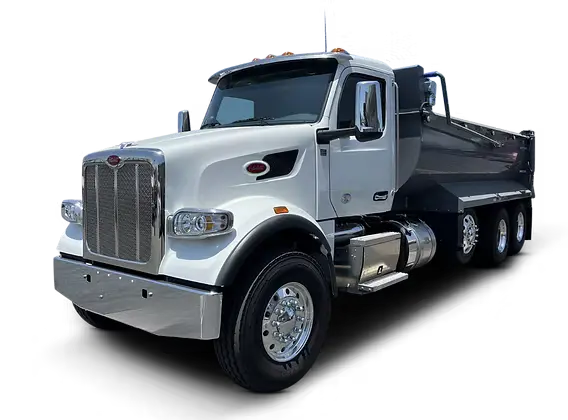
A 65-foot combination written specifically for dumping equipment
Michigan has a length allowance that exists for one kind of equipment, and it is unusual enough to be worth reading carefully. MCL 257.719, at subsection (2)(f), sets the general limit for a truck tractor, semitrailer and trailer, or a truck tractor and 2 semitrailers, at 59 feet.
Subsection (2)(g) raises that to 65 feet for a truck tractor, semitrailer and trailer, or a truck tractor and 2 semitrailers, in which no semitrailer or trailer is more than 28-1/2 feet long — but only while the vehicle is being used for a business purpose reasonably related to picking up or delivering a load, and only if each semitrailer or trailer is equipped with a device or system capable of mechanically dumping construction materials or dumping construction materials by force of gravity.
Three conditions therefore travel together: the per-unit length, the business purpose, and a dumping mechanism on every trailing unit. It is rare for a length statute to describe a body type at all, and rarer still for it to condition the allowance on the equipment being capable of the work. A Michigan operator running that configuration has an allowance that a general freight carrier with identical dimensions does not.
Michigan writes its permit rules around this kind of work as well. MCL 257.725, at subsection (11), provides for an annual permit for the movement of construction equipment issued to a power unit, without requiring a separate permit for each individual piece of equipment carried by that power unit; the state transportation department fee for that permit is $264.00 under subsection (4), against $50.00 for an ordinary single trip and $100.00 for multiple trips or an annual permit. Subsection (12), added by a 2018 amendatory act, further provides that such a permit may be presented on a mobile device, may not restrict daily operating hours, may include only Memorial Day weekend, the Fourth of July holiday and Labor Day weekend as restricted holidays, and may not require travel more than 10 miles per hour below the posted speed limit.
The insurance consequences follow the configuration rather than the statute. A trailing unit that dumps is a unit with hydraulics, a raised-body exposure and an overturn profile of its own, and it belongs on the schedule as a rated unit rather than as an attachment. Where those units are pulled behind equipment the insured does not own, or dropped with another party, the interchange question needs answering — that is trailer interchange territory, and it is regularly missed on multi-unit dump combinations because the trailers look like part of one vehicle.