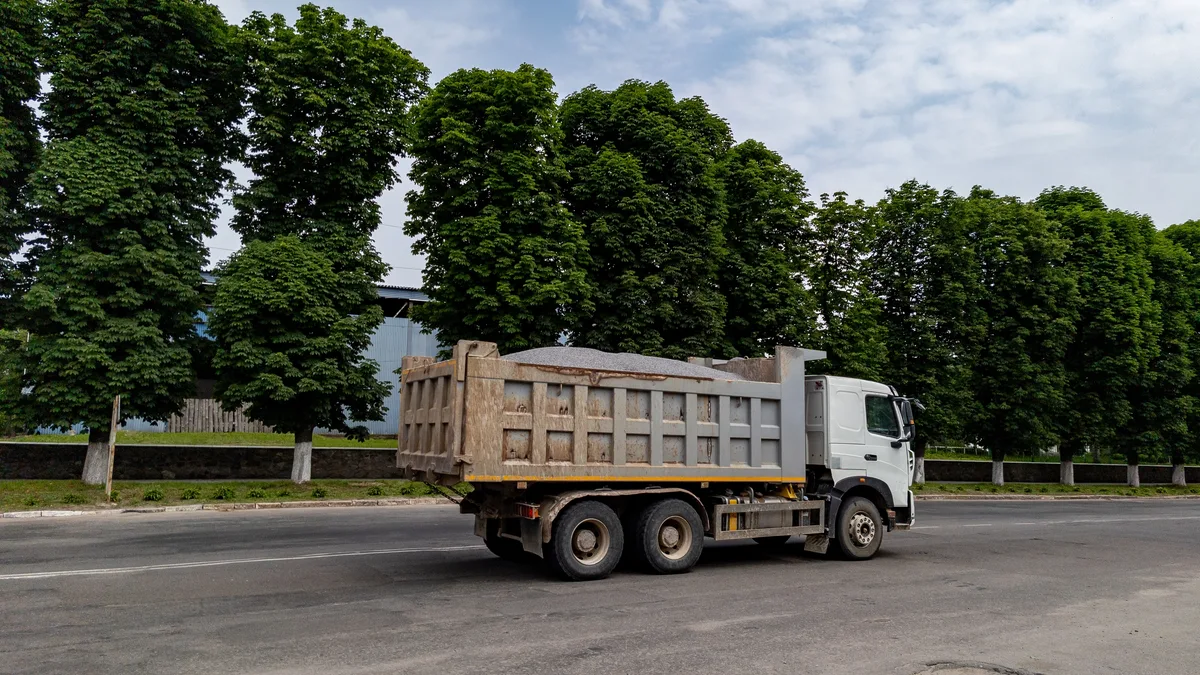
The garbage permit is written around a body a dump truck does not have
Nebraska runs exactly one overweight tolerance for waste hauling, and it excludes an open dump body on the face of the rule. Section 007.03A of 408 Neb. Admin. Code ch. 3, the Department of Transportation’s permit regulation effective April 30, 2023, provides that Garbage Permits “may be issued for the movement of a truck with an enclosed body and a compacting mechanism designed and used exclusively for the collection and transportation of garbage or refuse.”
What that truck gets is worth knowing precisely, because it is the shape of the relief Nebraska was willing to grant. Such a truck and load “may exceed the maximum axle load permitted by law by no more than 20 percent on only one axle, on one tandem axle, or on a group of axles,” while remaining within the maximum gross load permitted by Neb. Rev. Stat. §§ 60-6,290 and 60-6,294. The permit issues only for travel on a designated route, is valid twenty-four hours a day including weekends and holidays on the Nebraska highway system, and carries a capitalized limitation in the rule itself: garbage permits are not valid for the National System of Interstate and Defense Highways. Terms run from one month up to one year, at ten dollars per month capped at one hundred dollars per year.
An open dump body and a roll-off both fail the body test before the weight question is ever reached, so the twenty percent tolerance is structurally out of reach for the vehicle this page is about. That is a cleaner answer than an absence would have been — the rule states the class it means to reach and the class is a packer truck.
The general permit rules explain why no aggregate counterpart exists. Section 003.17 of the same chapter, sitting in the general provisions governing overweight and over-dimensional permits, states that “Permits will not be issued for vehicles or loads which can be reduced to comply with the size and weights permitted by statutes (divisibility of vehicles or loads).” The statute says the same thing at Neb. Rev. Stat. § 60-6,298(1)(b)(i): no permit issues for a vehicle carrying a load unless the load exceeds the size or weight limits, “cannot be dismantled or reduced in size or weight without great difficulty,” and of necessity must move over the highways.
The permit fees themselves are statutory ceilings rather than prices, and the hedge is load-bearing. Section 60-6,298(7) allows a permit fee “of not to exceed fifty dollars,” with continuing or continuous permits not exceeding fifty dollars for ninety days, one hundred dollars for one hundred eighty days or two hundred dollars for one year, and single trip superload ceilings of two hundred fifty dollars at three hundred thousand pounds or less, four hundred dollars above that to five hundred thousand, and eight hundred dollars beyond it. The section as read carries source line Laws 2026, LB1126, § 85, with an effective date of July 18, 2026, and the Department may charge direct costs on a superload in addition to the fee.
Two further conditions in the same statute reach an aggregate operator directly. Section 60-6,298(3) lets the Department or local authority “require such undertaking or other security as may be deemed necessary to compensate for any injury to any roadway or road structure,” and § 60-6,298(8) requires that the vehicle already be registered under § 60-3,147 or § 60-3,198 for the maximum gross vehicle weight the permit would allow before the permit issues. Section 003.06 of the regulation adds that the Department may require a certificate showing the amount of public liability and property damage insurance carried.