Motor carrier classes by state

New Jersey dump trucking insurance for aggregate and construction haulers

In New Jersey, moving dirt is a licensed activity and moving quarry stone is not. The 2019 soil and fill recycling law put the collection, transportation and brokering of fill inside a licensing structure built for the solid waste industry, with the license application going to the Attorney General. The commodity in the body decides which body of law the truck is operating under.

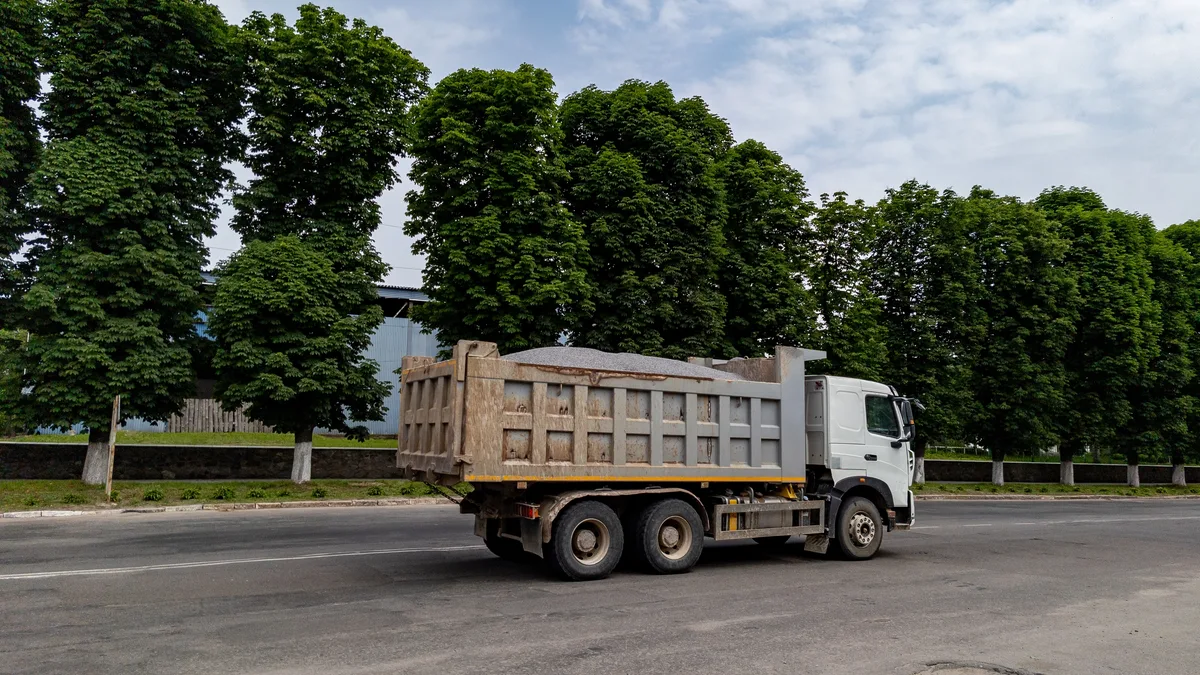
Loaded dump truck on a paved road — New Jersey Dump Trucking Insurance from Truck Guard Insurance

Short high-frequency trips, work performed off the pavement at pits and placement sites, and hoist and body damage that a physical damage schedule rarely priced correctly are features of this trade wherever it operates. The dump trucking insurance page covers them, which leaves this page free for what New Jersey does differently.

New Jersey’s distinguishing feature is an entry control. Most states regulate this trade through weight limits and permits and leave the question of who may be in the business to general corporate law. New Jersey runs a licensing regime over one of the commodities dump trucks move most often, and the vetting attached to it reaches beyond the company into its officers, their families, and the brokers and consultants who merely do business with it.

That has an immediate effect on what an insurance submission has to contain. A New Jersey operator hauling fill has a license file, a disclosure statement and a list of the yards where its trucks are kept. An operator running the same trucks on registered vocational plates has speed rules, radius rules and a weight statute that switches off inside a measured distance of the job. A permitted operator has an insurance certificate whose seven required contents are specified in advance. Those are three different documents describing the same fleet, and they do not always agree.

Every figure below is read from the enrolled chapter law or from the New Jersey Department of Transportation’s current guidebook, each cited with the date the source itself carries.

Hauling fill, soil or demolition material in New Jersey? Send the license or registration status with the equipment list — in this state that status is part of the operation’s legal ability to trade, not paperwork that follows the policy.

Start a New Jersey quote

The material in the body decides whether a license is needed at all

P.L.2019, c.397, approved January 21, 2020 and effective immediately by its own section 19, amends the definitions at C.13:1E-127 and adds two terms that decide the whole question. “Soil and fill recycling services” means “the services provided by persons engaging in the business of the collection, transportation, processing, brokering, storage, purchase, sale or disposition, or any combination thereof, of soil and fill recyclable materials.” Transportation is named in the definition, so hauling is itself a regulated service rather than a step inside somebody else’s regulated service.

The other term is where operators get caught. “Soil and fill recyclable materials” means “non-putrescible aggregate substitute, including, but not limited to, broken or crushed brick, block, concrete, or other similar manufactured materials; soil or soil that may contain aggregate substitute or other debris or material, generated from land clearing, excavation, demolition, or redevelopment activities that would otherwise be managed as solid waste, and that may be returned to the economic mainstream in the form of raw materials for further processing or for use as fill material.”

The definition then excludes four things, and the fourth is the one an aggregate hauler needs to read carefully: the term does not include “virgin quarry products including, but not limited to, rock, stone, gravel, sand, clay and other mined products.” Also excluded are Class A recyclable material; Class B recyclable material shipped to a departmentally approved Class B recycling center; and beneficial use material for which the generator has prior departmental approval to transport to an approved and designated destination.

So the line runs through the load. A truck bringing crushed stone out of a quarry is carrying a virgin quarry product and is outside the definition. The same truck bringing excavation spoil off a redevelopment site, or crushed concrete from a demolition, is carrying soil and fill recyclable material and is inside it. A mixed operation that does both is inside the licensing regime for part of its week, and the licensing question is answered per activity rather than per company.

One further exclusion sits in the services definition itself and it names a familiar site type: “soil and fill recycling services” does not include “the operation of a solar electric power generation facility at a properly closed sanitary landfill where soil and fill materials have been previously deposited for permanent disposal.” The carve-out is for the generation facility, which leaves deposition of fill at such a site inside the licensed activity rather than outside it.

The department takes the registration; the Attorney General takes the license

The act builds a two-stage entry control, and the two stages go to two different offices. Stage one is registration with the Department of Environmental Protection under new C.13:1E-127.1. Stage two is a license application filed “with the Attorney General.” An operator who thinks of this as an environmental permit will file in the wrong place.

The registration content is short and specific, and one line of it is unusual enough to plan around. The registration must include the name of the business concern and its New Jersey corporate filing number; contact information including a valid phone number and email address; a certified statement that the concern is actively engaged in soil and fill recycling services at the time of registration; and “the address of the business concern and the addresses of any other locations where trucks or equipment used by the business concern are kept.” Every yard, not merely the office, is disclosed by statute — which also means the list of premises the state holds and the list a general liability schedule was written against should be the same list.

The timing provisions ran from the effective date and have long since expired, which changes what a new entrant actually does today. Registration was due no later than 90 days after the effective date. From 180 days, no business concern could engage in soil and fill recycling services without a registration or a license. Registrants then had 270 days to file “a valid and administratively complete application for a soil and fill recycling license with the Attorney General,” with a 90-day extension available from the Attorney General on a showing of good cause.

The act writes the answer for anyone arriving after those windows closed. Subsection g. of section 1 provides that a business concern seeking to engage in soil and fill recycling services later than 90 days after the effective date, which has not submitted a registration form, “shall file an application for a soil and fill recycling license with the Attorney General.” For an operator entering the business now, the license is the operative requirement and the registration route is spent.

The registration, while it lasted, was a conditional and fragile thing. It is non-transferable. It “shall temporarily authorize the registrant to provide soil and fill recycling services pending the approval or denial” of the license application. It expires automatically on either a failure to file the license application in time or a final departmental determination on it. And issuance of a registration “shall not preclude the department from subsequently denying a soil and fill recycling license to the registrant” — holding one never implied getting the other.

The disclosure statement reaches people who are not on the payroll

The vetting machinery the 2019 act borrowed is the disclosure statement at C.13:1E-128, written for the solid and hazardous waste industry and now applied to soil and fill. Every applicant and permittee files a disclosure statement with the Attorney General, and “any person required to be listed in the disclosure statement shall be fingerprinted for identification and investigation purposes” under procedures the Attorney General establishes. The Attorney General then prepares and transmits an investigative report to the department, based in part on the statement, and may request and receive criminal history information.

What makes this heavier than an ordinary licensing form is the definition of “key employee.” The act defines it as any individual employed or otherwise engaged by the applicant, permittee or licensee “in a supervisory capacity or empowered to make discretionary decisions with respect to the solid waste, hazardous waste, or soil and fill recycling operations of the business concern”; then extends it to “any family member of an officer, director, partner, or key employee, employed or otherwise engaged by the applicant or permittee”; and then extends it again to “any broker, consultant or sales person employed or otherwise engaged by, or who do business with, the applicant, permittee, or licensee” with respect to those operations.

The phrase “who do business with” is doing real work there. A broker who never appears on a payroll can be a key employee for disclosure purposes. And “family member” is separately defined at length — spouse, domestic partner, partner in a civil union, child, parent, sibling, aunt, uncle, niece, nephew, first cousin, grandparent, grandchild, and the in-law, step and half relations, “whether the individual is related by blood, marriage, or adoption.” A closely held hauling company staffed by relatives has more people inside the disclosure perimeter than it has on the organization chart.

The statement itself asks for history as well as identity. It requires a description of experience and credentials, including past or present licenses, in the collection, transportation, treatment, storage, brokering, transfer or disposal of solid waste or hazardous waste or the provision of soil and fill recycling services, held by the applicant and by its key employees, officers, directors or partners. It requires a listing and explanation of any notices of violation, prosecutions, administrative orders or license revocations issued by New Jersey or any other state or federal authority in the ten years immediately preceding the filing, that are pending or that resulted in a finding or settlement. And it requires a listing and explanation of judgments of liability or convictions rendered against the applicant or against any key employee, officer, director or partner.

Enforcement is layered rather than sequential. On finding a violation, the department may issue a compliance order, bring a civil action, levy a civil administrative penalty, bring an action for a civil penalty, or petition the Attorney General to bring a criminal action — and “Administrative and judicial remedies provided in this section may be pursued simultaneously.” Engaging in soil and fill recycling services without a registration or license, or knowingly making a false or misleading statement to the department or the Attorney General in connection with one, is a crime of the third degree carrying a fine of not more than $50,000.00 for a first offense and not more than $100,000.00 for a second and each subsequent offense, plus restitution.

The civil administrative penalty carries its own internal condition and the condition must travel with the figure: the department may assess “not more than $50,000.00 for each violation provided that each day during which the violation continues shall constitute an additional, separate, and distinct offense,” but “shall not assess a civil administrative penalty in excess of $25,000.00 for a single violation, or in excess of $2,500.00 for each day during which a violation continues, until the department has adopted, pursuant to the ‘Administrative Procedure Act,’ P.L.1968, c.410 (C.52:14B-1 et seq.), rules” requiring it to consider operational history, severity, mitigation and deterrence. The higher ceiling depends on that rulemaking, which was not confirmed for this page.
Adding demolition or excavation spoil to a New Jersey run? That changes the commodity and can change the licensing question, so it is worth a conversation before the first load rather than after the first inspection.

Get a New Jersey quote

No certificate, no permit — and the certificate has to say seven things

The New Jersey Department of Transportation’s Commercial Vehicle Size and Weight Guidebook, January 2024 edition, restates the insurance condition on oversize and overweight permits at its section 5.2, citing N.J.A.C. 13:18-1.7(b). The rule is stated as a bar rather than as a condition subsequent: “An application for a permit shall not be accepted unless the applicant provides proof of coverage by insurance in the following minimum limits.”

The limits are split rather than combined, which is worth noticing on a schedule that may have been written on a combined single limit basis:

Two mechanical requirements sit alongside the limits. The policy “shall contain a provision that there will be 10-day prior notice to the Motor Vehicle Commission in the event of cancellation or termination of the insurance.” And proof must be an insurance certificate carrying seven specified items: the name and address of the insured; the policy number; the policy expiration date; automobile coverage meeting the stated minimums; a description of the vehicles covered under the policy; the ten-day cancellation clause; and the agent’s signature. A certificate missing any of them is not proof under the rule.

The Guidebook records one narrow relief: filing an insurance certificate is not required for an oversize permit issued for the operation of a private utility, or a house type trailer or semitrailer, in which case the provisions of the Security-Responsibility Law at N.J.S.A. 39:6-23 et seq. apply instead. That relief does not reach a loaded dump body.

Section 5.1 then closes the argument an operator sometimes tries after a bridge or pavement claim. Any person driving a vehicle subject to and in excess of statutory weight limitations and permit requirements is liable for all damage the highway or highway structure sustains, recoverable in a civil action by the authorities in control of it, and “The fact that the vehicle causing the damage was being operated within the authorized size and weight limitations or permitted by a special permit shall not be accepted as a defense.” Holding the permit is not a shield, which is why the permit file and the trucking auto liability limit should be reviewed as one question rather than two.

The Guidebook carries its own currency hedge on its first page and it applies to every figure taken from it: “Information contained in this guidebook regarding the fees/permits listed and the various laws and regulations governing commercial motor vehicle operations in New Jersey are subject to change without notice. This guidebook is produced solely as a convenience to the public and the State assumes no warranty or representation given or the use of any of the material provided or for unintentional omissions, errors, or misprints which appear in this guidebook.”

  • $100,000 for bodily injury or death to any one person in any one occurrence.
  • $300,000 for bodily injury or death to two or more persons in any one occurrence.
  • $100,000 for damage to or destruction of property in any one occurrence.

Constructor plates come with a speed rule that reads backwards

New Jersey registers construction trucks into a named vocational class. The Guidebook sets out Code 41 Constructor registration under N.J.S.A. 39:3-20b as available to vehicles with a gross weight between 41,000 and 70,000 pounds, on satisfactory proof that the applicant “is actually engaged in construction work or in the business of supplying material, transporting material, or using such registered vehicle for construction work.” The plates are regular commercial plates beginning with the prefix “X,” which makes the class visible from the roadside.

Three restrictions ride with the class, and the first of them runs the opposite way from intuition. A Code 41 vehicle “cannot operate on a highway at a speed greater than 45 miles per hour when carrying a load under 50 percent of the registered gross weight.” The lightly loaded truck is the one held to 45. The second restriction applies the same 45 mile per hour ceiling whenever one or more axles carries a load exceeding the limits prescribed in N.J.S.A. 39:3-84. The third is geographic: the vehicle “cannot exceed 30 miles (air mile radius) when carrying a load over 50 percent of the registered gross weight.”

The reason those restrictions are tolerable is what comes with them. For a Code 41 vehicle, “The provisions of paragraph 5 of subsection b. of N.J.S.A.39:3-84 (maximum gross and axle weights) shall not apply; provided the vehicle or combination of vehicles is operated within an area that is 30 miles or less from the point established as a headquarters for the particular construction operation.” The exemption is measured from the job rather than from the road class, and the headquarters point for the particular construction operation is what anchors it.

For anyone reviewing an operation, that means the radius is not a fleet attribute. It moves with the project. A contractor who relocates its site headquarters relocates the thirty-mile area in which the weight paragraph is disapplied, and a haul that was inside the area last month may not be inside it now. The registered gross weight is doing double duty as well — it sets the plate class and it is the denominator in both the 50 percent speed test and the 50 percent radius test.

Dual registration is contemplated in both directions. A Code 41 vehicle may also be registered as Code 39 Solid Waste and the reverse, on presentation of a photocopy of the title and payment of the full fee for the second code. The result is two sets of plates and two registrations for one truck, and the Guidebook is explicit about what that means in practice: both sets of plates must be displayed on the vehicle and both registrations must always be carried in it. At a registered weight of 55,000 pounds or more, the federal Heavy Use Tax Form 2290 must be uploaded for online renewal.

Solid waste plates run through a certificate of convenience and necessity

Code 39 Solid Waste registration under N.J.S.A. 39:3-20c is the other vocational class a dump operator may hold, and the Guidebook states an entry condition borrowed from utility regulation rather than from motor vehicle law: applicants “must hold a ‘Certificate of Convenience and Necessity’ issued by the Board of Public Utility Commissioners,” and that certificate must be uploaded for online renewal. Whatever else this class is, it is not a registration a carrier simply applies for.

The class carries registration weight ceilings in place of the ordinary table: 42,000 pounds for a two-axle vehicle, and 60,000 pounds for a tandem three-axle vehicle, a four-axle vehicle, or a four-axle truck tractor-trailer combination. And the operative limit is the document rather than the statute: “Vehicles registered as a Solid Waste Disposal Vehicle shall be limited to the allowable gross weight as shown on the registration certificate.” The number on the card governs the truck.

The weight-statute disapplication runs here too, with an interstate exception attached. While operating, paragraph 5 of subsection b. of N.J.S.A. 39:3-84 does not apply, “except when the vehicle or combination of vehicles registered as ‘solid waste’ is operated on any highway which is part of the National System of Interstate and Defense Highways, as provided in 23 U.S.C. s.103.” A solid waste unit that leaves local roads for the Interstate re-enters the statutory limits at the ramp.

The third class is narrower and it is defined by a prohibition. Code 56 Contractor Equipment-In-Transit registration under N.J.S.A. 39:4-30 produces plates displaying the words “CONTRACTOR EQUIPMENT IN-TRANSIT,” issued in bundles of five sets with hyphenated numbers through five. The equipment it covers is named: road-building machinery, backhoes, front end loaders, well drilling equipment including necessary attachments, cranes, arrow boards, chippers and shredders, cement mixers, compressors, and other self-propelled and towed equipment used in moving to and from construction locations.

The bar is absolute and it is the reason a Code 56 plate is not a substitute for a registration: “No load may be carried on or in any vehicle or piece of equipment registered under Code 56 while moving to or from any construction site or while moving upon any public roadway.” Any vehicle towing a piece of equipment displaying a Code 56 plate must itself be properly registered. Equipment moves on these plates; material does not — so a machine traveling on Code 56 is an item on a physical damage or equipment schedule in transit, and not freight in the sense any cargo wording contemplates.

Overweight runs around the clock; oversize keeps daylight hours

The Guidebook draws a sharp operational line between the two permit families, and for an aggregate hauler it falls on the useful side. Under section 5.3.4, “Overweight permits issued to operate in excess of statutory weight limits, and of legal dimension, are authorized to travel 24 hours a day 7 days a week.” Oversize permits are not: section 5.3.1 confines operation under an oversize permit to daylight hours of sunrise to sunset on any highway where clear space available for use by passing traffic is less than ten feet including roadway and improved shoulder.

Four conditions qualify the overweight permission and each is a condition on validity rather than advice. The permitted vehicle is prohibited from operating when the load cannot be operated safely at a maximum speed of 40 miles per hour when lighted lamps are required, unless the permit says otherwise. The permit is not valid when visibility is less than 500 feet or when hazardous road conditions are present. The permit is not valid where gross weight including load exceeds 800 pounds per inch of tire width on any or all wheels. And a New Jersey registered vehicle operating in excess of legal weight limits “must be registered at the maximum registration weight permitted in State Statute.”

That last condition is the one that connects the permit file back to the registration file. A permit does not cure an under-registered truck; it presupposes a fully registered one. An operation holding overweight permits on units registered below the statutory maximum has a defect that no permit fee resolves.

Height brings its own duty, and the sanction for missing it is loss of the permit rather than a fine. Where a permitted vehicle or load exceeds 14 feet in height, section 5.3.3 makes it the permittee’s responsibility to notify all public utility companies, the Department of Transportation, and county and municipal traffic engineering departments having control of overhead wires, cables, signal lights or bridges crossing the permitted route, before the move is made, under N.J.S.A. 39:4-28. “The permit shall be void for failure to make such notifications and/or to comply with the recommendations or request of any of the above offices.” A raised body clears 14 feet routinely, which is why this reads as a dump-operation rule even though it is written for high loads.

The cost mechanism for a single trip is stated as a base plus a rate plus two add-ons. The Guidebook’s permit fee table sets the single-trip overweight fee at a $10 permit fee plus $5 for every 2,000 pounds over the legal axle or gross weight limits, with a $12 transaction fee and a service charge of five percent of the total fee. The oversize side of the same table runs a $10 permit fee plus $1 for every foot or fraction of a foot over 14 feet in width, and $1 for every foot or fraction over 63 feet in trailer or load length for non-house trailers. Emergency permits carry no fee. Those figures are the Guidebook’s own restatement and they sit under the disclaimer quoted above; county, municipal and toll road permits, and permits on bi-state authority facilities, are obtained outside the Department of Transportation permit entirely, which is a separate application an operator crossing into a river crossing or a county route has to make on its own.

Movement timing on holidays follows a stated rule rather than a list of dates: where a holiday falls on a Sunday, permitted operation is not allowed on the following Monday, and where it falls on a Saturday, it is not allowed on the preceding Friday. For a fleet on a placement schedule, that pushes the lost day to a predictable side of the weekend.

Coverage lines a New Jersey dump and aggregate account usually carries

The state minimum is a licensing threshold. The program an operator actually needs is built from these lines:

  • Trucking Auto Liability — Primary liability coverage for bodily injury and property damage caused by your truck while under dispatch.
  • Physical Damage — Collision and comprehensive coverage for the tractor, trailer, and attached equipment you own or finance.
  • Motor Truck Cargo — Coverage for the freight you haul against loss or damage in transit.
  • Trailer Interchange — Coverage for non-owned trailers you pull under written interchange agreements.
  • General Liability — Coverage for premises and operations liability away from the truck — terminal yards, customer docks, and non-driving exposures.
  • Workers Compensation — Statutory coverage for driver and yard-employee injury, structured for trucking payrolls and interstate operations.
  • Non-Trucking (Bobtail) Auto Liability — Liability coverage for the tractor when operated off-dispatch — bobtailing home or running personal errands.
  • Pollution Liability — Coverage for cargo-related pollution events and upset/overturn spills not covered by standard auto liability.

Why Truck Guard Insurance for a New Jersey dump and aggregate account

We write dump and aggregate hauling as a named class rather than as an exception to general trucking, and we read each account against the weight and permit regime of the state it operates in. For a New Jersey operator that means starting from what the trucks are actually licensed and configured to carry, sizing physical damage to bodies and hoists rather than to a chassis value, and treating pit, stockpile and job-site work as its own exposure rather than an extension of the highway auto form.

If the operation also runs freight under separate authority, the New Jersey trucking insurance page covers the state’s broader motor carrier picture, and the dump trucking insurance page covers the class mechanics that apply wherever the operator runs.

New Jersey dump trucking insurance questions

Does hauling fill in New Jersey require a state license?

Generally yes. P.L.2019, c.397 defines soil and fill recycling services to include the collection, transportation, processing, brokering, storage, purchase, sale or disposition of soil and fill recyclable materials, and requires a soil and fill recycling license. Registration with the Department of Environmental Protection was the transitional route and its windows have expired, so a business entering the trade now files an application for a soil and fill recycling license with the Attorney General under subsection g. of section 1 of the act.

Is quarry sand, stone and gravel covered by the soil and fill rules?

No. The definition of soil and fill recyclable materials in P.L.2019, c.397 expressly excludes virgin quarry products including, but not limited to, rock, stone, gravel, sand, clay and other mined products. It also excludes Class A recyclable material, Class B recyclable material shipped to a departmentally approved Class B recycling center, and beneficial use material with prior departmental approval. Excavation spoil and crushed demolition concrete are inside the definition; virgin quarry output is not.

Who issues the soil and fill recycling license in New Jersey?

The application goes to the Attorney General. The Department of Environmental Protection took the registration under C.13:1E-127.1 and issues it within 90 days of submission, but the license application is filed with the Attorney General, and the act states that issuing a registration does not preclude the department from subsequently denying a license to the registrant. The Attorney General also receives the disclosure statement and transmits an investigative report to the department.

Who counts as a key employee on the New Jersey disclosure statement?

The definition is broader than a payroll. It covers anyone employed or otherwise engaged in a supervisory capacity or empowered to make discretionary decisions about the operations; any family member of an officer, director, partner or key employee who is employed or otherwise engaged by the applicant or permittee; and any broker, consultant or sales person employed or otherwise engaged by, or who does business with, the applicant, permittee or licensee. Family member is separately defined to include in-law, step and half relations by blood, marriage or adoption.

What insurance does New Jersey require before it will issue a permit?

The January 2024 NJDOT guidebook restates N.J.A.C. 13:18-1.7(b) as barring acceptance of a permit application without proof of coverage at $100,000 for bodily injury or death to any one person in any one occurrence, $300,000 for two or more persons in any one occurrence, and $100,000 for property damage in any one occurrence. The policy must carry a 10-day prior notice of cancellation to the Motor Vehicle Commission, and the certificate must show seven specified items including the agent’s signature.

What does a Code 41 Constructor registration change for a New Jersey dump truck?

It disapplies paragraph 5 of subsection b. of N.J.S.A. 39:3-84, the maximum gross and axle weight paragraph, provided the vehicle operates within an area 30 miles or less from the point established as headquarters for the particular construction operation. The class is available between 41,000 and 70,000 pounds gross on proof of engagement in construction work, uses commercial plates prefixed X, holds the vehicle to 45 miles per hour when carrying under 50 percent of registered gross weight, and caps the radius at 30 air miles when carrying over 50 percent.

Can a New Jersey overweight permit be used at night?

Yes. The guidebook states that overweight permits issued to operate in excess of statutory weight limits, and of legal dimension, are authorized to travel 24 hours a day 7 days a week. The permit is still invalid when visibility is less than 500 feet, when hazardous road conditions are present, when the load cannot be operated safely at 40 miles per hour with lighted lamps required, or where gross weight exceeds 800 pounds per inch of tire width. Oversize permits are confined to daylight hours in the situations the guidebook describes.

What voids a New Jersey permit on a load over 14 feet high?

Failing to notify. Under N.J.S.A. 39:4-28 as restated in the guidebook, the permittee must notify all public utility companies, the Department of Transportation, and county and municipal traffic engineering departments controlling overhead wires, cables, signal lights or bridges along the permitted route before the move. The permit is void for failure to make those notifications or to comply with the recommendations or requests of any of those offices. A raised dump body reaches that height routinely.

Sources

Every figure on this page was read at the source below on August 11, 2026, with the effective date of the version read. Treat each as current as of that date rather than as permanent.

Get a New Jersey dump trucking insurance quote

Send the declared or registered weights alongside the axle configurations, and tell us where the material moves from. We will size the program against the work the trucks actually do rather than against a statutory floor.

Start a quote Call 317-942-0549