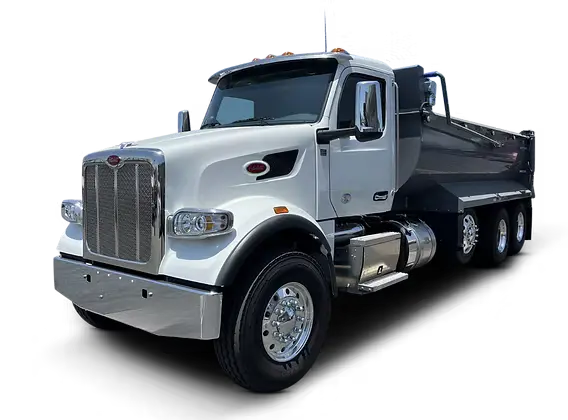
New York will permit a load of gravel — and prices it by wheelbase
Most states reserve overweight permits for loads that cannot be broken down. New York runs a separate program for loads that can. Its permit office states the category without ambiguity: a divisible load is cargo of legal dimensions that can be separated into units of legal weight without affecting the physical integrity of the load, and the department’s own permit FAQs give the first example as “aggregate (sand, top soil, gravel, stone),” followed by logs, scrap metal, fuel, milk and refuse.
The controlling statute is section 385 of the Vehicle and Traffic Law, which NYSDOT publishes itself: its Divisible Load Overweight Permits page links the text under the label “Title 3, Article 10, Section 385 — Dimensions and Weights of Vehicles.” One caveat travels with that convenience. The agency reprint carries no compilation date and no amendment history, so while the figures in it can be read directly, its currency cannot be confirmed from the document itself. Read against it, New York’s ordinary limits are a single-axle maximum of 22,400 pounds, 36,000 pounds on two consecutive axles spaced under eight feet, and a gross weight of 34,000 pounds plus 1,000 pounds per foot of wheelbase, capped at 80,000.
The permit weights come from a different formula. Perm 69 (SW), the department’s statewide permit-type and fee schedule dated 01/2020, states it as “(1,250 x Wheelbase) + 42,500,” with the overall wheelbase measured in inches and rounded to the nearest whole foot. A Type 1 permit — three or four axles, minimum 16-foot wheelbase, maximum trailer length 48 feet — carries a $360.00 fee and a maximum gross of 97,400 pounds. A Type 1A, requiring five or more axles, runs $750.00 for five or six axles and $900.00 for seven or more, to a maximum gross of 102,000 pounds. A Type 7 permit, at six or more axles and a minimum 36½-foot wheelbase, reaches 107,000 pounds.
Two limits matter more to a dump operator than the headline weights. Statewide permits are valid on roadways under NYSDOT jurisdiction and on the Thruway, but Perm 69 states they “are not valid for operation over local roads or on roads and bridges operated by the Metropolitan Bridge Authority (MTA), Bridge Authority and the New York City Department of Transportation” — a real constraint when the last mile is a town road. And every divisible load permit is an “R” restricted permit: permitted vehicles may not cross bridges signed “No Trucks with ‘R’ Permits” unless the bridge is officially rated as waivered. The 22,400-pound figure reappears here in a second-order role, as the steering-axle ceiling running across the Type 1, Type 1A and Type 7 permit types alike.