Motor carrier classes by state

Ohio dump trucking insurance for aggregate and construction haulers

Ohio will not issue an overweight permit that outlives the policy behind it. The rule is one sentence in the administrative code, and it converts a renewal date into a dispatch constraint: no permit may run past the expiration date of the insurance policy or endorsement filed as evidence of financial responsibility. Let a certificate lapse and the permit does not merely become non-compliant — it was never written that far.

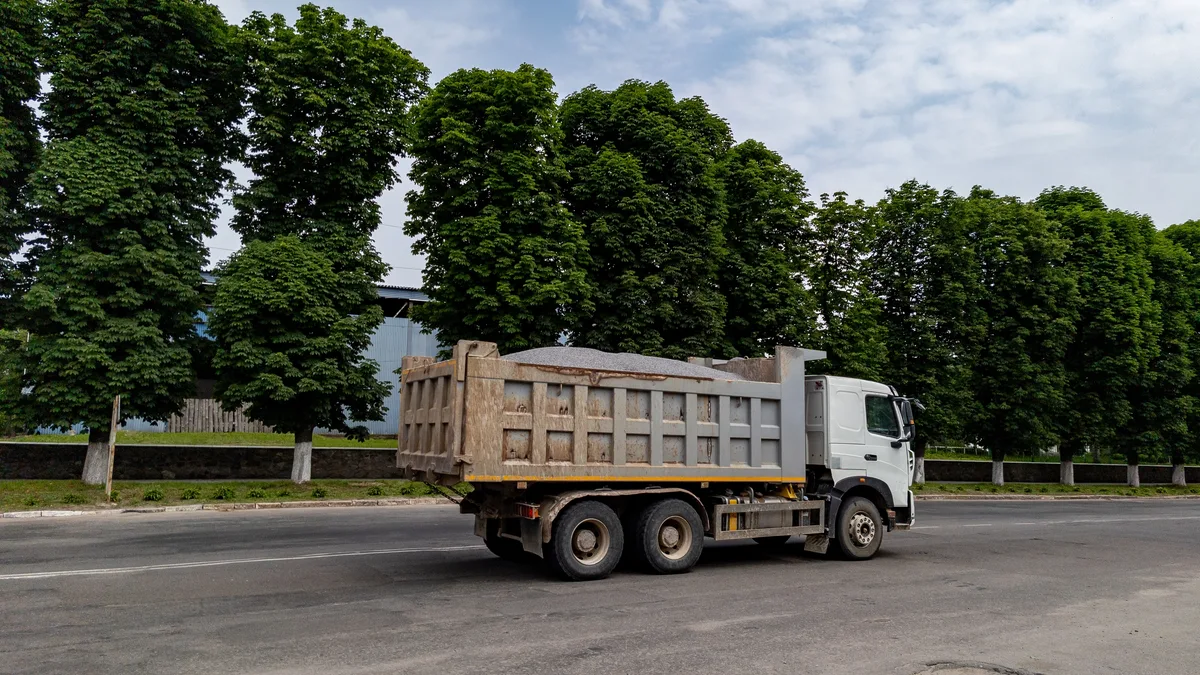
Loaded dump truck on a paved road — Ohio Dump Trucking Insurance from Truck Guard Insurance

Ohio keeps its heavy-haul law in two places, and reading only one of them makes the state look simpler than it is. The Revised Code creates the permit, names who may issue it, and hands the numbers to the Director of Transportation. The Administrative Code then supplies the numbers — the fee units, the durations, the financial-responsibility amount and the permit taxonomy — under an authority line that names the statute it implements.

The half that matters most to an insurance file is the administrative half. ODOT does not treat evidence of financial responsibility as a filing formality collected once and forgotten. It fixes an amount, allows the Director to raise it on a risk finding, requires a minimum notice period before the coverage behind it can be canceled, and then ties the life of the permit itself to the life of the policy.

Two Ohio instruments have no counterpart anywhere else on this grid. In the state’s north-west corner, Ohio adopts Michigan’s weight law by reference over prescribed routes to the Michigan border. And at the pit gate, a 2017 statute pushes heavy trucks leaving a permitted surface mining operation onto specific roads chosen not by the operator but by the county engineer and adopted by the county commissioners.

The rest is a weight schedule that quietly runs two regimes at once — one tracking the federal defaults on interstate pavement, another, materially different, on every other road surface in the state, including a dedicated rule for the three-axle group a dump truck actually rides on.

Pulling ODOT permits on an Ohio aggregate fleet? Send the policy expiration date and the endorsement or bond on file with the Special Hauling Permits Section — in Ohio those two facts set the outer edge of every permit you can be issued.

Start a Ohio quote

A permit cannot be written past the expiration date of the policy behind it

The governing sentence sits in Ohio Adm. Code 5501:2-1-03, paragraph (B), effective November 3, 2023: “In no case shall a permit be issued for a duration which extends beyond the expiration date of any insurance policy or endorsement provided as evidence of financial responsibility.” The rule sits directly beneath a seventeen-item table of maximum permit durations, and it overrides every one of them.

Read against that table, the effect is arithmetic rather than disciplinary. A construction equipment permit may run up to three hundred sixty-five calendar days. A Michigan legal weight permit may run up to ninety. A regional heavy hauling permit runs either up to five calendar days or up to ninety. A single trip permit runs up to five days; an emergency single trip, one day; an emergency single trip and return, three. Every one of those ceilings is cut short by whichever date the certificate on file expires first.

The amount behind the certificate is fixed in the fee rule rather than the application rule, which is why it is easy to miss. Ohio Adm. Code 5501:2-1-05(F) provides that the minimum liability insurance or surety bond each applicant must obtain as evidence of financial responsibility “shall be five hundred thousand dollars.” The same paragraph then hands the Director an upward valve: where the Director determines that the risk to the transportation system exceeds that minimum, the Director may increase the required level “to an amount determined to be sufficient to meet the increased level of risk.” The floor is published; the ceiling is a finding.

The application rule closes the loop on cancellation. Ohio Adm. Code 5501:2-1-02(F)(5) requires an insurance policy endorsement or surety bond in the amount specified by rule 5501:2-1-05 and on the form the department prescribes, with a standing-file provision — where a current unexpired endorsement or bond is already on file with the Special Hauling Permits Section, no separate submission accompanies each application. The requirement is waived for federal, state and local governments and political subdivisions. And any cancellation of the endorsement, of the policy the endorsement is attached to, or of the surety bond “must be effected with a minimum thirty day notice of cancellation.”

For an agent, that is an unusually clean set of hooks. The renewal date is a permit ceiling, the cancellation clause has a floor written into a state rule, and the limit is a state-published minimum that a regulator can raise on an individual applicant. An Ohio permit hauler’s auto liability program should be reviewed with the permit calendar in front of it, not beside it.

  • Ohio Adm. Code 5501:2-1-03(B) — no permit may be issued for a duration extending beyond the expiration date of the policy or endorsement filed as evidence of financial responsibility.
  • Ohio Adm. Code 5501:2-1-05(F) — a five hundred thousand dollar minimum in liability insurance or surety bond, which the Director may increase on a finding of elevated risk to the transportation system.
  • Ohio Adm. Code 5501:2-1-02(F)(5) — endorsement or bond on the department’s prescribed form, held on standing file, with a minimum thirty day notice of cancellation.
  • Waived entirely for federal, state and local governments and political subdivisions.

Three north-west counties where Ohio applies Michigan’s weight law

Ohio Adm. Code 5501:2-1-01(N) defines a permit class that exists nowhere else in this grid: “‘Michigan legal permit’ means a permit granting a special privilege which allows the movement of an overweight vehicle over prescribed routes between Williams, Fulton or Lucas counties in Ohio and the Michigan border. The permitted weight shall be based on the state of Michigan’s weight law, with a gross vehicle weight not to exceed one hundred fifty-four thousand pounds, and with sufficient number of axles to meet the Michigan weight law.”

The framing matters more than the figure. The one hundred fifty-four thousand pound number appears in Ohio’s own rule, but it functions as a cap on a borrowed standard rather than as a free-standing Ohio weight limit. The operative rule is Michigan’s, including its axle count expectations; Ohio’s contribution is the corridor, the route approval and the ceiling. An operator running to the line from Toledo or Bryan is being measured against a schedule adopted by another legislature.

The instrument is priced separately from ordinary overweight movement. Under the fee schedule at Ohio Adm. Code 5501:2-1-05, a continuing Michigan legal permit carries a surcharge of one hundred five dollars up to one hundred twenty thousand pounds gross vehicle weight and one hundred forty-five dollars above it; a continuing annual Michigan legal permit runs four hundred fifty dollars and six hundred ten dollars against the same split. Duration is up to ninety calendar days for the continuing form.

Aggregate, sand and stone move across that border constantly, and the corridor is narrow enough that an underwriter can ask a direct question: does any part of this fleet’s work sit in Williams, Fulton or Lucas county, and if so, is it running Michigan-legal configurations under an Ohio permit? A truck built to a one hundred fifty-four thousand pound standard is a different physical damage and maintenance risk from one built to eighty, and it is legal here on a route basis rather than a statewide one.

Ohio runs one other cross-border instrument, and it is not a weight one. Rule 5501:2-1-01(O) and rule 5501:2-1-06 create an International Sealed Container permit for a freight container sealed by a U.S. customs or packer’s seal, moving from an Ohio point of origin to an approved Ohio intermodal facility with a destination outside the United States. It is a container program, and a loaded dump body is not a container.

Above one hundred twenty thousand pounds the fee starts counting tons and miles

Ohio prices permits as a fixed processing charge plus stacked surcharge units. Ohio Adm. Code 5501:2-1-05(A) sets the base: “the basic processing charge of twenty dollars plus each unit of surcharge that is applicable to that movement.” Below one hundred twenty thousand pounds gross vehicle weight, a one-way overweight movement carries one hundred twenty-five dollars outbound and sixty-five dollars on the return, and the arithmetic ends there.

Above that line the surcharge changes character. For a one-way movement exceeding one hundred twenty thousand pounds gross vehicle weight, the outbound unit is one hundred twenty-five dollars “plus four cents per ton over sixty tons, per mile traveled,” with the same increment applied to the return at sixty-five dollars. The fee stops being a flat charge for a piece of paper and becomes a function of how heavy the load is and how far it goes — which is to say, a charge that scales with the damage the movement is expected to do.

Continuing permits are priced on the same split: four hundred ninety dollars outbound and two hundred fifty dollars return for overweight up to one hundred twenty thousand pounds. Continuing annual permits run one thousand nine hundred sixty dollars outbound and one thousand dollars return in the same tier. Revisions cost fifty dollars on the heavier tiers and ten dollars otherwise. Boat, construction equipment, farm equipment, manufactured building and marina permits are eighty dollars flat.

Two relief provisions in the same rule are worth knowing before a bid is priced. Under paragraph (D), all fees are waived for federal, state and local governments and political subdivisions, and where an overweight or over-dimension movement is in conjunction with a bona fide public construction project for such a body, “only the basic processing fee and the applicable revision fees will be charged.” A contractor hauling for a public owner is paying twenty dollars, not the surcharge ladder.

Paragraph (E) adds a cost that is not a fee at all. Where a movement requires special work by the department — special traffic control or special engineering analysis — the applicant reimburses the department’s total direct costs, depositing the Director’s estimate up front by cash, check or money order, with the excess returned if the actual cost comes in lower and a bill issued if it comes in higher. Paragraph (G)(2) allows an advance payment account funded to cover estimated fees for up to a six-month period, drawn down as permits issue.

One dollar figure is fixed on the face of the statute rather than in the rule. Ohio Rev. Code § 4513.34(C)(1), effective June 30, 2023 under House Bill 23 of the 135th General Assembly, delegates the schedule to rule but then provides that “the fee to operate a triple trailer unit, at locations authorized under federal law, shall be one hundred dollars.”

  • Twenty dollars basic processing charge on every application, plus applicable surcharge units.
  • $125 outbound / $65 return for a one-way overweight movement up to 120,000 lb gross vehicle weight.
  • Plus four cents per ton over sixty tons, per mile traveled, on both legs once the movement exceeds 120,000 lb gross vehicle weight.
  • $490 / $250 continuing and $1,960 / $1,000 continuing annual in the up-to-120,000 lb tier.
  • $80 for a construction equipment permit; $50 or $10 for revisions depending on tier.
  • Basic processing fee only where the movement is in conjunction with a bona fide public construction project for a government or political subdivision.

We write Ohio dump and aggregate fleets, including ODOT permit holders filing the $500,000 endorsement and operators running designated pit routes under § 5577.081.

Get a Ohio quote

One origin, five destinations, and it will take a divisible load

Ohio Rev. Code § 4513.34(A)(1) names a “special regional heavy hauling permit” and never defines the adjective. The definition is in the rule, at Ohio Adm. Code 5501:2-1-01(CC), and it is geometric rather than geographic in the interstate sense: the permit “allows an overweight and/or over dimension vehicle to make movements between an origin and up to five separate destinations within a proximal geographical vicinity over prescribed routes.”

Two sentences later the rule says something that matters a great deal to an aggregate hauler: “The permit may be issued to divisible or nondivisible loads.” Permit systems built around a non-divisibility test are the norm; a permit class that names divisible loads on its face is not. Duration is set at Ohio Adm. Code 5501:2-1-03(A)(17) as either up to five calendar days or up to ninety calendar days, and it may be issued as a single permit or a ninety-day continuing permit.

The shape of that permit maps onto a plant-and-jobs pattern rather than a long-haul one. One origin — a pit, a plant, a stockpile — and up to five destinations within a proximal vicinity over routes the department prescribes. That is a batch plant supply run or a paving season with several active sites, and it is the permit class an Ohio aggregate operation is most likely to be holding.

The construction equipment permit is a different animal and is often confused with it. Ohio Adm. Code 5501:2-1-01(C) defines it as allowing an unlimited number of movements of the same vehicle, including trailer, equipment or machinery, “to or from a construction work site for up to three hundred sixty-five calendar days” — but the vehicle’s width may not exceed twelve feet and its weight, length and height must stay inside the ordinary limits of Ohio Rev. Code §§ 5577.02 to 5577.05. It buys width, not payload, and it is defined by destination rather than by cargo. Its application is also excused from the route-disclosure requirement that binds other permits under rule 5501:2-1-02(F)(2).

Duration relief also runs through the statute. Ohio Rev. Code § 4513.34(B)(2) allows a permit for any period not exceeding one year “or for the duration of any public construction project,” which is the answer where a haul contract straddles a permit year — subject, always, to the insurance expiry cap that opens this page.

The road out of the pit is chosen by the county engineer

Ohio legislated a designated-route rule for aggregate haulage in 2017 and put it in the load-limits chapter rather than the permit chapter, which is why it is easy to miss. Ohio Rev. Code § 5577.081, effective September 29, 2017 under House Bill 49 of the 132nd General Assembly, requires that all vehicles entering or leaving a surface mining operation permitted under Chapter 1514 with a gross vehicle weight in excess of sixty-six thousand pounds “use the specific roads designated pursuant to sections 303.14 and 303.141 or 519.14 and 519.141 of the Revised Code as the primary means of ingress to and egress from the facilities or operation.”

Two movements are carved out on the face of the section: transferring unfinished aggregate material between facilities under the control of the same owner or operator subject to Chapter 1514, and unloading or loading finished aggregate product within a ten-mile radius of a permitted surface mining operation. Everything else above sixty-six thousand pounds is on the designated road.

The designation itself is a county process with real procedure attached. Under Ohio Rev. Code § 303.141, effective April 6, 2007, an applicant for a conditional zoning certificate must first write to the county engineer, who within fourteen days sets a meeting. At that meeting the applicant states the proposed location, the anticipated amount of aggregate material to be shipped by truck, and the anticipated primary market areas for the finished product. Within thirty days the engineer sends the county commissioners a written recommendation of specific roads, weighing four criteria: each road’s ability to handle the anticipated recurring loads, its present condition, the amount of residential development along it, and the most direct route to a state highway unless another route better accommodates the loads with fewer conflicts with existing housing.

The commissioners must adopt the recommendation or adopt it with modifications, and may modify only on those same four criteria and only by unanimous vote. The decision becomes final ten days later unless the applicant or an affected board of township trustees files written notice of appeal, in which case the commissioners hold a hearing within fourteen days at which witnesses testify under oath and are subject to cross-examination, with further appeal to the court of common pleas under Ohio Rev. Code § 2506.01. Township zoning reaches the same machinery through § 519.141.

The operator carries a signage duty — § 5577.081(B) requires a sign posted in a conspicuous location telling drivers which roads to use — and the driver carries the penalty. A first offense is a written warning entered on the person’s permanent record at the Bureau of Motor Vehicles; a second offense within one year of the first is a minor misdemeanor; a third or subsequent offense within that year is a misdemeanor of the fourth degree. Fine money is credited to the mining regulation and safety fund.

This is the provision that turns an Ohio routing conversation into an underwriting one. A designated ingress and egress route is a fixed, documented, county-adopted fact about a specific pit, and the exposure it creates — residential frontage, a defined mileage, a road chosen partly on how much housing lines it — is the same exposure that shows up later in a general liability claim file.

  • Over 66,000 lb GVW entering or leaving a Chapter 1514 surface mining operation — the designated roads are the primary means of ingress and egress.
  • Carved out: unfinished aggregate transfers between commonly controlled facilities, and loading or unloading finished product within a ten-mile radius of a permitted operation.
  • Designated by the county engineer’s recommendation, adopted or unanimously modified by the county commissioners, on four named criteria.
  • Appealable within ten days, heard within fourteen, on sworn testimony subject to cross-examination, then to common pleas under § 2506.01.
  • Penalty ladder: written warning on the BMV record, minor misdemeanor on a second offense within a year, fourth-degree misdemeanor on a third.

Off the interstate, Ohio wrote a three-axle group rule of its own

Ohio Rev. Code § 5577.04, effective June 29, 2001 under House Bill 73 of the 124th General Assembly, runs two weight regimes in one section. Division (B) applies to a road surface that is part of the interstate system and tracks the familiar defaults — twenty thousand pounds on any one axle, thirty-four thousand on any tandem, and the bridge formula in division (C), with two consecutive sets of tandem axles permitted thirty-four thousand pounds each where the first and last axles are thirty-six feet or more apart.

Division (D) applies to every road surface that is not part of the interstate system, which is where aggregate work lives, and it departs from that scheme. Two successive axles spaced four feet or less apart and weighed simultaneously take twenty-four thousand pounds. Spaced more than four feet apart, they take thirty-four thousand pounds plus one thousand pounds per foot or fraction over four feet, not to exceed forty thousand pounds.

Division (D)(3) is the part written for the truck this page is about. For three successive load-bearing axles designed to equalize the load between them, each spaced more than four feet from the next, with first-to-third spacing no more than nine feet, weighed simultaneously as a unit, the allowance is forty-eight thousand pounds — provided the total weight of vehicle and load does not exceed thirty-eight thousand pounds plus nine hundred pounds for each foot of spacing between the front axle and the rearmost axle.

There is an alternative at (D)(3)(b): forty-two thousand five hundred pounds on the group if it is part of a six-axle vehicle combination with at least twenty feet between front and rearmost axle, with total vehicle and load not exceeding fifty-four thousand pounds plus six hundred pounds per foot of that spacing. Both branches make the governing number a function of wheelbase, so two trucks with identical axle counts and different frames are not interchangeable on an Ohio scale.

One limit sits outside the axle tables entirely. Division (A) caps the maximum wheel load of any one wheel at six hundred fifty pounds per inch width of pneumatic tire, measured as prescribed by § 5577.03. That is a tire specification doing the work of a weight limit, and it moves when a fleet changes rubber. The whole of division (D) is prefaced “Except as provided in division (I) of this section,” and that qualifier travels with every figure above.

  • Any one axle, non-interstate — 20,000 lb.
  • Two successive axles, four feet or less apart, weighed simultaneously — 24,000 lb.
  • Two successive axles, more than four feet apart — 34,000 lb plus 1,000 lb per foot or fraction over four feet, capped at 40,000 lb.
  • Three successive equalizing axles, each more than four feet apart, first to third no more than nine feet — 48,000 lb, with vehicle and load not over 38,000 lb plus 900 lb per foot of front-to-rearmost spacing.
  • Alternative — 42,500 lb in a six-axle combination with at least twenty feet of that spacing, vehicle and load not over 54,000 lb plus 600 lb per foot.
  • Any one wheel — 650 lb per inch of pneumatic tire width.

Ohio strips the local toll and keeps the local repair bargain

Ohio Rev. Code § 4513.34(B)(1) preempts municipal permitting on the state system in express terms: “Notwithstanding sections 715.22 and 723.01 of the Revised Code,” a holder of a Director-issued permit may move the described vehicle on any highway that is part of the state highway system where the movement is partly within and partly without a municipal corporation’s limits, and “No local authority shall require any other permit or license or charge any license fee or other charge against the holder of a permit” for that movement. The preemption runs both directions — the Director may not require a second state permit of someone holding a local authority’s permit for movement on local highways.

What the same statute preserves is more interesting than what it strips. Division (D) provides that where a permit is to be issued, the Director or local authority “may limit or prescribe conditions of operation for the vehicle and may require the posting of a bond or other security conditioned upon the sufficiency of the permit fee to compensate for damage caused to the roadway or a street or highway structure.” The security is measured against whether the fee was enough, which is an unusual way to size a bond.

The next sentence is the local repair bargain. “In addition, a local authority, as a condition of issuance of an overweight permit, may require the applicant to develop and enter into a mutual agreement with the local authority to compensate for or to repair excess damage caused to the roadway by travel under the permit.” Ohio therefore takes away the duplicate local fee and hands the same local authority a road-repair agreement instead. On designated special economic development highways the Director has a parallel power to require periodic payments to the department.

Off the state system the county keeps genuine authority over what may run. Ohio Rev. Code § 5577.08, effective May 31, 1988, lets the board of county commissioners classify county and township roads and bridges — expressly excepting state highways and bridges on them — by reference to maximum permitted weights and speeds, considering the nature of the roadbed, its construction “and any other factors which are material.” The board then makes rules governing weight and speed by class. One sentence bounds the whole power: “The classifications made by the board under this section shall not apply to vehicles of a weight of five tons or less for vehicle and load.”

A loaded dump truck clears five tons before it leaves the yard, so the county classification reaches it and the exemption never does. For a fleet whose pits and job sites sit on township roads, the operative weight limit may be a county rule rather than § 5577.04, and a road-repair agreement may sit behind the permit that allows the movement at all.

A thaw reduction you can read at the county office before you load

Ohio publishes its seasonal reductions as percentages with a two-tier split, and it files them as public documents rather than leaving them to signs alone. Ohio Rev. Code § 5577.07, effective September 28, 1973 under House Bill 200 of the 110th General Assembly, applies when thaws or excessive moisture render improved highways insufficient to bear the traffic on them, or when such highways would be damaged or destroyed by heavy traffic during the period of thawing or excessive moisture.

On state highways the Director of Transportation prescribes the reduction, “which shall not be more than twenty-five per cent.” On improved highways and all other roads in the county other than state highways, the board of county commissioners prescribes “such reduction as the condition of the road or highway justifies, but in no case shall the reduction be more than fifty per cent.” The county tier is twice as severe as the state tier, and the same load that is legal on a state route in March may not be legal on the county road that reaches the pit.

The publication mechanism is what makes the regime plannable. The schedule of reduced maximum weights and speeds “shall be filed, for the information of the public, in the office of the board of each county in which the schedule is operative and in the office of the director.” At least one day before the reduction takes effect, the Director or board must place signs of substantial construction on the affected highways, at both ends and at the points of intersection by principal roads, conspicuously indicating the weight and speed limitations.

The reduction reaches weight and speed together, and both tiers are set as ceilings on a discretionary act rather than as fixed figures — the Director and the board each prescribe what conditions justify, up to twenty-five and fifty per cent respectively. The governing number for a county in a given spring is therefore a filed document obtainable from that county’s board office, not something inferred from a sign encountered at speed.

Where a driver’s citation lands on the company’s desk by operation of law

Ohio Rev. Code § 5577.14 creates a notification duty most states leave to a fleet’s own reporting. When the driver of any truck, trailer, semitrailer, commercial tractor or other commercial vehicle used to transport goods or property “the gross weight of which, with load, exceeds three tons” is arrested for a violation of §§ 4511.01 to 4511.76, 4513.01 to 4513.40 or 5577.01 to 5577.09, the arresting officer must immediately notify in writing the person, firm, association or corporation holding the certificate of public convenience and necessity or permit under which the vehicle is operated and in whose name it is registered with the Bureau of Motor Vehicles.

The notice must describe the vehicle, name the driver and state the time, place and nature of the offense, and copies go immediately to the Public Utilities Commission and to the superintendent of the state highway patrol. A three-ton threshold captures every loaded dump configuration on the road, so the citation reaches the certificate holder and two state bodies without anyone at the company reporting it.

Sitting behind that is a debarment power with ten enumerated grounds. Ohio Rev. Code § 4513.34(F) lets the Director debar a permit applicant for, among other things, repeatedly submitting false information or false travel plans, using another company or individual’s name, insurance, or escrow account without proper authorization, failing to comply with or substantially perform under a previously issued permit, accumulating repeated justified complaints, and failing to pay fees. Debarment reaches partners, officers and directors, and proceeds under Chapter 119 notice and hearing per division (G).

The cover rule is the one place Ohio is narrower than an operator might assume, and the distinction is worth stating precisely. Ohio Rev. Code § 4513.31(A) is a general anti-escape duty phrased disjunctively — no vehicle may be driven or moved unless it is “so constructed, loaded, or covered as to prevent any of its load from dropping, sifting, leaking, or otherwise escaping therefrom.” Constructed, loaded, or covered: a tarp is one of three routes to compliance, not a standing requirement.

Division (B) is the actual cover mandate, and its commodity list is closed around waste — garbage, swill, cans, bottles, waste paper, ashes, refuse, trash, rubbish, wire, paper, cartons, boxes, glass, solid waste, “or any other material of an unsanitary nature that is susceptible to blowing or bouncing from a moving vehicle.” Clean construction aggregate is not in that list and is reached only by the division (A) general duty, which a correctly loaded body can satisfy. That is a real distinction and it should not be blurred in either direction — the general duty still applies, and material coming off a body is still a violation and still an exposure that lands on a dump truck program rather than on the driver alone.

Coverage lines a Ohio dump and aggregate account usually carries

The state minimum is a licensing threshold. The program an operator actually needs is built from these lines:

  • Trucking Auto Liability — Primary liability coverage for bodily injury and property damage caused by your truck while under dispatch.
  • Physical Damage — Collision and comprehensive coverage for the tractor, trailer, and attached equipment you own or finance.
  • Motor Truck Cargo — Coverage for the freight you haul against loss or damage in transit.
  • Trailer Interchange — Coverage for non-owned trailers you pull under written interchange agreements.
  • General Liability — Coverage for premises and operations liability away from the truck — terminal yards, customer docks, and non-driving exposures.
  • Workers Compensation — Statutory coverage for driver and yard-employee injury, structured for trucking payrolls and interstate operations.
  • Non-Trucking (Bobtail) Auto Liability — Liability coverage for the tractor when operated off-dispatch — bobtailing home or running personal errands.
  • Pollution Liability — Coverage for cargo-related pollution events and upset/overturn spills not covered by standard auto liability.

Why Truck Guard Insurance for a Ohio dump and aggregate account

We write dump and aggregate hauling as a named class rather than as an exception to general trucking, and we read each account against the weight and permit regime of the state it operates in. For a Ohio operator that means starting from what the trucks are actually licensed and configured to carry, sizing physical damage to bodies and hoists rather than to a chassis value, and treating pit, stockpile and job-site work as its own exposure rather than an extension of the highway auto form.

If the operation also runs freight under separate authority, the Ohio trucking insurance page covers the state’s broader motor carrier picture, and the dump trucking insurance page covers the class mechanics that apply wherever the operator runs.

Ohio dump trucking insurance questions

Can an Ohio overweight permit run longer than my insurance policy?

No. Ohio Adm. Code 5501:2-1-03(B) provides that “In no case shall a permit be issued for a duration which extends beyond the expiration date of any insurance policy or endorsement provided as evidence of financial responsibility.” A construction equipment permit may be written for up to three hundred sixty-five days and a Michigan legal weight permit for up to ninety, but each is cut short by whichever certificate expires first. Cancellation of the endorsement, the underlying policy or the surety bond requires a minimum thirty day notice under rule 5501:2-1-02(F)(5).

How much insurance does ODOT require for an oversize or overweight permit?

Five hundred thousand dollars. Ohio Adm. Code 5501:2-1-05(F) fixes the minimum liability insurance or surety bond each applicant must obtain as evidence of financial responsibility at that figure, on the form the department prescribes. It is a floor rather than a fixed amount: where the Director determines the risk to the transportation system exceeds the minimum, the Director may increase the required level to an amount sufficient to meet the increased level of risk. The requirement is waived for governments and political subdivisions.

What is Ohio’s Michigan legal permit?

A corridor permit that adopts another state’s weight law. Ohio Adm. Code 5501:2-1-01(N) allows movement of an overweight vehicle over prescribed routes between Williams, Fulton or Lucas counties and the Michigan border, with the permitted weight “based on the state of Michigan’s weight law,” a gross vehicle weight not to exceed one hundred fifty-four thousand pounds, and sufficient axles to meet that law. Continuing surcharges run one hundred five dollars up to 120,000 lb GVW and one hundred forty-five dollars above it, or four hundred fifty and six hundred ten dollars annually.

What does an Ohio overweight permit cost above 120,000 pounds?

The surcharge becomes distance and tonnage based. Under Ohio Adm. Code 5501:2-1-05(A), every application carries a twenty dollar basic processing charge plus surcharge units. For a one-way movement exceeding one hundred twenty thousand pounds gross vehicle weight the outbound unit is one hundred twenty-five dollars “plus four cents per ton over sixty tons, per mile traveled,” with the same increment on the sixty-five dollar return leg. Below that threshold the outbound and return units are flat at one hundred twenty-five and sixty-five dollars.

Which roads must a loaded truck use leaving an Ohio quarry or sand pit?

The ones the county designated. Ohio Rev. Code § 5577.081 requires vehicles over sixty-six thousand pounds gross vehicle weight entering or leaving a Chapter 1514 surface mining operation to use the specific roads designated under §§ 303.14 and 303.141 or 519.14 and 519.141 as the primary means of ingress and egress. Transfers of unfinished aggregate between commonly controlled facilities, and loading or unloading finished product within a ten-mile radius, are excepted. A second offense within a year is a minor misdemeanor and a third is a fourth-degree misdemeanor.

What can a tri-axle dump truck weigh on an Ohio county road?

It depends on the wheelbase, not only the axles. Ohio Rev. Code § 5577.04(D)(3) allows forty-eight thousand pounds on three successive equalizing axles spaced more than four feet apart with first-to-third spacing no more than nine feet, but only where total vehicle and load stays within thirty-eight thousand pounds plus nine hundred pounds per foot between the front and rearmost axle. An alternative at (D)(3)(b) gives forty-two thousand five hundred pounds in a six-axle combination with at least twenty feet of that spacing.

Can an Ohio city charge a second permit fee on a state route?

No. Ohio Rev. Code § 4513.34(B)(1) provides, notwithstanding §§ 715.22 and 723.01, that no local authority may require any other permit or license or charge any license fee or other charge against the holder of a Director-issued permit for movement on the state highway system, and the Director may not require a second permit of a local authority’s permit holder. Division (D) nonetheless lets a local authority require a mutual road-repair agreement as a condition of its own overweight permit.

How far can Ohio cut weights during a spring thaw?

Twenty-five per cent on state highways and up to fifty per cent on county roads. Ohio Rev. Code § 5577.07 has the Director of Transportation prescribe the state-highway reduction, capped at twenty-five per cent, and the board of county commissioners prescribe the county reduction as road conditions justify, capped at fifty per cent. The schedule of reduced weights and speeds is filed for public information in each affected county board office and in the Director’s office, with signs placed at least one day before the reduction takes effect.

Does Ohio require a tarp on a load of gravel?

Not as a standalone mandate. Ohio Rev. Code § 4513.31(A) requires that a vehicle be “so constructed, loaded, or covered” as to prevent its load from dropping, sifting, leaking or otherwise escaping — three alternative routes to compliance. The dedicated cover mandate in division (B) is closed around a waste commodity list and material of an unsanitary nature, which does not reach clean construction aggregate. The general duty still applies in full, and escaping material is still a violation.

Sources

Every figure on this page was read at the source below on August 11, 2026, with the effective date of the version read. Treat each as current as of that date rather than as permanent.

Get a Ohio dump trucking insurance quote

Send the declared or registered weights alongside the axle configurations, and tell us where the material moves from. We will size the program against the work the trucks actually do rather than against a statutory floor.

Start a quote Call 317-942-0549