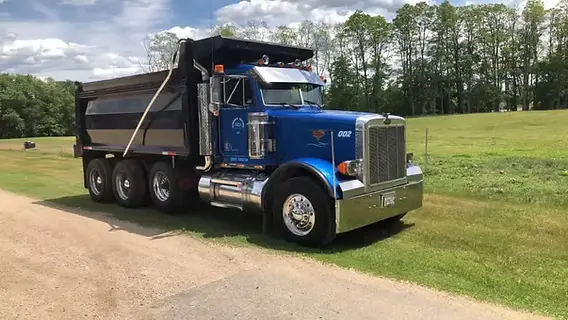
The legal limits are the federal ones — the permitted ladder is where Tennessee differs
It is worth saying plainly rather than dressing up: Tennessee’s ordinary limits are the familiar federal figures. TDOT’s own permit office states them as gross weight 80,000 pounds, single axle 20,000 pounds and tandem axle 34,000 pounds, with legal width of 8 feet 6 inches and legal height of 13 feet 6 inches.
What differs is the ladder available by permit, and it is keyed to something most states do not key it to. Rule 1680-07-01-.09 states the general position first: the maximum allowable axle weights by special permit are 20,000 pounds on a single axle and 40,000 pounds on a tandem, and in no case shall a single axle in a tandem group exceed 20,000 pounds.
The higher figures then arrive with a width condition attached. Under paragraph (2), a special permit may be issued for axle weights exceeding those maximums provided the maximum width of the vehicle — including the truck and semi-trailer or trailer combination — does not exceed ten feet, with the load permitted to exceed ten feet if properly permitted. Inside that condition, no single axle may carry more than 23,000 pounds, no tandem axle group more than 46,000 pounds, and no tridem group more than 60,000 pounds.
That is a narrow-combination rule rather than a narrow-trailer rule, and the distinction matters when a fleet specifies equipment. The measurement runs across the tractor as well as the trailer, so a wide-track power unit can put a combination over ten feet even where the trailer alone would have cleared it, and the axle allowance drops back to 20,000 and 40,000 accordingly.
One transcription caution belongs with the citation. Rule 1680-07-01-.09(2) is printed in the official document with its subparagraphs running (a), (b), (c), then (e) — there is no (d). Quote the substance rather than the letters.
Above the ladder, paragraph (3) provides that movements with a gross weight exceeding 165,000 pounds may only be permitted where the movement is not detrimental or unsafe to the traveling public and the highway can accommodate it, and must be approved by the TDOT Structures Division before a permit issues. Some movements under 165,000 pounds are also subject to that prior approval based on axle spacing, which is a scheduling fact rather than a weight fact and belongs in a haul plan.
- 80,000 lb gross / 20,000 lb single / 34,000 lb tandem — the legal limits before any permit.
- 20,000 lb single and 40,000 lb tandem — the general permitted maximums under Rule 1680-07-01-.09(1).
- 23,000 / 46,000 / 60,000 lb — single, tandem and tridem, available where the combination width does not exceed ten feet.
- Over 165,000 lb — TDOT Structures Division approval required before issuance, and sometimes below that figure on axle spacing.