A city cannot post a state highway route without WSDOT saying so in writing
RCW 46.44.080, captioned “Local regulations—State highway regulations” and last amended by 2006 c 334 s 16, grants and then limits local authority in a single chain of provisos. Local authorities may prohibit motor trucks or impose weight limits on highways under their jurisdiction “whenever any such public highway by reason of rain, snow, climatic or other conditions, will be seriously damaged or destroyed.” Where a highway has been closed generally, they must still authorize, by general rule or special permit, school buses, emergency vehicles and “motor trucks transporting perishable commodities or commodities necessary for the health and welfare of local residents.”
Then comes the limit that decides routing disputes inside city limits: “PROVIDED FURTHER, That the governing authorities of incorporated cities and towns shall not prohibit the use of any city street designated a part of the route of any primary state highway through any such incorporated city or town by vehicles or any class of vehicles or impose any restrictions or reductions in permissible weights unless such restriction, limitation, or prohibition, or reduction in permissible weights be first approved in writing by the department of transportation.” A city street that carries a primary state highway route is not the city’s to downweight alone.
Every local restriction also has a second condition precedent. The authority must act by ordinance or resolution and must erect and maintain signs at both ends of the affected stretch, and the statute makes the ordinance ineffective until that has been done. An unposted restriction is not yet in force, which makes the sign rather than the minute book the operative document for a driver.
The department holds the same power over state highways and must give public notice of a closure or restriction. When it exercises that power for a freeze-thaw event, the restriction takes a published shape rather than a percentage. WAC 468-38-080, captioned “Emergency load restrictions for heavy vehicles,” sets out two sign-posted tables — “emergency load restrictions” and “severe emergency load restrictions” — each giving a permitted gross load for each tire size in two columns, conventional tires and tubeless or special with a .5 marking. Under the ordinary table, an 11.00 conventional tire carries 4,500 lbs. and a 10-22.5 carries 3,400 lbs.; under the severe table the same 11.00 and over column falls to 3,000 lbs. and a 10-22.5 to 2,250 lbs. Only vehicles equipped with tires in the table may operate under permit while either sign is posted.
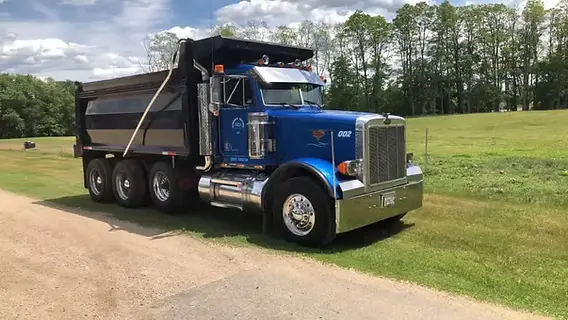
Three answers in the same rule bear directly on dump configurations: there is no allowance for a rigid trail axle, no allowance for more than two tires on the steering axle, and a front-axle carve-out permitting a maximum ten thousand pound front-axle load for a truck or truck-tractor on conventional 10:00 x 20 or 11:00 x 22.5 tires or larger. A temporary additional tonnage permit does not override any of it. The department attaches its own operational note to the rule, and it is worth carrying as written: “The department recommends that carriers check the department’s website www.wsdot.wa.gov/freight/mcs for possible advance warning on road restrictions.”
What a violation costs is set separately. RCW 46.44.105 assesses a basic penalty of not less than fifty, seventy-five and one hundred dollars on a first, second and third finding, then adds a per-pound schedule on top: three cents per pound for the first four thousand pounds over; $120 plus twelve cents per additional pound from 4,001 through 10,000; $840 plus sixteen cents from 10,001 through 15,000; $1,640 plus twenty cents from 15,001 through 20,000; and $2,640 plus thirty cents per additional pound at 20,001 and more. Violating a posted limitation carries its own penalty of not less than one hundred fifty dollars, and on a second violation within twelve months involving the same power unit the court suspends the certificate of license registration for not less than thirty days. The court may suspend the penalty for five hundred pounds of excess weight per axle on a first violation in a calendar year, capped at a two thousand pound suspension, and the statute states plainly that outside that first violation the basic and additional penalties may not be suspended.