Motor carrier classes by state

Wisconsin dump trucking insurance for aggregate and construction haulers

Wisconsin runs three separate winter weight programs, and an aggregate hauler sits differently in every one of them. One hands out extra gross weight the gravel operator is not eligible to use. One suspends permits without touching a legal load. The third cuts a legal truck to 24 tons on about 170 miles of highway.

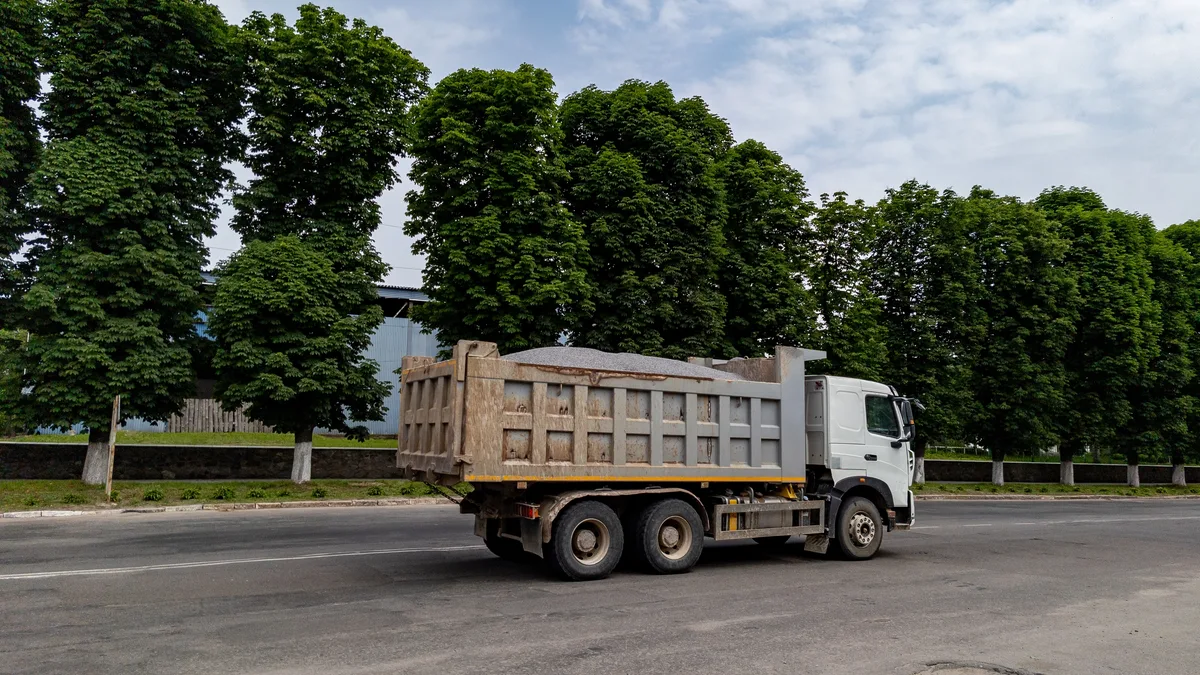
Loaded dump truck on a paved road — Wisconsin Dump Trucking Insurance from Truck Guard Insurance

The parts of dump and aggregate hauling that make the class difficult to place are largely the same in every state — the short-radius accident profile, the off-road and job-site exposure that sits outside a standard auto form, the body and hoist damage that physical damage schedules routinely under-report. That material belongs to the class rather than to Wisconsin, and it is set out on the dump trucking insurance page rather than repeated here.

What Wisconsin adds is a winter calendar with three named programs on it, administered by the same department, running on overlapping dates, and answering three different questions. Operators routinely collapse them into one thing called “frost laws.” They are not one thing, and the difference decides whether a truck runs, whether a permit is worth renewing, and whether a seasonal revenue gap is a road-closure problem or a permit problem.

The program that gets the most attention is the frozen road declaration, and it is the one that runs in the opposite direction from what the phrase “frost law” suggests. It does not lower weights. It raises them. But it raises them for a short list of commodities that does not include sand, gravel, rock or fill — so the same declaration that puts a contractor’s winter salt truck 18,000 pounds ahead leaves his aggregate trucks exactly where they were.

Everything below is cited to the statute, rule, declaration or department publication that sets it, with the date that version carries. The Wisconsin figures move on several different clocks — the statute is amended by the legislature, the posted-road list is reissued each spring, the zone declarations are issued mid-season — so a number carried without a date is a number that has already started going stale.

Running salt in winter and aggregate the rest of the year? Tell us the commodity split before the truck list — in Wisconsin the commodity decides which winter program the unit lives under.

Start a Wisconsin quote

Why one contractor gets a winter raise and his neighbor does not

Wis. Stat. § 348.175, last amended by 2015 Wis. Act 360, is titled for exactly what it covers: seasonal operation of vehicles hauling peeled or unpeeled forest products cut crosswise, or abrasives, or salt for highway winter maintenance. Those three categories are the entire eligible list. The statute permits that traffic to move “in excess of gross weight limitations under s. 348.15” during the winter months when the highways are frozen hard enough that no damage results.

Aggregate is not on the list, and the omission is not an oversight the department can waive. A Wisconsin court of appeals decision has already policed the boundary on the forest-products side, holding in State v. T.P. Trucking, 2006 WI App 98, that “peeled or unpeeled forest products cut crosswise” does not reach wood chips — the phrase means logs, posts, poles and similar timber cut to length. A statute read that tightly against a wood hauler is not going to stretch to cover crushed stone.

The commercial consequence lands hardest on the mixed contractor, and Wisconsin has a great many of them. An operator who plows and salts municipal contracts in winter and hauls aggregate the rest of the year owns one fleet that lives under two regimes on the same calendar. The salt work runs at declaration weights. The aggregate work runs at ordinary legal weights on the same trucks, the same roads and the same days. Anyone building a seasonal revenue model for a Wisconsin dump operation needs that split drawn before the first quote, because the two halves do not scale together.

It also changes what the equipment is doing. A unit running at declaration weight is loaded heavier than the same unit running aggregate, which shows up in frame, suspension and hoist wear long before it shows up anywhere else. That is a physical damage conversation as much as a liability one, and a schedule written off summer duty cycles will not reflect what a winter salt contract actually does to the chassis.

What the declaration authorizes, and how the department triggers it

The department publishes the current declaration as a dated document rather than a standing rule, and the 2025-26 declaration is specific about both the weights and the boundaries. Under it the maximum gross vehicle weight is 98,000 pounds including all axles, each individual axle is limited to 23,000 pounds, and an axle must carry at least 8 percent of the vehicle’s gross weight to be counted as an axle at all. Eligible vehicles must be legally registered — currently registered for 80,000 pounds, or for the maximum gross allowed by axle count and spacing under Wis. Stat. § 348.15 (3) (c) or (br) if that is less. Against an 80,000-pound legal ceiling, 98,000 pounds is 18,000 pounds of additional gross, available without buying a permit — the size of the benefit an eligible hauler collects and an aggregate hauler watches go past.

The boundaries matter more than the tonnage. The declaration authorizes all state and US numbered highways within the declared zones, but expressly does not authorize travel on any state highway carrying a posted weight restriction. It does not reach the Interstate system at all except the I 39 and I 41 corridors, a carve-out written into § 348.175 itself. And it authorizes no local roads whatever: the declaration text directs operators to check with local highway maintaining authorities, and states that where local authorities have not issued their own declaration, normal weight limits apply.

The 18-inch frost figure that circulates in Wisconsin trucking conversation is real, but it is worth knowing where it comes from, because it is not in the statute. Section 348.175 says only that the highways must be “so frozen that no damage may result.” The 18 inches, the zones and the instrumentation all come from a department guidance document — the WisDOT Frozen Road Declaration Guidelines, noticed for public comment in the Wisconsin Administrative Register as DTSD95 — rather than from the legislature.

That guidance sets the operational test: state highways are determined to be frozen when frost has reached a depth of at least 18 inches below the pavement surface. The department reaches that determination with a frost model adapted from Minnesota, then confirms it against 91 frost tubes installed in asphaltic pavements and read manually for frost and thaw depth, and against the Roadway Weather Information System — 65 roadside weather stations whose sensors record sub-surface temperature at 18 inches below the pavement. Regional highway operations staff add daily visual inspection, and National Weather Service long-range outlooks feed the forward estimate.

The state is divided into five zones, described in the guidance as distinct climatological regions correlating with historical declaration boundaries, running from the Lake Superior and Michigan border in Zone 1 down to the Illinois border in Zone 5. A declaration issues for a zone once all highways in it meet the test. The guidance puts the average start of the frozen road period, in one or more zones, at December 22 and the average end at March 4. Timing is then fixed by statute: § 348.175 requires each declaration to “be effective as of 12:01 a.m. on the 2nd day following the declaration,” a very short notice window rather than a schedule to plan against.

The 2025-26 season shows how wide the spread runs. The department declared Zones 1 and 2 effective Sunday, December 14, 2025, Zone 3 effective Thursday, December 18, 2025, and Zones 4 and 5 effective Friday, February 6, 2026 — nearly eight weeks between the north and the south of a single state. The department can also pull the benefit back mid-winter: the guidance provides for a mid-season thaw during which it may temporarily impose spring weight restrictions, with at least the same notification period required at the start of the declaration.

  • Maximum gross 98,000 pounds, including all axles, per the Wisconsin Frozen Road Declaration issued for the 2025-26 season.
  • 23,000 pounds maximum on any individual axle, with an 8 percent minimum share of gross required for an axle to count.
  • Eligible commodities only — abrasives or salt for highway winter maintenance including salt brine and liquid calcium chloride, and peeled or unpeeled forest products cut crosswise, not including wood chips.
  • No posted state highways, no local roads, no Interstate except the I 39 and I 41 corridors as defined in Wis. Stat. § 348.01 (2) (bc) and (bd).

Class II is a permit program, and a legal gravel truck is not in it

The second program is the one most likely to be misread on an aggregate account, because its name suggests road closures and its effect is nothing of the kind. Class II restrictions are imposed under Wis. Stat. §§ 348.26 and 348.27 on state highways judged to have unstable subgrade while frost leaves the ground, and what they restrict is travel by vehicles operating under overweight permits.

The department states the mechanism plainly: during the thaw period most divisible load multiple trip permits exceeding legal axle weights or 80,000 pounds are suspended, and overweight non-divisible multiple trip and single trip permits must stay off highway sections designated as Class II. A truck operating at legal weight is not addressed by any of that. The operator who is parked in a Wisconsin spring is the operator whose business model depended on a permit, not the one hauling gravel at 80,000 pounds.

The scale is larger than most operators assume. The department lists approximately 1,400 miles across 94 segments of bituminous highway on the Class II list during the freezing and thawing period, currently accounting for about 12 percent of state highways — the 2026 list was updated March 9, 2026. The guidance document puts the average date for imposing spring weight restrictions at March 9 and the average date for ending them at May 9, and the 2026 season ran long: restrictions ended in Zones 1 and 2 on Thursday, April 30, 2026, having already ended in Zones 3 through 5.

Two divisible permit classes survive the suspension, and both are commodity-specific in the same way the frozen road declaration is. The seed potato (PS) permit is not suspended during a declared spring thaw unless the suspension specifically names it. The raw forest products (RS) permit — authorizing 98,000 pounds gross in combinations of six or more axles under Wis. Stat. § 348.27 (9m) (a) 4. — remains valid during spring thaw, and remarkably, RS combinations are authorized to exceed posted special weight limitations on state trunk and connecting state highways, though they must still obey posted limits on local highways. Wisconsin therefore does have a permit that beats a state posting. It is available for logs, and it is not available for stone. The same asymmetry shows up on the log hauling side of the ledger, where the seasonal calendar reads very differently.

For an operator who does hold an annual permit, the practical planning point is that the suspension is partial rather than total. Only the weight provision of a divisible load multiple trip permit is suspended during spring thaw; over-length loads authorized by the same permit may continue to move. If any part of the fleet runs on oversized and overweight permits, that distinction is worth confirming permit by permit before the season rather than at a scale house.

We place Wisconsin aggregate and dump accounts including tandem and tri-axle fleets, mixed salt and gravel operations, and contractors running their own pits.

Get a Wisconsin quote

The 170 miles where a legal load is also too heavy

The third program is the smallest and the only one that stops a legal-weight gravel truck. Some highway sections are, in the department’s words, too weak to withstand even the legal load limit of 80,000 pounds during the seasonal freezing and thawing period, and those sections are signed. WisDOT puts the total at approximately 170 miles across 13 segments, which it notes accounts for less than 2 percent of all state highways.

The posted level is uniform across the list. Every segment on the 2026 Wisconsin Springtime Posted Roads list, updated March 5, 2026, carries the same limits: 6 tons for a single axle, 10 tons for tandem axles, and a maximum gross weight of 24 tons. Set against the ordinary class “A” figures of 20,000 pounds on a single axle and 80,000 pounds gross, a 12,000-pound single axle and a 48,000-pound gross are a 40 percent reduction on both — which lands the posting on the same 60 percent ratio the legislature applied to class “B” highways in Wis. Stat. § 348.16 (2).

For a tandem dump that is not a reduction, it is a stand-down. A tri-axle running legal gross cannot be lightened to 24 tons and still be worth dispatching, so the practical answer on a posted segment is a detour or a suspended haul. The list is short enough to be read in full and specific enough to be actionable: the 2026 list names sixteen county-level rows across ten numbered state highways — 52, 54, 55, 65, 107, 122, 131, 153, 169 and 173 — in Forest, Langlade, Marathon, Shawano, Wood, Polk, Saint Croix, Lincoln, Iron, Ashland and Crawford counties, each with a named beginning and ending point and a named regional contact. Every segment on the 2026 list took effect Monday, March 9, 2026, at 12:01 a.m. CDT.

Wisconsin does provide relief, but it is discretionary and it is not aimed at aggregate. Under Wis. Stat. § 349.16 (3), regional highway operations offices may exempt vehicles carrying certain commodities or performing certain services from posted road restrictions where the exemption is reasonable and necessary to promote public health, safety or welfare — the department names school buses, heating fuel and milk as its examples. A separate provision covers septic and holding tank pumping on 24-hour health grounds, with the operator required to notify the regional office within 72 hours of running the posted road.

Local roads are a separate universe again, and for a dump operator they are usually the ones that matter. County and township maintaining authorities decide when their own roads are posted, and WisDOT refers all questions about them to those authorities. A pit-to-site haul that never touches a state highway can be shut by a town board on a schedule no state page publishes.

What Wisconsin allows the rest of the year

Outside the winter programs the architecture is conventional and worth stating precisely, because every seasonal figure above is a percentage of it. Under Wis. Stat. § 348.15 (3), amended most recently by 2023 Wis. Act 158, no wheel or set of multiple wheels supporting one end of an axle may impose more than 11,000 pounds, no single axle may exceed 20,000 pounds, and the steering axle of a truck tractor is capped at 13,000 pounds unless the manufacturer’s rated capacity of the axle and tires supports more, to a limit of 20,000 pounds. Paragraph (3) (d) allows two consecutive sets of tandem axles to impose 34,000 pounds each provided the overall distance between the first and last axles of those sets is 36 feet or more, and 80,000 pounds is the gross ceiling the department itself describes as the legal load limit.

Class “B” highways are the year-round reduction most likely to catch an aggregate hauler off guard. Section 348.16 (2) caps operation on a class “B” highway at 60 percent of the § 348.15 (3) weights without a permit, and class “B” designation is made by local authorities under Wis. Stat. § 349.15 — meaning a county trunk, town highway or village street can carry a 60 percent limit in July with no frost anywhere in the state. Pickup and delivery to a place of business or residence with an entrance on the class “B” road is excepted, which is a narrower door than it sounds.

One clean negative is worth recording because it forecloses a question that comes up on multi-state fleets. In 23 CFR part 658, Appendix C (4-1-24 edition), the table of longer combination vehicles grandfathered under Pub. L. 102-240 lists Wisconsin as NO in all three categories — truck tractor with two trailing units, truck tractor with three trailing units, and “other.” Wisconsin froze in no longer combination vehicle authority on the National Network, so an operator moving equipment or crews across the upper Midwest cannot carry a neighboring state’s combination practice into Wisconsin and expect it to be recognized.

Wisconsin is also unusually generous about commodity-specific axle relief off the Interstate, which is worth knowing precisely so that it is not mistaken for something an aggregate hauler can use. Section 348.15 (3) has separate paragraphs lifting single-axle limits for milk (21,000 pounds), for peeled or unpeeled forest products cut crosswise and for scrap metal (21,500 pounds), and for septage (21,500 pounds) — each capped at 80,000 pounds gross and each expressly inapplicable to the Interstate system outside the I 39 and I 41 corridors. There is no equivalent paragraph for sand, gravel, stone or fill.

What this changes on a Wisconsin aggregate account

None of the three programs alters an insurance requirement directly. What they alter is the operating pattern the insurance is priced against, and on a Wisconsin dump account that pattern has a shape most underwriting questionnaires do not ask about:

The account that can answer those cleanly is usually the account that has already separated its salt revenue from its aggregate revenue and knows which trucks cross between them. The account that cannot is often carrying a winter exposure profile nobody has priced, or paying to renew a permit that is suspended for two months of the year it is meant to cover.

  • Commodity mix by season. Which units run abrasives or salt under a frozen road declaration, which run aggregate, and which do both — because the declaration eligibility follows the load, not the truck.
  • Loaded weight in winter versus summer. A unit eligible for 98,000 pounds in January and running 80,000 in July has two duty cycles, and the heavier one drives frame, suspension and hoist wear that a summer-based schedule will understate.
  • Permit inventory and its seasonal value. Which divisible load multiple trip permits the operator holds, and whether the weight provision being suspended through spring thaw leaves the permit worth its annual cost.
  • Posted-road exposure on the actual haul routes. Not just the sixteen state rows on the 2026 posted list, but the county and town roads between the pit and the job — which are posted by local authorities on schedules the state does not publish.
  • Zone footprint. Which of the five zones the operator works in, since the 2025-26 declarations ran nearly eight weeks apart between the northern and southern zones and a fleet spanning two zones spans two calendars.
  • Off-road and job-site work. Pit access, stockpile work and site delivery sit at the edge of a standard auto form, and the auto liability and general liability line is where a large share of aggregate claims actually falls.

Coverage lines a Wisconsin dump and aggregate account usually carries

The state minimum is a licensing threshold. The program an operator actually needs is built from these lines:

  • Trucking Auto Liability — Primary liability coverage for bodily injury and property damage caused by your truck while under dispatch.
  • Physical Damage — Collision and comprehensive coverage for the tractor, trailer, and attached equipment you own or finance.
  • Motor Truck Cargo — Coverage for the freight you haul against loss or damage in transit.
  • Trailer Interchange — Coverage for non-owned trailers you pull under written interchange agreements.
  • General Liability — Coverage for premises and operations liability away from the truck — terminal yards, customer docks, and non-driving exposures.
  • Workers Compensation — Statutory coverage for driver and yard-employee injury, structured for trucking payrolls and interstate operations.
  • Non-Trucking (Bobtail) Auto Liability — Liability coverage for the tractor when operated off-dispatch — bobtailing home or running personal errands.
  • Pollution Liability — Coverage for cargo-related pollution events and upset/overturn spills not covered by standard auto liability.

Why Truck Guard Insurance for a Wisconsin dump and aggregate account

We write dump and aggregate hauling as a named class rather than as an exception to general trucking, and we read each account against the weight and permit regime of the state it operates in. For a Wisconsin operator that means starting from what the trucks are actually licensed and configured to carry, sizing physical damage to bodies and hoists rather than to a chassis value, and treating pit, stockpile and job-site work as its own exposure rather than an extension of the highway auto form.

If the operation also runs freight under separate authority, the Wisconsin trucking insurance page covers the state’s broader motor carrier picture, and the dump trucking insurance page covers the class mechanics that apply wherever the operator runs.

Wisconsin dump trucking insurance questions

Does Wisconsin’s frozen road declaration let a gravel truck run heavier?

No. Wis. Stat. § 348.175, last amended by 2015 Wis. Act 360, limits the increase to peeled or unpeeled forest products cut crosswise, abrasives, and salt for highway winter maintenance. Sand, gravel, rock and fill are not on that list, and no department declaration can add them. A contractor who also hauls winter salt or abrasives collects the benefit on those loads only, using the same trucks that stay at ordinary legal weights when they carry aggregate.

How much weight does the declaration actually add?

The Wisconsin Frozen Road Declaration issued for the 2025-26 season authorizes a maximum gross vehicle weight of 98,000 pounds including all axles, with any individual axle limited to 23,000 pounds and required to carry at least 8 percent of the vehicle’s gross weight to count as an axle. Measured against the 80,000-pound legal load limit the department publishes, that is 18,000 additional pounds of gross, available without purchasing a permit.

How does Wisconsin decide when the roads are frozen?

By a test set in department guidance rather than in the statute. The WisDOT Frozen Road Declaration Guidelines, noticed in the Wisconsin Administrative Register as DTSD95, treat state highways as frozen when frost reaches at least 18 inches below the pavement surface. The department uses a frost model adapted from Minnesota, then confirms against 91 manually read frost tubes and 65 Roadway Weather Information System stations with sensors at 18 inches, plus daily visual inspection.

Do Class II restrictions stop a legal-weight dump truck?

Generally no. WisDOT describes Class II restrictions as suspending most divisible load multiple trip permits exceeding legal axle weights or 80,000 pounds, and requiring overweight non-divisible permits to stay off Class II sections. A truck running at legal weight is not addressed. The Class II list covers approximately 1,400 miles across 94 segments, about 12 percent of state highways, with the 2026 list updated March 9, 2026.

What are the posted road limits in Wisconsin and how many miles are affected?

Every segment on the 2026 Wisconsin Springtime Posted Roads list, updated March 5, 2026, carries the same limits: 6 tons on a single axle, 10 tons on tandem axles, and 24 tons maximum gross. WisDOT puts the posted network at approximately 170 miles across 13 segments, less than 2 percent of all state highways. All segments on the 2026 list took effect Monday, March 9, 2026, at 12:01 a.m. CDT.

Can a permit override a posted weight limit in Wisconsin?

In one narrow case, yes. WisDOT states that raw forest products (RS) permit combinations — authorized at 98,000 pounds gross on six or more axles under Wis. Stat. § 348.27 (9m) (a) 4. — may exceed posted special weight limitations on state trunk and connecting state highways, though they must obey posted limits on local highways. That authority is commodity-specific. Nothing equivalent exists for sand, gravel or stone, and the frozen road declaration itself expressly excludes posted state highways.

How much notice does a Wisconsin operator get before a declaration changes?

Very little, and it is fixed by statute. Wis. Stat. § 348.175 requires that each declaration be effective as of 12:01 a.m. on the 2nd day following the declaration. The department applies at least the same notification period when imposing a mid-season thaw or ending the declaration. Zone timing varies widely: in 2025-26 the department declared Zones 1 and 2 effective December 14, 2025 and Zones 4 and 5 effective February 6, 2026.

What are Wisconsin’s ordinary weight limits, and what is a class “B” highway?

Under Wis. Stat. § 348.15 (3), amended by 2023 Wis. Act 158, a single axle is limited to 20,000 pounds, one end of an axle to 11,000 pounds, and two consecutive sets of tandem axles may carry 34,000 pounds each where the first-to-last distance is 36 feet or more, against an 80,000-pound gross ceiling. Section 348.16 (2) caps class “B” highways at 60 percent of those figures without a permit, and local authorities make that designation under Wis. Stat. § 349.15.

Sources

Every figure on this page was read at the source below on August 11, 2026, with the effective date of the version read. Treat each as current as of that date rather than as permanent.

Get a Wisconsin dump trucking insurance quote

Send the declared or registered weights alongside the axle configurations, and tell us where the material moves from. We will size the program against the work the trucks actually do rather than against a statutory floor.

Start a quote Call 317-942-0549