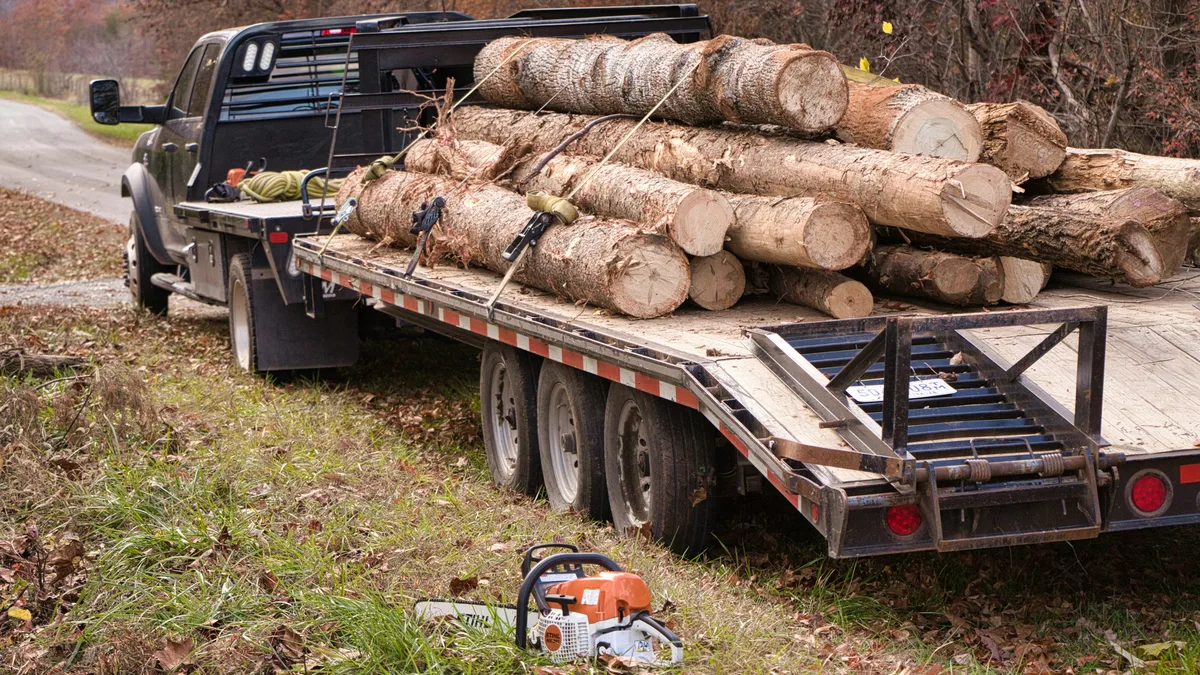
The rule that does reach this truck is about inspection, and it names where the sticker goes on a trailer
14B N.C. Admin. Code 07C .0101 is the live safety rule, adopted under the authority of G.S. 20-17.7 and 20-381 and readopted effective November 1, 2018. Its subsection (b) mirrors the statute, applying the adopted parts to intrastate for-hire and private carriers whose vehicles meet the same four-way 26,001 pound test. Its subsection (d) does something different.
Subsection (d) provides that “The regulations adopted by the U. S. Department of Transportation relating to inspection, repair, and maintenance of motor vehicles (49 CFR Part 396.17 through 396.23 and including Appendix G) apply to all for-hire motor carrier vehicles, and all private motor carrier vehicles engaged in intrastate commerce over the highways of the State if such vehicles have a GVWR of greater than 10,000 pounds.”
Greater than 10,000 pounds. Not 26,001. This is the North Carolina provision that reaches a light combination running intrastate, and it is the one that gets missed, because everything above it in the same rule is keyed to a number three times higher.
Subsection (e) then carries the display duty, and its placement language is written for combinations. “Every motor vehicle registered or required to be registered in North Carolina and subject to the inspection requirements of the Federal Motor Carrier Safety Regulations (49 CFR Part 396), shall display a current federal inspection certificate when operated on the streets and highways of this State. On self-propelled vehicles, the federal inspection certificate shall be displayed on the driver’s side of the vehicle, exclusive of the window or rear view mirror. On trailers and semitrailers, the federal inspection certificate shall be located on the left side as near as possible to the outside lower front of the vehicle.”
The certificate has four required contents and they must be “legible for review by the public”: the date of inspection; the name and address of the motor carrier or other entity where the inspection report required by 49 CFR 396.21(a) is maintained; information uniquely identifying the vehicle inspected, such as the VIN; and a certification that the vehicle has passed an inspection in accordance with 49 CFR 396.17.
For an operator this is a records question as much as an equipment one. The certificate has to name where the report lives, which means the report has to live somewhere and be produceable. And it attaches per vehicle, which for this configuration means the gooseneck carries its own — a point that a fleet running several trailers behind fewer power units will feel more than a single-rig owner-operator will.
There is a downstream insurance consequence to holding, or not holding, that record. A maintenance and inspection file is the document set an adjuster and a plaintiff both ask for after a loss involving a trailer, and its absence is read as an absence of the practice rather than an absence of the paperwork. That is true whether or not the state was the reason it existed. The same logic runs through the physical damage conversation on a trailer that has been in service several years.
- 14B NCAC 07C .0101(b) — the adopted safety parts, intrastate, at 26,001 pounds on the four-way test.
- 14B NCAC 07C .0101(d) — periodic inspection under 49 CFR 396.17 through 396.23 and Appendix G, intrastate, at a gross vehicle weight rating greater than 10,000 pounds.
- 14B NCAC 07C .0101(e) — the current federal inspection certificate, displayed, with placement specified separately for self-propelled vehicles and for trailers and semitrailers.
- Four required contents on the certificate, legible for public review, including where the 396.21(a) report is maintained.