Motor carrier classes by state

California tow trucking insurance for wrecker and recovery operators

California regulates towing the way it regulates a profession rather than a price. The driver carries a certificate from one of two different departments, the rate ceiling is a comparison to the operator’s own approved rate rather than a published number, and the penalty for getting it wrong is written as a multiple of what was charged and handed to the vehicle owner to enforce.

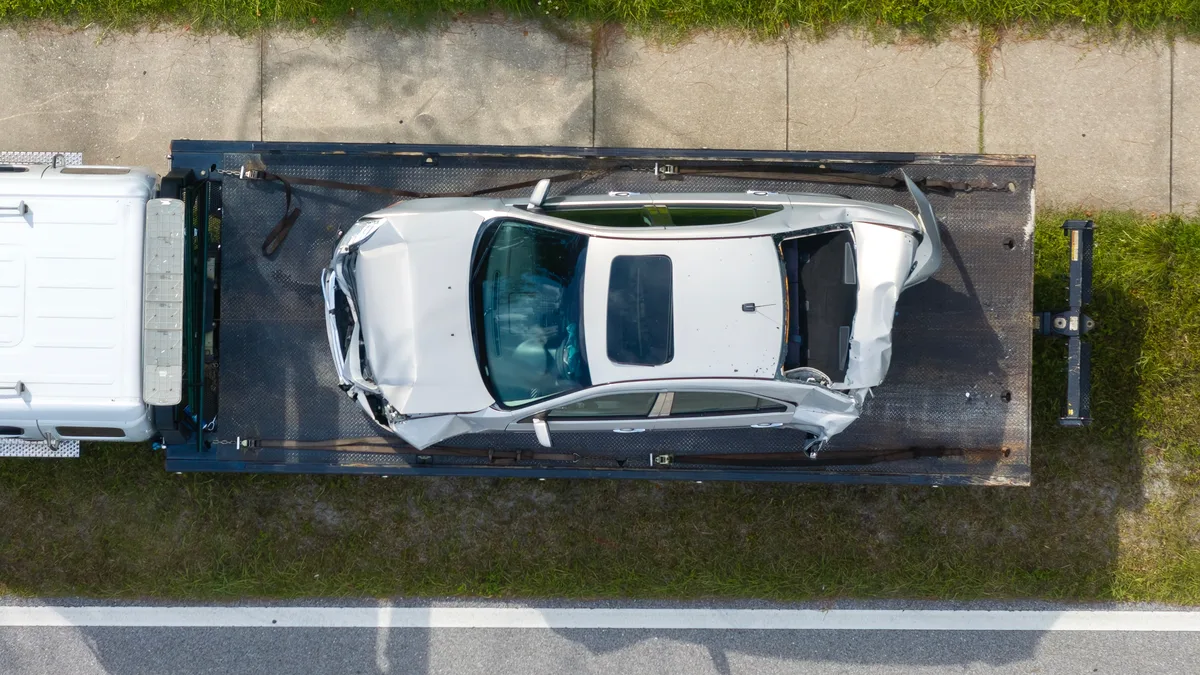
Aerial view of a damaged car on a tow truck deck — California Tow Trucking Insurance from Truck Guard Insurance

The structural difficulty in tow and recovery is the same everywhere: the operator ends up in possession of a vehicle he does not own, the auto policy will not respond to damage to property in the insured’s care, and the on-hook form exists to close that gap. Those mechanics travel with the class and not with the map, so they live on the tow trucking insurance page. This one picks up where they stop.

California’s distinctive contribution is procedural. There is no state fee schedule to look up, no weight-bracketed maximum, no table of light, medium and heavy rates adopted by rule. What there is instead is a dense set of statutory duties — sign dimensions, notification clocks, hearing rights, lien timelines, driver certification — each attached to a specific consequence, and a good number of those consequences run to the vehicle owner as a private civil claim rather than to a regulator as a fine.

That changes what an underwriter is actually looking at. On a California tow account the frequency exposure is procedural: a sign that is the wrong size, a notification made 70 minutes after the hook instead of 60, a release refused to an owner who arrived before the truck pulled off the lot. None of those is a collision, none of them involves the wrecker touching anything, and each of them has a statutory price attached that is stated in the Vehicle Code.

Every figure below carries the section that sets it and the session law that last amended that section. California amends these provisions piecemeal — § 22658 was last reworked in 2022, § 22851 has stood since 2001, Civil Code § 3068.1 since 2010 — so the amendment date is part of the citation rather than a footnote to it.

Running wreckers in California? Send the driver certificate roster alongside the equipment list — the certificate, not the truck, is where California puts the credential.

Start a California quote

Two departments issue the driver certificate, and they are not the same document

California credentials the person, not the permit on the truck, and it splits the paperwork between two agencies. Vehicle Code § 12520, operative from January 1, 1997, provides that no person employed as a tow truck driver shall operate a tow truck without a valid California driver license of the appropriate class in immediate possession, together with a tow truck driver certificate issued by the Department of Motor Vehicles or a temporary tow truck driver certificate issued by the Department of the California Highway Patrol.

The permanent certificate is not indefinite. Under the same section it is valid for a term of up to five years and expires on the same date as the holder’s driver license, which means the certificate renewal cycle and the license renewal cycle are welded together. A driver whose license lapses has lost two documents, not one, and the second one is the one that makes him employable as a tow operator.

The employer-side duty sits in Vehicle Code § 2430.5, amended by Stats. 1992, Ch. 1241, effective January 1, 1993. An employer must require an applicant to submit either the CHP temporary certificate or the DMV permanent certificate, must review and retain a copy, must maintain rosters of certified drivers and of those prohibited from freeway service patrol work, and must make those records available for CHP inspection at the primary place of business. The section closes with a sentence that gets overlooked: a violation of it by an employer is a misdemeanor.

Two consequences follow for an account file. First, the driver roster is a compliance artifact in California in a way it is not in most states — it is the thing the CHP inspects, and the gap between the payroll list and the certificate list is the finding. Second, a hiring lapse is a criminal exposure sitting on the business rather than on the individual, which is not a shape a standard liability program is built to answer and is worth naming explicitly when the account is presented.

  • Permanent certificate. Issued by the Department of Motor Vehicles, valid up to five years, expiring on the same date as the holder’s driver license (§ 12520).
  • Temporary certificate. Issued by the Department of the California Highway Patrol, and accepted by § 2430.5 as the alternative an employer may take at hire.
  • Immediate possession. Both the appropriate-class driver license and the certificate must be on the driver while the tow truck is operated (§ 12520).
  • Employer records. Copies retained, rosters of certified drivers maintained, records produced for CHP inspection at the primary place of business (§ 2430.5).
  • Employer penalty. A violation of § 2430.5 by an employer is a misdemeanor.

There is no California rate table — there is a comparison

The question operators ask first is what California allows them to charge, and the statute answers it sideways. Vehicle Code § 22658, amended by Stats. 2022, Ch. 206 (AB 2174) effective January 1, 2023, does not name a maximum. Subdivision (i)(1)(A) defines an excessive charge instead by reference to two benchmarks: the rate the towing company would charge under an agreement with the local law enforcement agency, or the rate approved for that towing operator by the Department of the California Highway Patrol.

That is a comparative ceiling, and it has an unusual property. The number an operator may not exceed on a private-property removal is derived from that same operator’s own approved rate for public work. Raise or lower the CHP-approved schedule and the private-property ceiling moves with it. Two companies working the same shopping center in the same city can therefore have two different lawful maximums, and neither can discover the other’s by reading a statute.

The enforcement is what gives it teeth. Under subdivision (j)(1), a person who charges a vehicle owner a charge greater than that permitted is civilly liable to the vehicle owner for four times the amount charged. That is not a fine paid to an agency and it does not require a regulator to act — it is a private claim brought by the person whose vehicle was towed, and the measure of it is a multiple of the invoice rather than of any loss the owner suffered.

Subdivision (e)(1) adds a second multiplier on a different failure. Where there has been a failure to comply with paragraph (1), (2) or (3) of subdivision (a) — the signage and authorization requirements — liability runs to double the storage or towing charges. Both of these are contractual-and-statutory exposures rather than bodily injury or property damage in the ordinary liability sense, and whether any given policy responds to them is a wording question that should be asked before the account binds, not after the first demand letter arrives.

What a California tow truck may not do at a collision scene

Most states leave scene conduct to local rotation contracts. California puts it in the Vehicle Code with a criminal penalty attached. Vehicle Code § 22513, amended by Stats. 2016, Ch. 518 (AB 2167) effective January 1, 2017, prohibits a towing company or tow truck operator from stopping at the scene of an accident to solicit towing services unless one of two things is true: the service was requested by a law enforcement officer or public agency under that agency’s procedures, or the operator was summoned to the scene or asked to stop by the owner or operator of a disabled vehicle.

The section then makes that testable. Before arriving, the operator must have written information in hand — the name and telephone number of the person who called, the make, model, year and license plate of the vehicle, the date and time of the summons, and the identity of the person who obtained that information. Those records must be made available to law enforcement within 48 hours of a request and retained for three years.

The penalty is set out in the section itself: a person who willfully violates subdivision (b), (c) or (d) is guilty of a misdemeanor punishable by a fine of not more than $2,500, imprisonment in a county jail for not more than three months, or both. For an operator running multiple trucks that is a supervision problem as much as a legal one, because the conduct the statute reaches is the conduct a dispatcher is not present for.

The insurance angle here is indirect but real. Scene-chasing allegations tend to arrive bundled with other claims — an unauthorized tow, a damaged vehicle, a disputed invoice — and the § 22513 record-keeping requirement is the operator’s only contemporaneous evidence that the call was legitimate. A fleet that keeps those written call records as a matter of routine has a defense file. One that does not has an argument. The wrecker itself is a separate question again — a unit working a live collision scene is the piece of equipment most likely to be struck, and physical damage on the tow truck is rated on that exposure rather than on mileage.

  • Two lawful reasons to stop. A request from a law enforcement officer or public agency under its procedures, or a summons from the owner or operator of the disabled vehicle.
  • Written information before arrival. Caller name and telephone number, vehicle make, model, year and license plate, date and time of the summons, and who took the information.
  • Production and retention. Available to law enforcement within 48 hours of request; retained for three years.
  • Penalty. Willful violation is a misdemeanor punishable by a fine of not more than $2,500, up to three months in county jail, or both.

We place California tow and recovery accounts from single-truck private-property operators to heavy rotator fleets running law enforcement rotation and storage yards.

Get a California quote

The lien attaches at the scene and then runs on a clock

California starts the lien earlier than most operators expect. Vehicle Code § 22851, amended by Stats. 2001, Ch. 127 effective July 30, 2001, gives the keeper of a garage a lien for compensation that arises when the vehicle is removed and is in transit, or when vehicle recovery or load salvage operations requested by a law enforcement agency have begun at the scene. The lien does not wait for the yard gate. It exists while the rotator is still rigging.

That matters for heavy work specifically. On a load-salvage or recovery job requested by law enforcement, the compensable event and the lien both begin at the roadside, which is where the labor, the equipment hours and the traffic-control exposure actually are. It also means the operator’s security interest is running during the phase of the job with the highest chance of a third-party incident, which is a useful thing to keep in mind when sizing auto liability on a heavy division.

The lien then runs against a calendar. Section 22851 limits it to compensation for a maximum of 60 days of storage, extended to 120 days where a lien sale authorization under Civil Code § 3068.1 is applied for within 30 days of the vehicle being removed. Miss the filing window and the recoverable storage period is halved by operation of statute, regardless of how long the vehicle actually sits.

One boundary is drawn hard: no lien attaches to any personal property in or on the vehicle. Personal effects must be returned to the registered owner or the owner’s agent on demand and without charge during business hours, defined in the section as 8 a.m. to 5 p.m., Monday through Friday, excluding state holidays. An operator who holds a customer’s tools or load hostage against an unpaid invoice is not exercising a lien in California. He is holding property he has no lien on, and the conversion exposure that follows lands in general liability and garage territory rather than anywhere on the auto policy.

The $4,000 line in the lien sale, and where a post-storage hearing does not reach

The sale procedure splits on the value of the vehicle. Civil Code § 3068.1, amended by Stats. 2010, Ch. 566 (AB 519) effective January 1, 2011, sends a vehicle appraised at $4,000 or less down the Section 3072 route and a vehicle valued above $4,000 down the Section 3071 route, with different filing windows attached to each. For the lower-value track, lien sale proceedings under Section 3072 must commence within 15 days of the date the lien arises, and the storage lien is limited to 60 days where notice is filed inside that window.

For a commercial tow operator that threshold falls in an awkward place. A Class 8 tractor, a straight truck, a work van with a body on it — these sit well above the line, which pushes the file into the Section 3071 track with its 120-day storage limit and its own application requirements. A light passenger vehicle abandoned in a lot usually sits below it. A single operator therefore runs two different lien-sale workflows depending on what got towed, and the appraisal is the fork.

The section also gives the vehicle’s owner an inspection right that has an operational cost: on written demand the lienholder must permit inspection within a period of at least 24 hours but not more than 72 hours after receiving the demand, during normal business hours. That is a staffing obligation on a yard that may be storing the vehicle a long way from anyone’s office.

Then there is the gap. Vehicle Code § 22852, amended by Stats. 2004, Ch. 650 effective January 1, 2005, builds the post-storage hearing regime: notice of storage mailed or personally delivered to the registered and legal owners within 48 hours excluding weekends and holidays, and a hearing conducted within 48 hours of the request, again excluding weekends and holidays. But the section states expressly that it does not apply to vehicles removed from private property under § 22658. So the removals that carry the sign requirements, the notification clock and the four-times exposure are precisely the removals the post-storage hearing does not cover — which is why the disputes arising from them show up as civil claims against the operator rather than as administrative hearings.

  • Vehicles valued at $4,000 or less. Lien satisfied under Civil Code § 3072; proceedings commence within 15 days of the date the lien arises; storage lien limited to 60 days where notice is filed in that window.
  • Vehicles valued above $4,000. Lien satisfied under Civil Code § 3071; storage lien limited to 120 days where the lien sale application is filed under that section.
  • Inspection on demand. At least 24 hours but not more than 72 hours after written demand, during normal business hours.
  • Post-storage notice. Within 48 hours of storage, excluding weekends and holidays (§ 22852).
  • Post-storage hearing. Within 48 hours of the request, excluding weekends and holidays — and unavailable for § 22658 private-property removals.

Signs, clocks and the release an operator must offer

The private-property regime in § 22658 is where the largest number of small procedural failures live, and the requirements are unusually specific. The sign must be not less than 17 inches by 22 inches in size, with lettering not less than one inch in height, and it must display the telephone number of the local traffic law enforcement agency together with the name and telephone number of each towing company authorized to remove vehicles from the property.

The notification clock is tighter than most operators run. Subdivision (m) requires the towing company to notify the local law enforcement agency after the vehicle is removed, and makes failure to do so within 60 minutes after the vehicle is removed and in transit, or 15 minutes after arriving at the storage facility, whichever time is less, a misdemeanor. Read the tie-breaker carefully: a short tow to a nearby yard is governed by the 15-minute arrival trigger, not the 60-minute one, and that is the version of the rule that catches urban operators.

Subdivision (h) creates the release obligation. Where the owner of the vehicle returns after it has been coupled to the tow truck but before it has been removed from the property, the towing company may charge not more than one-half of the regular towing charge and must release the vehicle. That is a pricing rule and a conduct rule at once, and a refusal is the fact pattern that most often converts an ordinary tow into a claim.

The local layer sits on top of all of it. Los Angeles, San Francisco and San Diego each administer their own official police garage arrangements and tow contracts, and Vehicle Code § 22850.5, amended by Stats. 2015, Ch. 740 (AB 281) effective January 1, 2016, lets a city, county, or state agency adopt a regulation, ordinance or resolution establishing release procedures and imposing administrative charges. This page publishes no municipal dollar figure for any California city. Those amounts are set by ordinance and revised on each jurisdiction’s own calendar, and we could not confirm a current one at its own primary source while writing this. An operator quoting work in one of those cities should be reading the schedule that city has actually adopted.

  • Sign size. Not less than 17 inches by 22 inches, lettering not less than one inch in height (§ 22658(a)).
  • Sign content. The local traffic law enforcement agency telephone number, plus the name and telephone number of each towing company authorized to tow from the property.
  • Notification. Within 60 minutes of removal and in transit, or 15 minutes after arrival at the storage facility, whichever is less — failure is a misdemeanor (§ 22658(m)).
  • Release before removal. Not more than one-half of the regular towing charge, and the vehicle must be released (§ 22658(h)).
  • Excessive charge. Civil liability to the vehicle owner for four times the amount charged (§ 22658(j)).
  • Signage and authorization failures. Liability for double the storage or towing charges (§ 22658(e)).

Coverage lines a California tow account usually carries

The state minimum is a licensing threshold. The program an operator actually needs is built from these lines:

  • Trucking Auto Liability — Primary liability coverage for bodily injury and property damage caused by your truck while under dispatch.
  • Physical Damage — Collision and comprehensive coverage for the tractor, trailer, and attached equipment you own or finance.
  • Motor Truck Cargo — Coverage for the freight you haul against loss or damage in transit.
  • Trailer Interchange — Coverage for non-owned trailers you pull under written interchange agreements.
  • General Liability — Coverage for premises and operations liability away from the truck — terminal yards, customer docks, and non-driving exposures.
  • Workers Compensation — Statutory coverage for driver and yard-employee injury, structured for trucking payrolls and interstate operations.
  • Non-Trucking (Bobtail) Auto Liability — Liability coverage for the tractor when operated off-dispatch — bobtailing home or running personal errands.
  • Pollution Liability — Coverage for cargo-related pollution events and upset/overturn spills not covered by standard auto liability.

Why Truck Guard Insurance for a California tow account

We write tow and recovery as a named class rather than as an exception to general trucking, and we read each account against the licensing regime of the state it operates in. For a California operator that means starting from the permit list, sizing on-hook to the heaviest class actually recovered rather than to a state floor, and treating the storage yard as its own exposure rather than an extension of the wrecker.

If the operation also runs freight under separate authority, the California trucking insurance page covers the state’s broader motor carrier picture, and the tow trucking insurance page covers the class mechanics that apply wherever the operator runs.

California tow trucking insurance questions

Is there a maximum tow rate in California?

Not with a published statewide figure. Vehicle Code § 22658(i)(1)(A), as amended by Stats. 2022, Ch. 206 effective January 1, 2023, defines an excessive charge by comparison — a charge exceeding what the company would charge under its agreement with the local law enforcement agency, or the rate approved for that operator by the California Highway Patrol. The ceiling is therefore operator-specific rather than uniform across the state.

What is the four-times exposure in Vehicle Code § 22658?

Subdivision (j)(1) makes a person who charges a vehicle owner more than the section permits civilly liable to that owner for four times the amount charged. It is a private claim brought by the vehicle owner rather than an agency fine, and the measure is a multiple of the invoice rather than of any loss proved. Subdivision (e)(1) separately imposes liability for double the storage or towing charges where the signage and authorization requirements are not met.

Who issues a California tow truck driver certificate?

Both the DMV and the CHP, in different forms. Vehicle Code § 12520 requires a tow truck driver to carry a valid appropriate-class California driver license plus a tow truck driver certificate issued by the Department of Motor Vehicles, or a temporary certificate issued by the Department of the California Highway Patrol. The permanent certificate runs up to five years and expires on the same date as the holder’s driver license.

Is the employer responsible for driver certification in California?

Yes, and the duty is criminal rather than administrative. Vehicle Code § 2430.5, amended effective January 1, 1993, requires an employer to obtain and retain a copy of each driver’s temporary or permanent certificate, maintain rosters of certified drivers and of drivers prohibited from freeway service patrol work, and produce those records for CHP inspection at the primary place of business. A violation of the section by an employer is a misdemeanor.

When does a California towing lien attach?

Earlier than the yard. Vehicle Code § 22851, amended by Stats. 2001, Ch. 127 effective July 30, 2001, provides that the lien arises when the vehicle is removed and is in transit, or when vehicle recovery or load salvage operations requested by a law enforcement agency have begun at the scene. On a heavy recovery the lien is therefore running while the equipment is still rigging at the roadside.

Can a California operator hold property found inside the vehicle?

No. Vehicle Code § 22851 states that no lien shall attach to any personal property in or on the vehicle, and requires that such property be given to the registered owner or the owner’s agent on demand without charge during business hours, which the section defines as 8 a.m. to 5 p.m., Monday through Friday, excluding state holidays. Withholding a customer’s tools or load against an unpaid invoice creates a conversion exposure rather than a lien.

What is the $4,000 threshold in Civil Code § 3068.1?

It splits the lien sale procedure. Under Civil Code § 3068.1, amended by Stats. 2010, Ch. 566 effective January 1, 2011, a vehicle valued at $4,000 or less is sold under Section 3072, with proceedings commencing within 15 days of the date the lien arises and the storage lien limited to 60 days. A vehicle valued above $4,000 goes through Section 3071, with the storage lien limited to 120 days. Most commercial vehicles fall on the higher side.

Does a private-property tow get a post-storage hearing in California?

No. Vehicle Code § 22852, amended by Stats. 2004, Ch. 650 effective January 1, 2005, sets the post-storage regime — notice within 48 hours and a hearing within 48 hours of request, each excluding weekends and holidays — but states expressly that it does not apply to vehicles removed from private property under § 22658. Disputes over those removals surface as civil claims against the operator instead.

Sources

Every figure on this page was read at the source below on August 11, 2026, with the effective date of the version read. Treat each as current as of that date rather than as permanent.

Get a California tow trucking insurance quote

Send the permit inventory and the heaviest class you recover. We will structure on-hook and garage limits against the work rather than against the state floor.

Start a quote Call 317-942-0549