Motor carrier classes by state

Colorado tow trucking insurance for wrecker and recovery operators

Colorado’s towing rate schedule is not a fixed table. It re-indexes every March 15 against the Denver-Aurora-Lakewood consumer price index, and the schedule now in force took effect March 15, 2026 on a 2.28 percent adjustment. Every figure on this page carries that date, because next March they all move.

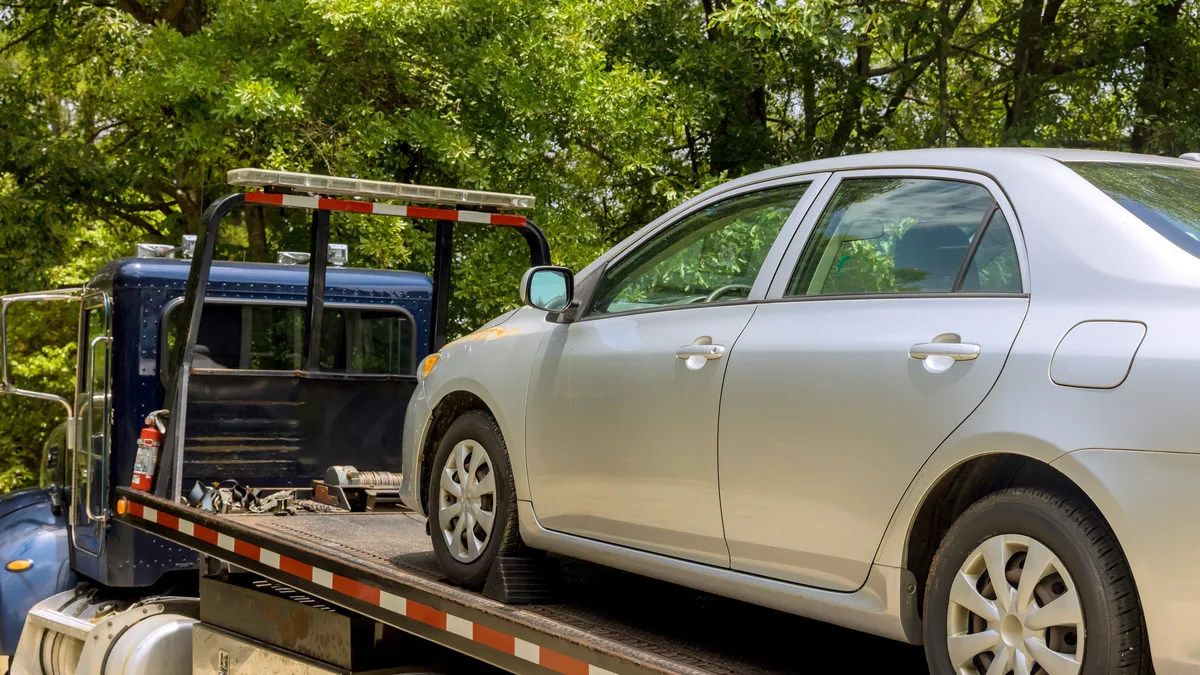
Car loaded on the deck of a tow truck — Colorado Tow Trucking Insurance from Truck Guard Insurance

The custody problem at the center of tow and recovery — an operator holding a vehicle he does not own, a general liability form that excludes exactly that, and an on-hook form written to answer it — belongs to the class rather than to Colorado. It is set out on the tow trucking insurance page and is not restated here.

Colorado’s distinguishing feature is that the Public Utilities Commission occupies the field. There is no meaningful county or municipal layer to reconcile: the Commission issues the towing carrier permit, prescribes the insurance and the forms it is proved on, sets the maximum rates, prescribes the authorization form a property owner signs, and collects an annual operational return. Denver, Colorado Springs and Aurora do not publish their own competing tow schedules the way large metros do in states that devolve the question. One rulebook covers the state.

What makes that rulebook harder to work with than a static one is the indexation. Under the Commission’s rules the base rates are adjusted annually, beginning March 15, 2022 and effective March 15 of each year thereafter, against the annual percentage change in the United States Bureau of Labor Statistics Consumer Price Index for Denver-Aurora-Lakewood. A Colorado rate figure is therefore true for about twelve months. A quote sheet, a rate card or a compliance file built on last year’s numbers is not slightly out of date — it is quoting a schedule that has been superseded.

One item on the schedule moves faster still. The mileage and fuel surcharge changes monthly, and for that reason no figure for it appears anywhere on this page. It is published on its own Commission page, linked below, and it should be read there each month rather than transcribed anywhere.

Renewing a Colorado towing carrier permit? Send the current Form E, Form 12-INS and Form 14-INS filings — in Colorado the Commission holds the proof of coverage, so the filings and the policy have to agree.

Start a Colorado quote

The schedule has an expiry date, and it is March 15

4 CCR 723-6-6511 sets the maximum rates and charges a Colorado towing carrier may assess, and it builds the annual adjustment into the rule itself. The base rates are adjusted for inflation annually, starting March 15, 2022 and effective March 15 of each year thereafter, based on the annual percentage change in the Bureau of Labor Statistics Consumer Price Index for Denver-Aurora-Lakewood. The Commission then publishes the resulting schedule.

The schedule in force as this page was written is the one the Commission published as effective March 15, 2026, computed on an inflation adjustment of 2.28 percent. The Commission also keeps the prior schedule visible — the one effective April 14, 2025 through March 14, 2026 — which is a useful signal in itself: the rule expects operators, insurers and consumers to be reconciling charges against whichever schedule was in force on the day of the tow, not against whichever one is current when the invoice is disputed.

That is a working constraint rather than a footnote. A tow performed on March 10 and disputed in June is judged against a schedule that no longer exists, so a Colorado operator’s records have to be date-anchored at the level of the individual job. It is also why an insurance or compliance file for a Colorado account should carry a review date of mid-March rather than an anniversary date. The renewal calendar and the rate calendar are not the same calendar, and the rate one does not care when the policy incepts.

The Commission permits one charge outside the indexed schedule: under § 5-2-212, C.R.S., a towing carrier may assess a surcharge for credit card transactions in addition to the published maximums.

The maximums in force as of March 15, 2026

All of the following are maximum charges published by the Colorado Public Utilities Commission as effective March 15, 2026, on the 2.28 percent adjustment described above. GVWR throughout refers to the gross vehicle weight rating of the towed vehicle, not of the wrecker. Each figure is superseded on March 15, 2027.

Two structural points are easy to miss in that list. First, the storage brackets are not the same brackets as everything else — storage splits once, at 10,000 pounds, while drop charges, hourly recovery and PPI base rates all split three times. Second, the carrier may elect to charge storage by length at $1.82 per foot instead of by bracket, which on a long recovered combination is a different and often larger number than the $59.45 daily rate.

A caution on what is deliberately absent. The mileage and fuel surcharge is part of this schedule but changes monthly, and no figure for it is published here. The Commission maintains a towing carrier fuel surcharge page for the current month. Rule 6511(b)(III) and (b)(IV) frame it: mileage may be assessed on a private property impound tow up to 12 miles for tows within 10 miles of Interstate 25, or up to 16.5 miles for tows farther than 10 miles from I-25, and a fuel surcharge may be assessed when the price per gallon of diesel exceeds $2.60.

Rule 6511 also carries several charges to zero or near it in the residential context, following House Bill 22-1314. Since August 10, 2022 a towing carrier may not assess a drop fee related to a tow from residential private property under § 40-10.1-405(6) and (9), C.R.S., and may not accrue storage on a private property tow beyond the first 24 hours until statutory notification has been completed. Release of personal property from a vehicle towed from residential private property is free of charge, and the request may be made from the time of the tow until 30 days after statutory notification under rule 6512(d).

  • Drop charge (owner appears after hookup but before removal) — $97.70 for GVWR of 10,000 pounds or less, $125.61 for 10,001 to 19,000 pounds, $167.48 for 19,001 to 33,000 pounds, and $195.41 for 33,001 pounds or greater.
  • Law-enforcement-ordered tow and recovery, hourly — $286.15 per hour for GVWR of 10,000 pounds or less, $341.99 for 10,001 to 19,000 pounds, $446.68 for 19,001 to 33,000 pounds, and $516.48 for 33,001 pounds or greater.
  • Heavy rotator, 60 tons and above — $816.60 per hour.
  • Private property impound base rate (the hook fee) — $250.91 for GVWR of 10,000 pounds or less, $288.57 for 10,001 to 19,000 pounds, $388.96 for 19,001 to 33,000 pounds, and $439.15 for 33,001 pounds or greater.
  • Storage, per 24-hour period or any portion of one — $48.19 for GVWR under 10,000 pounds and $59.45 for 10,000 pounds or greater, or $1.82 per foot by length at the towing carrier’s discretion.
  • Release of personal property — no charge from a residential private property impound; $102.28 per hour from a commercial private property impound and $102.28 per hour on a law-enforcement-ordered tow.
  • After-hours release — $106.06, for release from storage outside business hours, typically 8:00 AM to 5:00 PM Monday through Friday excluding legal holidays.
  • Statutory notification — $150.00 where the vehicle was towed from public property and $75.00 from private property, assessable once the title search has been performed and the required mailings sent.

What the Commission makes a Colorado towing carrier carry

This is the part of the Colorado scheme that is genuinely an insurance rule rather than a price rule. 4 CCR 723-6-6008 sets financial responsibility for motor carriers, and it names towing carriers as their own class with their own line in the table.

Under rule 6008(a)(I), coverage must be combined single limit liability, and the minimum level for towing carriers is $750,000 at any GVWR. The words any GVWR are the whole point. Colorado brackets its rates four ways by the weight of the towed vehicle, and then declines to bracket the liability minimum at all. A single light-duty repossession truck and a 60-ton rotator carry the identical statutory floor. The rule shows this is a deliberate choice rather than an oversight, because the very same table brackets movers — $750,000 at 10,000 pounds GVWR or more, $300,000 below that.

Rule 6008(a)(III) requires every towing carrier to keep cargo liability coverage in force, and defines it in on-hook terms: cargo liability coverage for a towing carrier includes coverage of physical damage to the motor vehicle in tow, on hook, and loss of its contents, extending to the carrier’s legal liability for loss or damage to the property of persons other than the insured carried in, upon or attached to the towing vehicle, its trailers or dollies. The rule sets no dollar minimum for a towing carrier’s cargo coverage. It sets one for movers, at $10,000, and pointedly does not carry that across. The coverage is mandatory; the limit is not specified.

That gap is the most consequential thing on this page for an operator running heavy. Colorado will not tell a rotator operator what on-hook limit is adequate, and a policy issued at a token limit satisfies rule 6008(a)(III) exactly as well as one issued at replacement cost for a loaded combination. The limit has to be argued from the heaviest and most valuable unit the operator actually recovers. See cargo and on-hook coverage.

Two further coverages attach by activity rather than by vehicle. Rule 6008(a)(IV) requires a towing carrier that provides storage, directly or through an agent, to keep garage keeper’s liability coverage in force to the extent of its legal liability for loss or damage to property of others stored by it — see general liability. Rule 6008(a)(V) requires workers’ compensation coverage in accordance with § 40-10.1-401(3), C.R.S. — see workers’ compensation. Note what does not attach: the $500,000 general liability requirement in rule 6008(a)(VI) applies to movers, not to towing carriers.

  • Form E or Form G — the Uniform Motor Carrier Bodily Injury and Property Damage Liability Certificate of Insurance, or the equivalent surety bond, filed with the Commission to prove the $750,000 combined single limit. A certificate of self-insurance issued under §§ 10-4-624 and 42-7-501, C.R.S., or under 49 C.F.R. part 387, may be filed instead.
  • Form H, Form J, or Colorado Form 12-INS — cargo liability. Rule 6008(a)(III) allows a towing carrier to file the Colorado Form 12-INS, Towing Carrier Cargo Liability Insurance Certificate, in lieu of the Form H.
  • Colorado Form 14-INS — the Garage Keepers Legal Liability Certificate of Insurance, which rule 6008(a)(IV)(B) requires all towing carriers to cause to be filed.
  • Form WC — proof of workers’ compensation coverage, filed in lieu of the policy. Where coverage is not required, a corporation or LLC files Department of Labor and Employment Form WC43 with a part B for each person listed on part A; other carriers file a statement that coverage is not required.
  • First-dollar wording — rule 6008(b)(IV) requires the policy or bond to provide for payment of benefits by the insurer directly to parties damaged by the carrier on a first-dollar, dollar-one basis, and rule 6008(b)(V) requires any retained-risk provision to obligate the insurer regardless of the level of funds in the pool. Rule 6008(b)(VI) bars the carrier from paying benefits directly.

We place Colorado towing carrier accounts from single light-duty units to 60-ton rotator operations, including carriers running storage and carriers filing Form 12-INS and Form 14-INS with the Commission.

Get a Colorado quote

The rate shape is hourly, and recovery bills on top of it

Colorado does not cap a law-enforcement-ordered recovery at a flat per-tow figure. Rule 6511(c)(I) states the maximum for law-enforcement-ordered tow and recovery operations as an hourly rate, calculated per required tow truck and driver, and billable in quarter-hour increments after the first hour. A four-hour clearance with three units on scene is therefore a fundamentally different invoice from a single hookup, and the schedule anticipates that.

Rule 6511(c)(IV)(D) then allows the carrier to bill, in addition to the hourly rate, the actual and reasonable cost of recovery equipment and labor in excess of one tow truck and driver for one hour, plus an additional 25 percent of those actual and reasonable costs. Colorado is one of the states where a heavy recovery can be billed close to what it genuinely costs to perform, provided the operator can evidence the costs.

The commercial consequence runs straight into the insurance file. Where the recoverable revenue on a major incident is time-and-equipment based, the operator’s incentive is to put more iron and more people on scene, and the exposure follows the equipment. The $816.60 hourly rotator line in the March 15, 2026 schedule exists because Colorado expects rotators to be used on its mountain corridors, and a fleet that owns one is not underwritten as a light-duty fleet that happens to have an extra truck. Physical damage on the rotator itself is frequently the largest single scheduled value on the account — see physical damage.

The hourly shape also changes what a claim file has to contain. An invoice built from clock time, unit count and itemized recovery cost is only defensible if the operator recorded clock time, unit count and itemized cost at the scene. Colorado’s rate rules and its evidentiary rules point at the same discipline from two directions, and the second of them is set out below.

The permit, the fee increases, and the February 1 return

A Colorado towing carrier operates on a Commission-issued permit under 4 CCR 723-6-6503. Rule 6503(a) requires the applicant to pay an application fee as administratively set by the Commission and to pay the required annual fees or be in compliance with the UCR Agreement. Rule 6503(b) requires a carrier submitting a permit application or a renewal to disclose all principals.

The Commission has recently raised both charges, and by a large multiple on one of them. Its towing industry page states that filing fees for towing carrier applications increased from $150.00 to $515.00 effective November 1, 2025, and that vehicle stamp fees increased from $50.00 to $51.00 per vehicle effective November 15, 2025. The application fee more than tripled; the per-vehicle stamp moved by a dollar. A multi-truck operator feels the second one across the fleet and the first one once.

Rule 6503(c) then imposes something most states do not: an annual operational data return. The information must be submitted on or before February 1 of each year, and rule 6503(c)(II) requires the volume of tows to be reported by category, including consensual, nonconsensual and law-enforcement-ordered tows. The return also covers the number of tow trucks operated and pricing for consensual tows, together with any other information the Commission determines necessary. The Commission publishes annual towing reports built from those returns.

The February 1 return deserves attention on an insurance submission for a reason that has nothing to do with compliance. It means a Colorado towing carrier already possesses, in a form it has certified to a regulator, the exact work-mix breakdown an underwriter would otherwise have to estimate. Consensual, nonconsensual and law-enforcement-ordered volumes are the three numbers that most affect how a tow account is rated, and in Colorado the operator has been compelled to count them. An account that cannot produce the substance of its own February 1 return is an account with a records problem.

Four photographs: the evidentiary record before a private-property tow

House Bill 22-1314, the Towing Bill of Rights, is implemented at 4 CCR 723-6-6508, and it converts a nonconsensual private-property tow from a dispatch decision into a documented one. The rule does not merely require the carrier to be right. It requires the carrier to have proved it was right, in a particular form, before the vehicle moved.

The authorization comes first. Rule 6508(b)(III)(A) requires the property owner authorization form to be filled out in full, signed by the property owner, and given to the towing carrier before the vehicle is removed from the property — and not greater than 24 hours prior to the tow. The Commission prescribes the form and requires its use for all nonconsensual private property tows, residential and commercial. A standing authorization, a blanket letter or a signature obtained a week earlier does not satisfy the rule, which effectively ends the practice of patrolling a lot on a general instruction.

On residential property a second clock runs in front of that one. Rule 6508(d)(III) requires written notice placed on the windshield of the vehicle at least 24 hours before towing it, stating that towing will occur if the improper parking continues, describing the violation, giving the time the vehicle will be towed if it is not moved, and warning that continued violations may result in towing without notice.

Then the photographs, which are the part operators most often underestimate. Rule 6508(e)(II) requires four images of the vehicle — from the front, from the rear, from the driver side and from the passenger side. Rule 6508(e)(II)(E) specifies the technical standard: each image must be rendered in a resolution of at least 2,000 pixels by 2,000 pixels, must contain the date and time the photograph was taken, and must have the vehicle fill at least three-fourths of the photograph, measured side to side. Rule 6508(e)(III) requires a fifth photograph documenting the reason for the tow, held to the same resolution and timestamp standard.

Five compliant photographs per tow, framed to a stated fraction of the image and stamped with date and time, is a real operational load on a high-volume private-property operation — and it is also the single best claims defense a Colorado operator has. A four-view timestamped record of a vehicle’s condition at pickup is precisely the evidence that resolves a pre-existing-damage allegation, which is the most common contested on-hook and garage keeper’s claim in the class. The rule was written as a consumer protection. It functions equally as a loss-control instrument, and an operator whose photographs are genuinely rule-compliant is defending damage claims from a position most operators in other states do not have.
Coverage lines a Colorado tow account usually carries

The state minimum is a licensing threshold. The program an operator actually needs is built from these lines:

  • Trucking Auto Liability — Primary liability coverage for bodily injury and property damage caused by your truck while under dispatch.
  • Physical Damage — Collision and comprehensive coverage for the tractor, trailer, and attached equipment you own or finance.
  • Motor Truck Cargo — Coverage for the freight you haul against loss or damage in transit.
  • Trailer Interchange — Coverage for non-owned trailers you pull under written interchange agreements.
  • General Liability — Coverage for premises and operations liability away from the truck — terminal yards, customer docks, and non-driving exposures.
  • Workers Compensation — Statutory coverage for driver and yard-employee injury, structured for trucking payrolls and interstate operations.
  • Non-Trucking (Bobtail) Auto Liability — Liability coverage for the tractor when operated off-dispatch — bobtailing home or running personal errands.
  • Pollution Liability — Coverage for cargo-related pollution events and upset/overturn spills not covered by standard auto liability.

Why Truck Guard Insurance for a Colorado tow account

We write tow and recovery as a named class rather than as an exception to general trucking, and we read each account against the licensing regime of the state it operates in. For a Colorado operator that means starting from the permit list, sizing on-hook to the heaviest class actually recovered rather than to a state floor, and treating the storage yard as its own exposure rather than an extension of the wrecker.

If the operation also runs freight under separate authority, the Colorado trucking insurance page covers the state’s broader motor carrier picture, and the tow trucking insurance page covers the class mechanics that apply wherever the operator runs.

Colorado tow trucking insurance questions

When do Colorado towing rates change?

Every March 15. Under 4 CCR 723-6-6511 the base rates are adjusted for inflation annually, beginning March 15, 2022 and effective March 15 of each year thereafter, against the annual percentage change in the Bureau of Labor Statistics Consumer Price Index for Denver-Aurora-Lakewood. The schedule currently in force took effect March 15, 2026 on a 2.28 percent adjustment. A Colorado rate figure is accurate for roughly twelve months and then is superseded.

What is the maximum drop charge in Colorado right now?

As of the schedule effective March 15, 2026, the maximum drop charge is $97.70 for a towed vehicle with a GVWR of 10,000 pounds or less, $125.61 for 10,001 to 19,000 pounds, $167.48 for 19,001 to 33,000 pounds, and $195.41 for 33,001 pounds or greater. Since August 10, 2022 no drop fee may be assessed at all on a tow from residential private property, under § 40-10.1-405(6) and (9), C.R.S.

What liability limit must a Colorado towing carrier carry?

A combined single limit of $750,000, at any GVWR, under 4 CCR 723-6-6008(a)(I). Colorado brackets its rate schedule four ways by the weight of the towed vehicle but does not bracket the liability minimum at all, so a light-duty unit and a 60-ton rotator carry the same statutory floor. Proof is filed with the Commission on a Form E or Form G, or by certificate of self-insurance.

Does Colorado set a minimum for on-hook cargo coverage?

No. Rule 4 CCR 723-6-6008(a)(III) requires every towing carrier to keep cargo liability coverage in force and defines it to include physical damage to the motor vehicle in tow, on hook, and loss of its contents — but states no dollar minimum for towing carriers. The rule sets a $10,000 minimum for movers and does not extend it. The coverage is mandatory and the limit has to be argued from the heaviest unit actually recovered.

How is a law-enforcement-ordered recovery billed in Colorado?

Hourly, not as a flat fee. Rule 6511(c)(I) sets the maximum per required tow truck and driver on an hourly basis, billable in quarter-hour increments after the first hour, running from $286.15 to $516.48 by GVWR bracket as of March 15, 2026, with a 60-ton-plus rotator at $816.60 per hour. Rule 6511(c)(IV)(D) additionally allows actual and reasonable recovery equipment and labor costs beyond one truck-hour, plus 25 percent of those costs.

Why does this page not give the Colorado mileage or fuel surcharge?

Because it changes monthly and any figure printed here would be wrong within weeks. The mileage and fuel surcharge is part of the schedule under rule 6511(b)(III) and (b)(IV), but the Commission republishes it every month on a dedicated page, linked in the sources below. Mileage applies to private property impound tows up to 12 miles within 10 miles of Interstate 25, or up to 16.5 miles beyond that, and a fuel surcharge applies when diesel exceeds $2.60 per gallon.

What does a Colorado towing carrier permit cost now?

The Public Utilities Commission raised the application filing fee from $150.00 to $515.00 effective November 1, 2025, and the tow truck vehicle stamp from $50.00 to $51.00 per vehicle effective November 15, 2025. Both figures are published on the Commission’s towing industry page. Rule 4 CCR 723-6-6503(a) sets the application fee as administratively determined by the Commission, which is why it can move without a rulemaking.

What photographs does Colorado require before a private-property tow?

Rule 4 CCR 723-6-6508(e)(II) requires four views of the vehicle — front, rear, driver side and passenger side — each rendered at a resolution of at least 2,000 by 2,000 pixels, containing the date and time taken, and framed so the vehicle fills at least three-fourths of the photograph measured side to side. Rule 6508(e)(III) requires a fifth photograph documenting the reason for the tow, to the same standard.

Sources

Every figure on this page was read at the source below on August 11, 2026, with the effective date of the version read. Treat each as current as of that date rather than as permanent.

Get a Colorado tow trucking insurance quote

Send the permit inventory and the heaviest class you recover. We will structure on-hook and garage limits against the work rather than against the state floor.

Start a quote Call 317-942-0549