
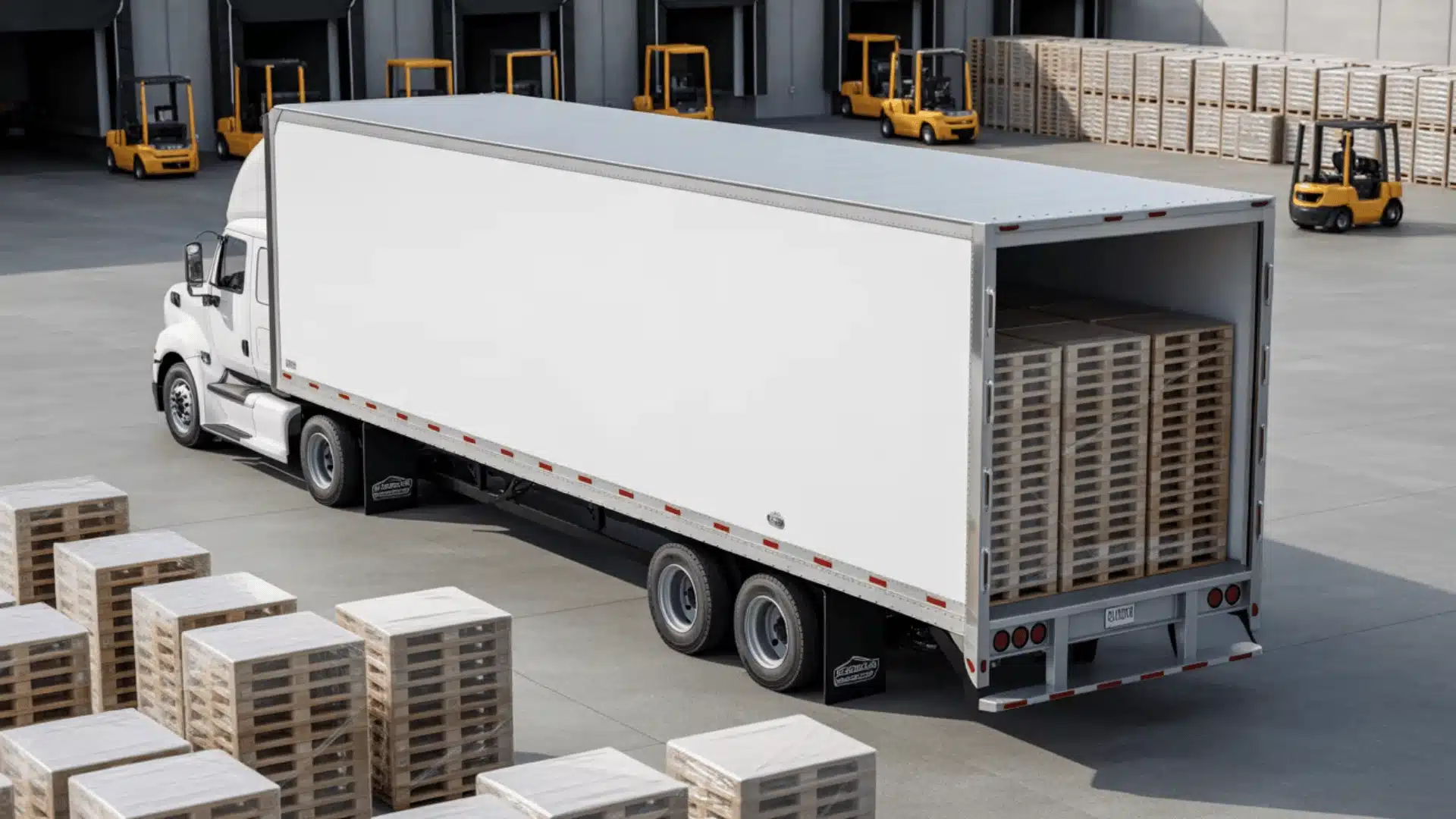

A trailer interchange agreement is the contract that decides who bears the risk of borrowed equipment, and trailer interchange insurance is the policy that pays when your side of that risk is triggered. The two have to line up. When they do, a damaged chassis or container is an ordinary claim. When they do not, it is a dispute between a motor carrier, an equipment provider and an insurer. For what happens after a crash, see towing someone else’s trailer: who pays after an accident.
This article walks through a typical agreement clause by clause, using illustrative terms written for the purpose. For the coverage itself, see trailer interchange coverage explained, and for a trailer sitting in your own yard, the drop-yard article. The coverage page for trailer interchange gives the product overview.
What is a trailer interchange agreement?
It is a written contract between the party that owns the equipment and the motor carrier that moves it. Federal safety rules give it a definition. In 49 CFR 390.5, an intermodal equipment interchange agreement is the UIIA or any other written document executed by an equipment provider and a motor carrier whose main purpose is to set out the responsibilities and liabilities of both parties for the interchange. Interchange itself is providing the equipment to a carrier under that agreement to move it for loading, unloading or repositioning, and it does not include leasing equipment for the carrier’s primary use in its own freight hauling.
Two things follow. A written agreement is the starting point of the risk transfer, and the line between interchange and leasing decides which paper governs. The UIIA is the best-known form, and what UIIA insurance requires covers its insurance side.
What do sample terms look like, clause by clause?
The samples below are written for this article. They are not from the UIIA or any insurer’s form, they contain no amounts, and your documents control. They show the shape of the clauses, which is what to look for.
Illustrative clause, custody: “The carrier takes custody of the equipment when it is hooked or loaded at the provider’s facility and keeps custody until the provider accepts it back at the designated return point.”
Illustrative clause, condition: “The carrier will inspect the equipment at pickup and note visible damage on the condition record. Damage not noted at pickup is presumed to have occurred while in the carrier’s custody.”
Illustrative clause, responsibility: “The carrier is responsible for loss of or damage to the equipment while in its custody, except for ordinary wear and tear.”
Illustrative clause, insurance: “The carrier will keep in force liability, cargo and equipment-damage insurance in the forms and limits the provider requires, name the provider as an additional insured, and give notice of cancellation.”
How does the agreement trigger interchange insurance?
Through the responsibility clause. Trailer interchange insurance is the coverage for physical damage to non-owned equipment in the carrier’s care, custody and control; the IANA’s insurance packet describes it in just those words. The agreement’s responsibility and custody clauses are what put the carrier on the hook for that damage, and the policy’s coverage grant is what pays it. If the agreement makes the carrier responsible for something the policy does not insure, the carrier pays out of pocket. If the policy insures something the agreement does not make the carrier responsible for, the coverage may never be needed.
The insurance clause adds a second link. It sets the form and the limit, and the packet says the limits for trailer interchange vary with the equipment providers involved. It also asks for additional insured status for the provider, which is a policy endorsement, not a clause in the agreement. A carrier should ask the agent for the endorsement by name.
Where do the agreement and the policy most often disagree?
Four places. The period: the agreement may run custody to acceptance while the policy covers only while the equipment is in use. The standard of responsibility: the agreement may make the carrier answer for all damage except wear, while the policy lists causes of loss and exclusions. The deductible: the agreement is silent on it, so the carrier carries it. And the notice terms: the insurance clause may require notice of cancellation that the policy does not carry unless endorsed. None of these is exotic. They are the places where a signed agreement turns out to ask for more than the policy gives.
Real-World Scenario: Imagine a hypothetical carrier that picks up a chassis without noting a dent already on the frame. Weeks later the provider charges for the dent under the responsibility clause, and the carrier’s claim runs into the condition clause, because nothing records the damage at pickup. Five minutes with a camera and a note on the record would have changed the outcome more than any change to the policy.
How do claims and notice clauses work?
Most agreements say when and how damage must be reported, and the clauses are strict because the provider needs to inspect the equipment and repair it. An illustrative version:
Illustrative clause, notice: “The carrier will report any damage to the equipment to the provider promptly after discovering it and will not move the equipment for further use until the provider has had the opportunity to inspect it.”
The insurance consequence is that the policy has its own notice terms, and the two clocks run together. A carrier who reports to the provider but not to the insurer, or the reverse, can lose ground with one of them. Report both on the same day, and keep copies of what you sent. The first-notice discipline for cargo losses, covered in the motor truck cargo article, applies here too.
What if the provider’s requirements change?
They can, and the agreement may allow for it. Providers update their insurance requirements, and the UIIA packet published by the IANA is itself revised, with a revision date on its first page. A carrier that signed in one year may be asked for different limits or documentation in the next. Treat the insurance clause as a living requirement: at each renewal, ask the agent to compare the current requirements to the policy, and ask the provider for its current requirements instead of relying on the version you saw at signing. The IANA keeps the UIIA program pages and the insurance packet current, so check them for the version in force.
What does the agreement leave to other coverages?
Several things. The freight inside a container belongs to the shipper, and the carrier’s liability for it is a motor truck cargo question, not an interchange question. Injury to people and damage to other people’s property in a collision is auto liability. And equipment you lease for your own primary use is outside the definition of interchange altogether, so the lease governs it and the usual physical damage questions apply. The agreement is about the borrowed equipment while it is in your custody. Keeping that boundary clear stops a carrier from expecting one policy to answer a claim that belongs to another.
What should you check before you sign?
Read the agreement with the policy beside it. Find the custody clause and mark its two ends. Find the condition procedure and decide who will do it every time. Find the responsibility clause and compare its standard to the policy’s causes of loss and exclusions. Find the insurance clause and list every item it asks for: forms, limits, additional insured status, notice. Then send the agreement to your agent before you sign, and ask for the wording that answers each point. For the cargo side of the same moves, the motor truck cargo page explains where freight coverage ends and equipment coverage begins.
Start a quote with the agreement attached if you want the two compared line by line.