
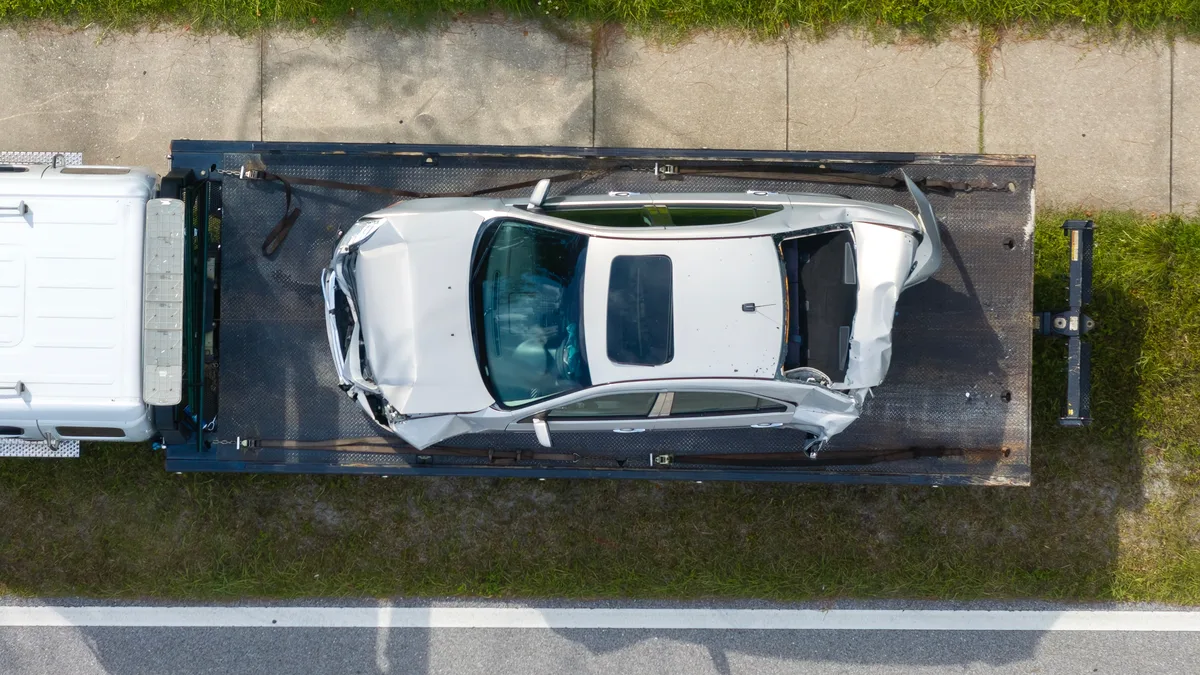

When a motor carrier tows someone else’s trailer and causes an accident, injury and damage to other people is usually paid by the auto liability policy covering the power unit, while damage to the borrowed trailer is paid only if you carry trailer interchange or non-owned trailer coverage. The freight inside is a third claim, answered by cargo. If you have no trailer coverage, the agreement under which you held the trailer can leave the repair bill with you.
The answer turns on three things: who was hurt, what was damaged, and what paperwork put the trailer behind your tractor.
Who pays for injuries and damage to other vehicles?
Your auto liability coverage, in most cases. Federal definitions in 49 CFR 390.5 treat a semitrailer as a vehicle that rests part of its weight on the towing vehicle, and many commercial auto forms treat a trailer attached to a covered power unit as part of that unit for liability purposes. The person injured or the driver of the other car makes a claim against the motor carrier operating the combination.
Ownership of the trailer usually does not change that answer. What can change it is wording. Some forms treat non-owned trailers differently, and some carriers’ policies are written so that liability follows only scheduled units. Read the definition of a covered auto in your policy, and ask your agent to confirm how it treats a trailer you do not own.
Who pays for damage to the trailer you were towing?
You do, unless you carry coverage for it, and if the agreement made you responsible. Most interchange and trailer agreements hold the carrier responsible for damage to the equipment while it is in the carrier’s possession. The owner sends you the repair bill, not its own insurer.
Three coverages can answer that bill. Trailer interchange covers a non-owned trailer held under a written interchange agreement. Non-owned trailer physical damage, offered by some insurers, covers trailers you use but do not own. Your own physical damage coverage covers the trailer only if it is scheduled on your policy, which is common for long-term rentals and rare for a trailer you picked up yesterday.
The comparison of these forms is in trailer interchange vs. cargo coverage on leased trailers.
Does the trailer owner’s insurance pay anything?
It might, and then it might come after you. A trailer owner may carry physical damage on its own fleet, and its insurer may pay the repair. If the agreement or the facts make the carrier responsible, that insurer can seek to recover what it paid from the carrier. Waivers of that right exist in some agreements, but they are not universal.
The safer assumption is that the owner will look to you. The sample clauses in trailer interchange agreement explained show how responsibility for equipment is usually worded.
Who pays for the freight in the trailer?
Your motor truck cargo coverage, if the cause of loss is covered. Under 49 U.S.C. 14706, a carrier that issues a receipt or bill of lading is liable for the actual loss or injury to the property. That liability exists whether or not the cargo form pays, so a crash that damages freight is the carrier’s problem first and the insurer’s only if the form agrees.
What changes if you were under dispatch for another carrier?
The lease and the dispatch status. Federal rules on lease and interchange of vehicles govern how equipment moves between carriers, and leases under those rules must say who provides insurance beyond the carrier’s public liability coverage.
If you are an owner-operator leased to a carrier and were hauling under its dispatch, the carrier’s auto liability usually answers for other people, and the lease decides who covers the trailer. If you were not under dispatch, the carrier’s policy may not respond, and your non-trucking or bobtail coverage may apply instead. Those forms commonly exclude time spent hauling for anyone, so a borrowed loaded trailer behind an off-dispatch tractor is a gap worth asking about. The article on non-trucking liability vs. bobtail explains the difference.
Real-World Scenario: Picture a hypothetical owner-operator with his own authority who takes a power-only load, hooking to a shipper’s loaded trailer at a distribution center. On a wet ramp the trailer slides into a guardrail and a passing car is damaged. His auto liability handles the car. The shipper’s freight is a cargo claim. The shipper then sends a bill for the trailer under the agreement he signed at pickup. He carries cargo and physical damage on his own tractor, but nothing for non-owned trailers, so the trailer repair is his to pay.
What should you do right after an accident with a borrowed trailer?
Report it to everyone, quickly. Call your insurer for the liability and cargo claims, and tell the trailer owner or equipment provider the same day, because agreements often set short notice periods. Photograph the trailer, the freight, the scene and the interchange paperwork, including any damage noted at pickup.
Keep the bill of lading, the interchange receipt or trailer agreement, and the dispatch record together. The claim for the trailer and the claim for the freight will be handled by different people, and each will ask for the same documents. If you hauled the trailer under another carrier’s authority, tell that carrier at once too.
What if the trailer was already damaged when you picked it up?
Then the paperwork from pickup decides the argument. Trailer owners repair what comes back damaged, and without a record of the trailer’s condition when you took it, the owner can bill you for a dent, a torn side or a failed light that was there before you hooked up. That bill may land on your trailer coverage, or on you if you have none.
Walk around every non-owned trailer before you leave with it. Note existing damage on the interchange receipt or trailer agreement, and photograph it with the date visible. If the owner’s staff will not note it, write it on your own copy and send a photo to the owner before you pull out. A record like that resolves most of these disputes in minutes, and the article on trailer interchange at a drop yard covers the same habit for trailers you drop and leave.
How should the coverage be set up before the next borrowed trailer?
Decide it before the trailer arrives, not after the crash. The steps are short:
- Ask your agent how your auto liability form treats non-owned trailers attached to your tractors, and get the answer in writing.
- Add trailer interchange or non-owned trailer physical damage, sized to the most valuable trailer you expect to pull.
- Check your cargo form’s covered causes of loss against the freight in those trailers.
- Read each trailer agreement for who is responsible for the equipment, and for how long.
If you pull other people’s trailers regularly, all four are routine. The overview in cargo, trailer interchange and general liability for trucks explains how those lines fit together as one program.
Which operations face this most often?
Power-only carriers, drayage and intermodal carriers, and any carrier that swaps trailers with customers or other carriers. Intermodal work is covered on the UIIA intermodal trucking insurance page. New carriers taking their first power-only loads are often the most exposed, because the first non-owned trailer arrives before anyone thinks to add the coverage; the page for new venture trucking insurance covers that stage.
What should you do next?
Look at the last month of loads and mark every trailer you did not own. Then start a quote and send that list with your current policy. We will tell you whether your auto liability treats those trailers as covered units and whether you need interchange or a non-owned trailer form for the trailers themselves.