Motor carrier classes by state

Arizona dump trucking insurance for aggregate and construction haulers

Arizona does not describe a legal truck only by what it weighs. A.R.S. § 28-1100(E) describes it by how many axles it is allowed to have — three, counting the front steering axle — unless every axle beyond that steers or casters. A four- or five-axle straight dump is outside that sentence on its face, and the way back inside is a permit.

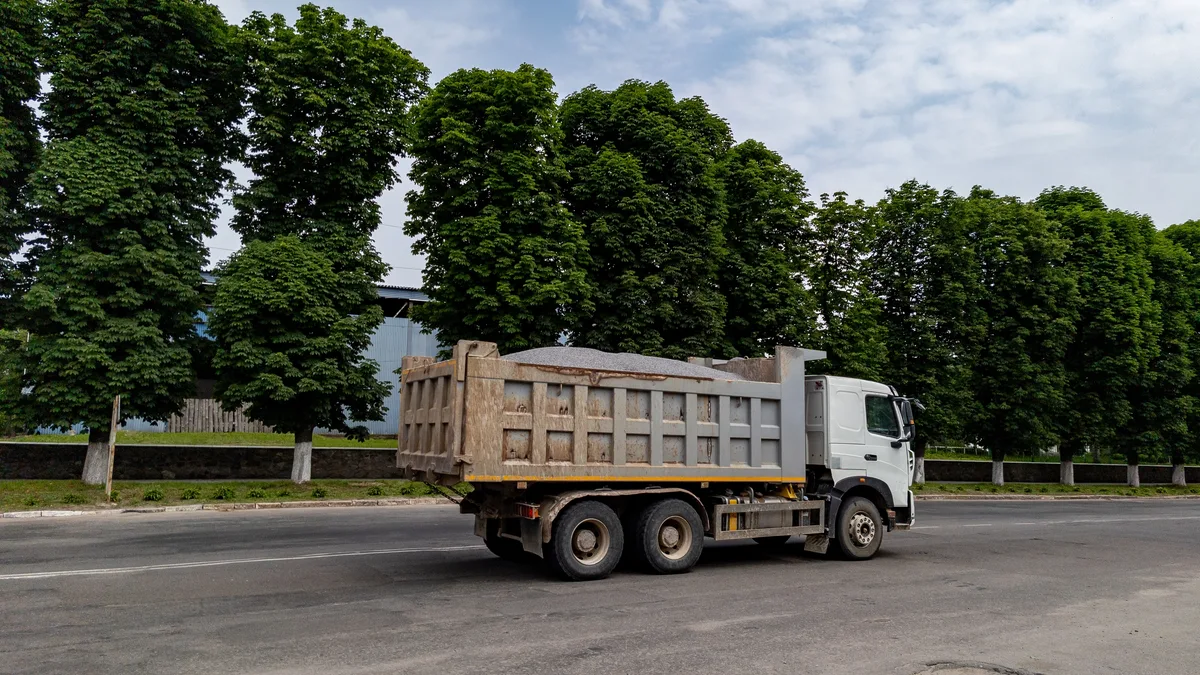
Loaded dump truck on a paved road — Arizona Dump Trucking Insurance from Truck Guard Insurance

The weight numbers in Arizona are the federal ones, and they are the least interesting thing on the page. A.R.S. § 28-1099(A) sets 20,000 pounds on any one axle. Section 28-1100(A) restates that, adds 34,000 on a tandem and 80,000 on a combination of five axles or more, and applies the bridge formula W = 500 (LN/(N-1) + 12N + 36) with the usual thirty-six-foot exception for two consecutive sets of tandems.

What separates Arizona is that three of those figures are quoted with the words "including enforcement tolerances" written inside them. The phrase appears three times in subsection (A) — on the single axle, on the tandem, and on the formula group. Whatever cushion an operator is used to assuming above a posted limit, in Arizona the legislature has already spent it and put the result in the number.

From there the statute stops talking about weight and starts talking about hardware. It caps axle count. It specifies where a lift-axle pressure control may physically be mounted. It writes a cure that tells an officer not to cite a driver in defined circumstances. And in a separate statute it puts an evidentiary precondition on a city that wants to keep trucks off an arterial. Arizona is a configuration state before it is a weight state, and a fleet spec’d elsewhere is what gets caught.

Bringing a super-dump or a lift-axle unit into Arizona? Send the axle count and the lift-axle control layout with the schedule. Two sentences in § 28-1100 decide whether the truck is legal-size equipment or permitted equipment, and the difference reprices the account.

Start a Arizona quote

Three axles, unless the extras steer or caster

Section 28-1100(E) reads that a single vehicle, or a single vehicle of a combination of vehicles, shall not be equipped with more than three axles including the front steering axle, unless the additional axles are steering axles or castering axles. The limitation does not apply to a vehicle operated with a permit issued under § 28-1103.

This is a cap on the vehicle, not on the load. It is indifferent to how much the truck weighs on the day. A straight dump carrying four or five axles — the configuration that exists precisely so a heavier payload can be spread legally — runs into the sentence before any scale does, and the only two answers in the statute are that the extra axles steer or caster, or that the truck is moving under a § 28-1103 special permit.

That has a direct consequence for how an Arizona schedule should be described. In most states the permit question follows from the load; here it can follow from the chassis. A unit that never exceeds 80,000 pounds and never leaves a legal route may still be a permitted vehicle in Arizona because of how it is built, and a fleet listed to an underwriter as running "legal weight" is not thereby running legal size.

The rest of the section closes off the obvious workaround. Subsection (D) states that it is not a defense in a prosecution that the vehicle is registered for a declared gross weight in excess of what the section allows, and adds that the department shall not make an allowance or refund for fees paid for the excess weight. Registering high buys nothing operationally and does not even get the fee back.

  • Three axles maximum on a single vehicle, counting the front steering axle — § 28-1100(E).
  • Additional axles permitted only where they are steering axles or castering axles.
  • Permit escape — the cap does not apply to a vehicle operated under a § 28-1103 permit.
  • Declared gross weight is not a defense and the fee is not refundable — § 28-1100(D).
  • Tandem defined as two or more consecutive axles more than forty and not more than ninety-six inches apart — § 28-1100(B).

Where the lift-axle pressure control has to live

Section 28-1100(F) is an equipment specification written into a weight statute. A vehicle or combination equipped with one or more variable load axles shall have the pressure control preset and located outside of the cab, so that the operator cannot vary the weight carried on the variable load axle or axles during transport of a load. The actuating control that raises or lowers the axle may be inside the cab for safety purposes, and that in-cab control must completely raise or completely lower the axle when activated.

Three separate requirements are packed into those two sentences, and they are separable in an inspection. The pressure setting must be preset rather than adjustable in transit. The pressure control must be physically outside the cab. And the raise-lower actuator, if it is inside the cab, must be all-or-nothing rather than proportional.

The reason the drafting takes that shape is the practice it is aimed at. A driver who can dial down lift-axle pressure from the seat can move weight off a group before a scale and back onto it afterwards, and can also run an axle partially deployed in a way that puts more load on the pavement than the axle count suggests. Arizona has answered that by moving the adjustment out of reach rather than by writing a rule about how it may be used.

For an operator this is a retrofit question as much as a purchasing one. Equipment built for a state that regulates lift axles differently may arrive in Arizona with an in-cab pressure gauge and regulator that is entirely ordinary elsewhere and non-compliant here. It is a cheap thing to verify on a walk-around and an expensive thing to discover at a port of entry.

The statute tells the officer not to write the ticket

Section 28-1101(C) is the most dump-specific enforcement provision in Arizona law, because it is written for the violation a dump truck actually commits. Where an officer finds that a person has violated only the axle weight limitation and not the total weight limitation, the officer shall request the driver to shift the load, as reasonable under the circumstances, to bring the vehicle into compliance.

What follows is a genuine cure rather than a discount. If the driver complies with the axle limitation after shifting the load and the excess axle weight was 2,500 pounds or less, the statute says the officer shall not cite the driver and the driver is not subject to a civil penalty for the axle violation. If the driver refuses the request, or shifts and still does not comply, or the excess was more than 2,500 pounds, the penalty is back on.

That threshold is worth planning against, because the misload it forgives is the ordinary one: material loaded slightly forward, a body that discharged unevenly, a tandem that came up heavy while the gross stayed legal. The condition is that the load can actually be shifted and that the driver cooperates on the spot — which makes driver instruction, not loading arithmetic, the control that captures the benefit.

Where the cure does not apply, subsection (B) sets minimum civil penalties on a graduated table running from $100.00 at 1,001 to 1,250 pounds of excess up to $1,400.00 at 4,751 to 5,000 pounds, and at 5,001 pounds and over the penalty is $1,400.00 plus an additional $100 for each 1,000 pounds of excess weight. Subsection (A)(1)(c) sets a penalty of $1 where the excess is 1,000 pounds or less. Subsection (A)(2) and (A)(3) then escalate: a second violation within six months of the preceding judgment is a class 3 misdemeanor, and a second conviction within a year of that is a class 2 misdemeanor. Overweight in Arizona is a civil matter until it is repeated.

  • Axle-only overweight, load shifted on request, excess 2,500 lb or less — no citation, no civil penalty.
  • Driver refuses to shift — civil penalty applies.
  • Shifted but still non-compliant, or excess over 2,500 lb — civil penalty applies.
  • Excess of 1,000 lb or less — $1 under § 28-1101(A)(1)(c).
  • 1,001 to 5,000 lb of excess — the graduated minimum table, § 28-1101(B).
  • 5,001 lb and over — $1,400.00 plus $100 for each additional 1,000 lb.
  • Repeat inside six months — class 3 misdemeanor; a further conviction within a year, class 2.

We place Arizona dump and aggregate accounts, including multi-axle and lift-axle equipment, permitted configurations, and fleets working the border band and the Phoenix-metro pit corridors.

Get a Arizona quote

A scale ticket cuts both ways

Two adjacent subsections make shipping paperwork evidence in an Arizona weight case, and they run in opposite directions. Under § 28-1101(F), a weight certificate or other document evidencing receipt of goods for shipment, issued by a person engaged in the business of transporting or forwarding goods, that states a gross weight in excess of the § 28-1099 or § 28-1100 maximum is prima facie evidence that the weight of the vehicle and load is unlawful.

Subsection (G) supplies the mirror image, and it is conditioned on a fact that describes aggregate exactly: if the commodity being carried is sold by weight, a certificate showing a gross weight that is not in excess of the § 28-1100 maximum is prima facie evidence that the gross weight is lawful. That presumption may be rebutted by the weight shown on the department’s stationary scale or a public weighmaster scale.

For a fleet hauling material that is priced by the ton, subsection (G) is a real asset — the same ticket that bills the customer is a presumption of legality — and it is only as good as the practice behind it. Tickets that are estimated, rounded, or written after the fact do not carry the same weight in either direction, and a fleet whose ticketing is loose has given up the defense while keeping the exposure in subsection (F).

Pavement repair is handled separately again, at § 28-1107, and the drafting closes the door an operator would most want open. Being over the article’s weight or height maximum under a § 28-1094 or § 28-1103 permit does not move the repair bill off the person who drove the load; the section names permitted movement expressly. Owner and driver stand behind it jointly where the driving was with permission, and the road authority sues to collect. Buying the permit buys the movement, not the road.

A city has to prove the street before it can close it

Section 28-1106 gives local authorities and the director the ordinary power to prohibit trucks or limit weight on designated highways with uniform signs designed by the department, at subsections (C) and (D). Subsection (E) then puts an evidentiary predicate on that power that most states do not have.

For ordinances or resolutions enacted on and after January 1, 2020, the director or a local authority may only restrict or prohibit a vehicle of legal size from operating on a highway that is a major arterial street connecting two or more local jurisdictions if the department or the local authority conducts a test drive or applies a vehicle template on the highway showing that a legal-size vehicle may not safely operate there. Subsection (F) forbids granting exceptions for categories, types or groups of routes once that finding is made, and subsection (G) stops a highway that carried no truck restriction before annexation from being folded into an existing post-2020 restriction unless it meets the same test.

Subsection (H) turns that into a right an operator can exercise. Any person may request in writing a review of a route restriction enacted on or after January 1, 2020, and the director shall act on all requests within ninety days after receiving the written request. If the director determines that a legal-size vehicle can operate safely on the arterial, the local jurisdiction may not restrict it. Definitions in subsection (K) do the load-bearing work: "major arterial street" is defined in five limbs, reaching any arterial with freeway or national highway system access, any arterial with a bridge on its route, and any arterial designated major in an adjoining jurisdiction; and "safely operate" means a determination based on a test drive, traffic engineering study or vehicle template.

Subsection (I) nullifies outright a truck restriction on a major arterial that did not provide through access between jurisdictions before January 1, 2023 and was subsequently improved after December 31, 2022 to provide it — unless one of three cures is met. The second of those is the notable one: the local authority notifies by certified mail all active statewide associations registered for lobbying purposes with the secretary of state that primarily represent trucking interests, and obtains a letter of support from all of them. Not a majority. All.

Subsection (J) then attaches a maintenance duty to the signs themselves. They must be placed near every intersection or junction with a traffic control device along designated highways, must inform the public of the restrictions, and must either direct the public to the fastest route out of the restricted route or state the distance of the restriction. Beginning January 1, 2024, restrictions imposed under subsections (C) and (D) are unenforceable on restricted routes in existence from and after October 30, 2023 if the director or local authority fails to erect or maintain signs as prescribed. That is a defense built into the statute, and it is conditioned on both dates and on a failure either to erect or to maintain — the whole sentence has to be satisfied, not half of it.

Nine people review the ordinance, and four of them are carriers

Arizona also runs a state check on local permit rules, and it has a named body. Under § 28-1103(F), a local authority that issues oversize or overweight permits shall adopt and enforce ordinances substantially identical to the department’s rules for overdimensional or overweight commercial vehicles, may add infrastructure, route and time-of-day restrictions, and shall provide all its current ordinances and rules to the department electronically for publication to the public.

Subsection (G) requires that before adoption, the engineer or designated officer with jurisdiction over the local authority’s highways submits the proposed ordinance to the department, which submits it to the overdimensional permit council. Subsection (H) gives the council ninety days from the department’s receipt to review it for compliance, and supplies the default: the proposed ordinance is deemed compliant if the council does not act within that period. On a noncompliance finding the council must notify the department before the ninety days end, and the department must notify the local engineer in writing within thirty days after the review with the specific provisions and the council’s reasons.

Section 28-1150 composes the council: nine governor-appointed members, being one from the department of public safety, one from the department of transportation, four representing motor carriers, one from a city or town over one hundred thousand persons, one from a city or town of one hundred thousand or less, and one from the governor’s office of highway safety. Members serve staggered three-year terms, meet at least annually, and are not eligible for compensation or reimbursement of expenses.

Four of nine seats held by carriers is an unusual composition for a body that reviews municipal ordinances, and it is worth knowing about for a practical reason: § 28-1103(J) makes clear this review does not limit a local authority’s power to restrict highway use under § 28-1106, so the two mechanisms operate in parallel. An Arizona haul route can be constrained by a permit ordinance that went through the council, or by a truck restriction that went through the § 28-1106 test-drive predicate, and they are answered in different places.

Permit prices, and the two figures that cannot travel alone

Section 28-1105(A) sets the fees in the statute itself. Excess size runs fifteen dollars for each special permit, thirty dollars for each thirty-day permit and three hundred sixty dollars for each annual permit. Excess weight runs seventy-five dollars for each permit and each thirty-day permit, and six hundred dollars for each annual permit. A permit for a vehicle exceeding both size and weight is charged at the excess weight amount. Section 28-1103(C)(3) separately sets a forty-five dollar excess width permit for a registered watercraft.

Two anti-stacking rules follow. Under subsection (C), where a permit is required by the director and by one or more local authorities, the applicant pays a permit fee only to the director. Under subsection (D), where only local authorities require it, the fee is paid only to the authority where the movement originates. Subsection (B) charges no fee at all for movements of vehicles owned by the United States, the state, or a county, city or town. Separately, § 28-1103(B) lets the director establish fees to cover all or part of the cost of review and analysis of overdimensional and overweight permit requests, collected in addition to the permit fee.

The border allowances are where the numbers get large, and neither of them may be quoted without the condition attached to it. Section 28-1103(C)(1) authorizes a thirty-day or one-year permit for a truck-semitrailer, truck-trailer, truck tractor-semitrailer-semitrailer or truck tractor-semitrailer-trailer combination at up to 129,000 pounds gross — but only where the cargo carrying unit does not exceed ninety-five feet, the axle weights stay within §§ 28-1099 and 28-1100, and the combination is traveling within twenty miles of the borders of Arizona and an adjacent state that allows such combinations of length and gross vehicle weight.

Section 28-1103(C)(2) authorizes a truck plus two trailing units, or a truck tractor, semitrailer and two trailing units, at up to 123,500 pounds — off the national intercity truck route network, again with a ninety-five foot cargo carrying unit, and only on either a state route within four miles of and extending to the border of an adjacent state that allows such combinations, or a state route that extends at least ten miles through an Indian reservation, does not cross the Colorado river and lies within twenty miles of and extends to such a border. Both allowances are contingent on what the neighboring state permits; stated without that condition, either figure is simply wrong.

The international border has its own arrangement inside the fee statute. Under § 28-1105(A)(2), for commercial vehicles traveling through an international port of entry on a special single trip excess weight permit, the seventy-five dollar fee is allocated each month fifty per cent to the state highway fund, twenty-five per cent to counties located in the twenty-five mile commercial border zone identified on the permit, and twenty-five per cent to incorporated cities and towns in that zone, apportioned among them by population.

The pit has a plan, and the haul road is in it

Arizona runs a dedicated state program for aggregate operations, separate from its hard-rock mining regime: Aggregate Mined Land Reclamation, at A.R.S. Title 27, Chapter 8. Under § 27-1271(A), an owner or operator may submit a single reclamation plan covering multiple aggregate mining units of an aggregate mining facility — a permission to consolidate, not a requirement to.

Subsection (B) enumerates thirteen required plan contents, and three of them reach a hauler rather than only a pit operator. Paragraph (7) requires a narrative description of roads that are proposed for the aggregate mining unit, which makes the haul road a plan element with a written description behind it. Paragraph (12) requires the distance in feet and the direction from the closest existing occupied residential structures, measured from the exterior of the structure to the closest crest of excavation and including any intermediate rights-of-way. Paragraph (13) requires a statement that notice of the proposed plan was given to each residential property owner whose property lies within a one-half mile radius of the operation as shown on the current property tax roll, naming the operator’s designated representative who will answer questions.

Paragraph (11) requires the plan to state the estimated costs of each proposed reclamation measure for the purposes of determining financial assurance requirements under article 5 of the chapter. The schedule that article 5 produces is a separate body of law that this page does not describe, and an operator with a live reclamation obligation should read it rather than infer it from the plan requirement that points at it.

Why any of this matters to a trucking program is proximity. A site whose plan already records a measured distance to the nearest occupied home, and whose neighbors were individually noticed inside a half-mile radius, is a site where complaint-driven disputes about dust, noise and truck movements have a documented starting point. That is the environment a haul contract operates in, and it is where general liability and, where the material or the site warrants it, pollution liability do their work rather than the auto form.

Two allowances that pay back hardware weight

Section 28-1100(H) allows a heavy-duty vehicle equipped with idle reduction technology to exceed the subsection (A) limits — on gross and on any one axle or axle group — by not more than five hundred fifty pounds or the weight of the idle reduction technology, whichever is less. It applies only if the operator, on request, proves by written certification the weight of the technology and demonstrates or certifies that it is fully functional at all times, and it borrows the definitions of "heavy-duty vehicle" and "idle reduction technology" from 42 United States Code section 16104a.

Section 28-1100(I) does the same job for a truck running on natural gas, battery electric or hydrogen. It may go above the subsection (A) figures, but not past eighty-two thousand pounds, and not past the difference between what the alternative fuel or fuel cell system weighs and what a comparable diesel tank and fueling system would weigh — whichever of those two ceilings comes first.

Neither credit is large and both are bounded twice over, but they are worth claiming because the hardware they offset displaces revenue weight pound for pound. An operator who has spec’d either technology and is loading to the base figure is leaving lawful payload behind, and an operator who is relying on one should know which subsection it is and be ready to produce the certification subsection (H) makes a precondition.

One thing neither subsection does is create headroom for ordinary loading. Both are measured against specific hardware, both cap at the lesser of a stated figure and the actual weight of the equipment, and § 28-1100(D) has already foreclosed the argument that a higher declared gross weight buys operating room.

  • Idle reduction technology — up to 550 lb or the technology’s weight, whichever is less, on gross and on any one axle or group.
  • Proof condition — written certification of weight, plus demonstration or certification of full functionality at all times.
  • Natural gas, battery electric or hydrogen — up to 82,000 lb gross, or the differential against a comparable diesel system, whichever is less.
  • Over-the-road bus — a separate 24,000 lb single axle allowance at § 28-1099(A)(2), not available to freight equipment.
  • Road machinery — moved job to job or to servicing under a § 28-1103 special permit, § 28-1099(A)(1).

The load-escape rule names clean air as a reason

Section 28-1098(A) is unusual in naming its own objectives in the opening clause, and it names two rather than one: highway safety, and air pollution prevention. Against those purposes, a truck may not be driven or moved unless it has been built or filled so that nothing comes out of it in transit. Three things are allowed anyway — enough sand to get traction, water or another substance sprinkled while cleaning or maintaining a roadway, and small fragments of agricultural material such as leaves and stems.

Subsection (B) adds the securement half: whatever is on the truck, and whatever is over it, has to be tied down well enough that neither works free or turns into a hazard for other road users. Subsection (C) sets the whole section aside for a vehicle in agricultural use on a farm.

Read in full, § 28-1098 is a construction-and-securement rule rather than a command to cover. It requires that escape be prevented and that a covering, where one is used, be secured; it does not contain a free-standing sentence directing that a load of sand or other loose material must be sheeted. That statement is scoped to this section as read in its entirety, and it is a description of how Arizona has drafted the duty rather than a claim about what any customer contract, air quality rule or site condition may separately require of a hauler in this state.

Subsection (D) prices it, and every tier is a ceiling rather than a fixed amount. A first violation in a sixty-month period causing no damage or injury draws a civil penalty of not more than $250; a second or subsequent violation in that sixty-month period, not more than $350; a violation resulting in an accident causing serious physical injury as defined in § 13-105, not more than $500; and a violation resulting in an accident causing death, not more than $1,000. The sixty-month look-back is the number to hold onto, because it makes a single spill event a five-year fact rather than an annual one.

What an Arizona schedule has to answer

Because so much of Arizona’s regime is written about equipment rather than about loads, the useful description of an Arizona fleet is a description of how the trucks are built and where they run — not a payload average and a loss run.

The two questions that reprice an account are the axle count and the lift-axle control layout, because § 28-1100(E) and (F) decide whether a unit is legal-size equipment or permitted equipment. The two that decide route exposure are whether the haul touches a major arterial with a post-2020 truck restriction, and whether any leg runs inside the twenty-mile border band where the § 28-1103(C) allowances live. Everything else follows from those four.

Two exposures then sit outside the auto policy altogether. Everything the crew does after the truck has stopped rolling, and everything the material does after it has left the body, answers to general liability rather than to a highway form. And a unit that is permitted for its configuration rather than for a load is not a dump truck with paperwork — it is a movement class of its own, which is why it belongs under oversized and overweight underwriting, with the hoist, body and lift-axle hardware inspected on the terms that physical damage is actually rated on.

  • Axle count per unit, and whether any axle beyond the third steers or casters — § 28-1100(E).
  • Lift-axle control layout, specifically whether the pressure control is preset and outside the cab — § 28-1100(F).
  • Permit classes carried, and whether any unit is permitted for configuration rather than for load.
  • Load-shift practice at scales, since § 28-1101(C) forgives an axle-only excess of 2,500 lb or less on compliance.
  • Ticketing discipline, given that § 28-1101(F) and (G) make the same document evidence in either direction.
  • Route exposure to post-2020 arterial restrictions, and whether a § 28-1106(H) review has ever been requested.
  • Border-band work within twenty miles of an adjacent state, where the 129,000 and 123,500 lb allowances apply on the neighbor’s terms.
  • Spill history over sixty months, which is the look-back § 28-1098(D) uses rather than a calendar year.

Coverage lines a Arizona dump and aggregate account usually carries

The state minimum is a licensing threshold. The program an operator actually needs is built from these lines:

  • Trucking Auto Liability — Primary liability coverage for bodily injury and property damage caused by your truck while under dispatch.
  • Physical Damage — Collision and comprehensive coverage for the tractor, trailer, and attached equipment you own or finance.
  • Motor Truck Cargo — Coverage for the freight you haul against loss or damage in transit.
  • Trailer Interchange — Coverage for non-owned trailers you pull under written interchange agreements.
  • General Liability — Coverage for premises and operations liability away from the truck — terminal yards, customer docks, and non-driving exposures.
  • Workers Compensation — Statutory coverage for driver and yard-employee injury, structured for trucking payrolls and interstate operations.
  • Non-Trucking (Bobtail) Auto Liability — Liability coverage for the tractor when operated off-dispatch — bobtailing home or running personal errands.
  • Pollution Liability — Coverage for cargo-related pollution events and upset/overturn spills not covered by standard auto liability.

Why Truck Guard Insurance for a Arizona dump and aggregate account

We write dump and aggregate hauling as a named class rather than as an exception to general trucking, and we read each account against the weight and permit regime of the state it operates in. For a Arizona operator that means starting from what the trucks are actually licensed and configured to carry, sizing physical damage to bodies and hoists rather than to a chassis value, and treating pit, stockpile and job-site work as its own exposure rather than an extension of the highway auto form.

If the operation also runs freight under separate authority, the Arizona trucking insurance page covers the state’s broader motor carrier picture, and the dump trucking insurance page covers the class mechanics that apply wherever the operator runs.

Arizona dump trucking insurance questions

Is a four-axle dump truck legal in Arizona?

Not as legal-size equipment unless the extra axles steer or caster. A.R.S. § 28-1100(E) provides that a single vehicle shall not be equipped with more than three axles including the front steering axle unless the additional axles are steering axles or castering axles, and the limitation does not apply to a vehicle operated with a permit issued under § 28-1103. The cap is on the vehicle, not on the load.

Where does Arizona require the lift-axle control to be mounted?

Outside the cab, and preset. A.R.S. § 28-1100(F) requires a vehicle with one or more variable load axles to have the pressure control preset and located outside of the cab so the operator cannot vary the weight carried during transport. The raise-and-lower actuating control may be inside the cab for safety purposes, but it must completely raise or completely lower the axle when activated.

Will an Arizona officer let a driver shift the load instead of citing?

In defined circumstances the statute requires it. Under § 28-1101(C), where only the axle limit and not the total weight limit is violated, the officer shall request the driver to shift the load. If the driver then complies and the excess axle weight was 2,500 pounds or less, the officer shall not cite the driver and no civil penalty applies for the axle violation. Refusal, continued non-compliance, or an excess above 2,500 pounds reopens the penalty.

Do Arizona weight limits include an enforcement tolerance?

The tolerance is inside the number. A.R.S. § 28-1100(A) states 20,000 pounds on any one axle and 34,000 pounds on a tandem "including enforcement tolerances," and uses the same phrase again for the bridge formula group. The stated figures are therefore not limits with an allowance on top.

Can an Arizona city ban trucks from an arterial street?

Only on evidence, for ordinances enacted on and after January 1, 2020. A.R.S. § 28-1106(E) requires the department or the local authority to conduct a test drive or apply a vehicle template showing that a legal-size vehicle cannot safely operate on a major arterial street connecting two or more local jurisdictions. Section 28-1106(H) also lets any person request a written review, on which the director must act within ninety days.

What makes an Arizona truck restriction unenforceable?

Sign failure. Under § 28-1106(J), beginning January 1, 2024, restrictions imposed under subsections (C) and (D) are unenforceable on restricted routes in existence from and after October 30, 2023 if the director or local authority fails to erect or maintain signs as prescribed by that subsection — signs near every intersection or junction with a traffic control device, informing the public of the restriction and either directing them to the fastest route out or stating the distance restricted.

How much can a combination weigh near the Arizona border?

Up to 129,000 pounds under § 28-1103(C)(1), or up to 123,500 pounds for the two-trailing-unit combinations in § 28-1103(C)(2) — but both are conditional. The first requires travel within twenty miles of the border of an adjacent state that allows such combinations of length and gross vehicle weight; the second requires a qualifying route to the border of an adjacent state that allows those combinations, and is unavailable on the national intercity truck route network.

Does Arizona give extra weight for alternative fuel or idle-reduction equipment?

Yes, capped. Section 28-1100(H) allows up to 550 pounds or the weight of the idle reduction technology, whichever is less, subject to the operator certifying the technology’s weight in writing and showing that the equipment works whenever it is called on. Section 28-1100(I) allows a natural gas, battery electric or hydrogen vehicle up to 82,000 pounds, or the differential against a comparable diesel tank and fueling system, whichever is less.

What is the penalty for spilling material from a truck in Arizona?

A capped civil penalty on a sixty-month look-back. Section 28-1098(D) sets not more than $250 for a first violation in a sixty-month period causing no damage or injury, not more than $350 for a second or subsequent violation in that period, not more than $500 where the violation results in an accident causing serious physical injury as defined in § 13-105, and not more than $1,000 where it results in a death.

Sources

Every figure on this page was read at the source below on August 11, 2026, with the effective date of the version read. Treat each as current as of that date rather than as permanent.

Get a Arizona dump trucking insurance quote

Send the declared or registered weights alongside the axle configurations, and tell us where the material moves from. We will size the program against the work the trucks actually do rather than against a statutory floor.

Start a quote Call 317-942-0549