Motor carrier classes by state

Delaware dump trucking insurance for aggregate and construction haulers

Delaware does not derive a dump truck’s legal gross weight from a bridge table. It reads the weight off the truck itself — how many axles it has, and how those axles are braked. Two axles buy 40,000 pounds, three buy 65,000, four buy 73,280, and a three-axle truck can add 5,000 more for a hundred dollars paid once at the registration counter.

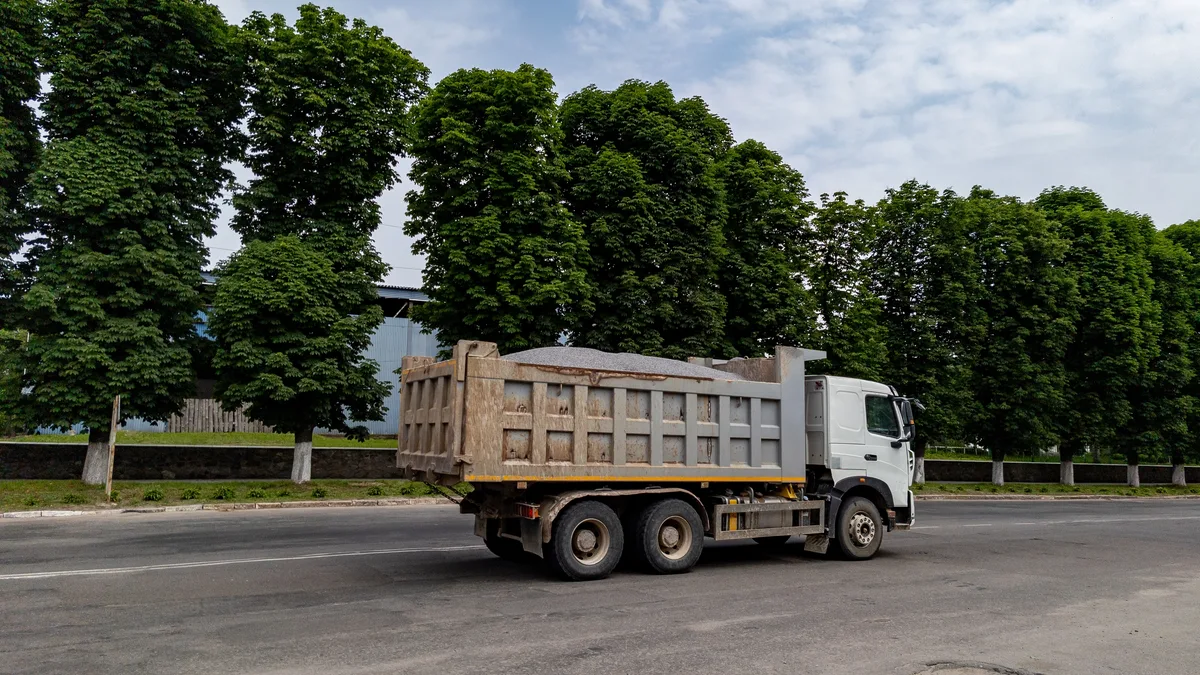
Loaded dump truck on a paved road — Delaware Dump Trucking Insurance from Truck Guard Insurance

Ask what a truck may lawfully carry in most jurisdictions and the answer is a procedure: measure the wheelbase, count the axles, read across the table, apply the formula. Delaware answers with a short list instead. 21 Del. C. § 4502(c), in the Delaware Code Online text as last amended by 84 Del. Laws, c. 416, § 2, sets one gross weight per axle count for single units and another per axle count for tractor-semitrailer combinations, and attaches a brake condition to each tier. A driver who can count axles and knows what is under them can compute a Delaware legal weight without a tape measure.

That design suits aggregate work, and it produces a very small number of numbers to get wrong. It also means the interesting questions in Delaware are not about tables. They are about which schedule applies on which class of road, what a construction-site registration actually buys, and what happens when a licensed weight and a manufacturer’s rating disagree.

The last of those changed this summer. A qualifier attached to the construction-site upgrade — sitting not in the weight chapter but in the registration chapter — carries a commencement date of June 15, 2026, and it takes away the one thing the upgrade used to allow. An operator who registered a tri-axle in Delaware in 2024 and one who registers the same truck now are not in the same position, and that difference is worth understanding before a schedule of values is priced.

Registering Delaware tri-axles for construction-site weight? Send the registered gross weights and the manufacturer’s GVWR for each unit together — since June 15, 2026 those two numbers have to agree.

Start a Delaware quote

The schedule reads off the axles and the brakes

21 Del. C. § 4502(c)(1) through (c)(3) build the single-unit ladder, and each rung carries a brake specification rather than an axle spacing. A vehicle equipped with 2 axles, having each of the 2 axles equipped with 2 hubs with a power brake on each hub, may not exceed a total gross weight of 40,000 pounds or the manufacturer’s gross vehicle weight rating, whichever is less. A vehicle equipped with 3 axles on the same terms is capped at 65,000 pounds or the manufacturer’s rating. A vehicle equipped with 4 axles, having each of the rear axles equipped with 2 hubs with a power brake on each rear hub, is capped at 73,280 pounds or the rating.

Read the two halves of each cap separately, because they fail in different ways. The statutory number is a legal ceiling that a police officer measures at a scale. The manufacturer’s gross vehicle weight rating is an engineering ceiling that no roadside scale reads, and the statute makes it operative by writing “whichever is less” into every tier. A Delaware truck can therefore be under the number the driver remembers and over the number the law actually imposes, and the driver will have no way to know that from the load alone.

The brake condition is doing real work too. It is written as a condition of entitlement to the weight, not as a general equipment rule — the higher tiers are available to a vehicle configured with two hubs per axle and a power brake on each hub, and a vehicle that is not so configured has not earned the tier. That matters when a used unit is bought out of state, rebuilt, or re-axled, because the modification that adds capacity on paper does not add it in law unless the braking follows.

Combination units run a parallel ladder on a different basis: § 4502(c)(4) caps a tractor and semitrailer with a total of 3 axles at 60,000 pounds, (c)(5) caps 4 axles at 70,000, and (c)(6) caps 5 or more axles at 80,000 — each again alternatively limited by the combined manufacturer’s rating. Notice what that does to a mixed fleet. A four-axle single unit is allowed more weight in Delaware than a four-axle tractor-semitrailer, which is the reverse of the intuition most operators carry in from states that run a bridge formula.

  • Two axles, single unit — 40,000 lb or the manufacturer’s GVWR, whichever is less, with 2 hubs and a power brake on each hub of both axles.
  • Three axles, single unit — 65,000 lb or the GVWR, on the same hub and brake terms.
  • Four axles, single unit — 73,280 lb or the GVWR, with 2 hubs and a power brake on each rear hub.
  • Tractor-semitrailer, 3 / 4 / 5-or-more axles — 60,000, 70,000 and 80,000 lb respectively, each alternatively capped at the combined GVWR.
A hundred dollars, paid once, for the top 5,000 pounds

The three-axle tier carries the clause that matters most to a Delaware dump operator, because a tri-axle single unit is the archetypal three-axle vehicle. Section 4502(c)(2) states that notwithstanding the 65,000-pound cap, and as limited in § 2105 of the same title, “it shall be lawful to operate such a vehicle to and from any construction site located in this State when the total gross weight does not exceed 70,000 lbs.” The same sentence extends the identical allowance to a vehicle containing agricultural products, and then attaches the price: “provided that vehicles utilizing the above exception shall pay a fee of $100 per vehicle at the time of registration for this extra weight capacity.”

That is a licensing transaction, not a permit transaction. There is no trip declaration, no route designation and no expiry inside the season — the fee is paid once per vehicle at registration and the capacity attaches to the truck for the registration year. For a contractor moving stone and fill between a pit and a job, the practical effect is that the top 5,000 pounds of a tri-axle’s legal payload is a line item on a registration receipt.

The scope condition is narrow and worth reading literally. The allowance runs “to and from any construction site located in this State.” It is not a general uprating of the three-axle tier, and it is not available for a haul that has no construction site at either end. An operator who runs a mix of construction delivery and general bulk work is operating one truck under two different legal ceilings depending on where the load is going, which is a dispatch discipline question long before it is an insurance one.

It is also the reason a Delaware registration document is a genuinely useful underwriting artifact. A registration that reflects the extra weight capacity tells you the operator has declared construction-site work and paid for the capacity to do it. A tri-axle fleet running job-site deliveries whose registrations show no such capacity is telling you something else. Either way the paper and the operation should agree before physical damage values and auto liability exposures are set.

June 15, 2026 closed the gap between the license and the rating

The cross-reference in § 4502(c)(2) — “as limited in § 2105 of this title” — sends the reader out of the size and weight chapter and into the registration chapter, and that is where the constraint actually lives. 21 Del. C. § 2105(d), as amended by 83 Del. Laws, c. 308, § 1, sets out five conditions on vehicles registering for the extra weight capacity, and the fifth is a date.

For years the general rule in § 2105(d) had been that a vehicle over 26,000 pounds could not be registered above its manufacturer’s gross vehicle weight rating, with the construction-site exception at § 4502(c)(2) carved out of that rule. The carve-out was already fenced: paragraph (d)(2) blocked it for any vehicle rated under 65,000 pounds, (d)(3) blocked it on a first registration, and (d)(4) blocked it for any vehicle of a model year twenty or more years before the registration date. Paragraph (d)(5) then closes the remainder outright — “Commencing June 15, 2026, no vehicle shall be registered at a weight in excess of the manufacturer’s gross vehicle weight rating for such vehicle.”

So the $100 line item survives, and so does the 70,000-pound construction-site ceiling in § 4502(c)(2). What no longer survives is the ability to reach that ceiling on a truck the manufacturer did not rate for it. As of that date the registered weight and the rating have to agree, and the truck that quietly ran at a licensed weight above its plate is now a registration problem as well as an engineering one.

This is the Delaware fact most likely to be stale in an operator’s own understanding, because nothing about it is visible at a scale house and nothing about it changed on the road. It changed at the counter. The reconciliation is straightforward and worth doing on every unit in a Delaware submission: the registered gross weight, the GVWR documented under § 2105(b), and the axle-and-brake configuration that § 4502(c) conditions the tier on, read against each other. Where a fleet was built around old registrations, renewals are where the difference will surface.

  • § 2105(d)(2) — a vehicle rated under 65,000 lb was never eligible to register above its rating.
  • § 2105(d)(3) — a vehicle being registered for the first time was never eligible.
  • § 2105(d)(4) — a vehicle of a model year 20 or more years before the registration date was never eligible.
  • § 2105(d)(5) — commencing June 15, 2026, no vehicle at all may be registered above its manufacturer’s rating.
  • § 2105(b) — the rating is proved by an affixed plate, sticker or plaque, new-vehicle delivery documents showing the VIN and rating, or a written manufacturer’s statement; where none exists, DMV assigns one on the federal bridge formula or an acceptable alternative.

We place Delaware dump and aggregate accounts, including tri-axle fleets registered for construction-site weight capacity and mixed operations running US 13 and US 113.

Get a Delaware quote

On a US route, Delaware’s own numbers govern

Delaware splits its weight law across two sections, and the split is not where an out-of-state operator expects it. Section 4503 is headed as the interstate and federal-aid section, but its own first subsection narrows it: “such weight limitations and restrictions listed in this section apply only to the interstate highway; weight limitations and restrictions for federal-aid primary system highways and United States numbered routes shall be as listed in § 4502 of this title.”

In a state whose aggregate traffic runs on US 13 and US 113 far more than on I-95, that sentence is the routing rule. The axle-count-and-brake schedule is not a back-road schedule — it is the schedule for the corridors the work actually uses. The federal regime, with its 20,000-pound single axle and 34,000-pound tandem or coupled axles at § 4503(c)(2) and (c)(3), applies on the Interstate and nowhere else in the state.

The consequence for a tri-axle running at construction-site weight is direct. A truck licensed and configured to carry 70,000 pounds to a job site is operating inside the state schedule for as long as it stays on state and US routes, and steps into a different weight world the moment the route crosses onto an interstate highway. Section 4510(b) leaves a door open — a vehicle over the § 4503 limits may lawfully run on an interstate highway or US numbered route if it holds a permit issued under § 4504 — but a permit is a per-movement instrument, and the permit fee for interstate operation under § 4504(a) is fixed by statute at $1.00 per single trip permit.

None of this is exotic, and that is the point: Delaware is small enough that a single haul can touch two weight regimes in twenty minutes. Route discipline is therefore a weight control on a Delaware account in a way it is not in a large state, and it belongs in the same conversation as driver hiring and general liability exposure at the job site.

Three axles puts a truck inside the fuel-tax scheme at any weight

Delaware’s motor carrier road tax uses a definition of “motor vehicle” that catches dump equipment on a criterion no scale reads. 30 Del. C. § 5202(5) reaches a vehicle used, designed or maintained for transportation of persons or property that is either (a) “having 2 axles and a gross registered vehicle weight exceeding 26,000 pounds,” or (b) “having 3 or more axles regardless of weight,” or (c) “used in combination when the weight of such combination exceeds 26,000 pounds gross registered vehicle weight.”

Paragraph (b) is the one to notice. Two of the three limbs are weight tests; the middle one is not. A three-axle vehicle is inside the scheme on axle count alone, however lightly it is registered, and a tri-axle dump truck is a three-axle vehicle by definition. There is no light-tri-axle exemption to find.

The obligation itself is ordinary — under § 5203 every motor carrier pays a road tax equivalent to the rate per gallon of the Delaware liquid fuels tax then in effect, calculated on fuel used in its operations on highways within the State, with a credit under § 5204 for fuel on which Delaware tax was already paid at the pump. What is not ordinary is who gets pulled in. An owner-operator with one three-axle truck doing local work has the same registration and reporting posture under Chapter 52 as a fleet, because the definition never asks how heavy the truck is.

For a new venture this is the kind of administrative obligation that goes unnoticed until a filing lapses, and a lapsed filing is a business-interruption event long before it is a claim. Operators standing up a first Delaware truck should treat the Chapter 52 registration as part of the same checklist as the DMV registration, alongside the authority and filing work that a new venture account carries anyway.

A road-tax bond that caps out at $20,000

Security requirements in trucking statutes are almost always minima — a carrier shall file a bond of not less than some amount. Delaware’s road-tax bond runs the other way, and the direction is unusual enough to be worth stating precisely.

Under 30 Del. C. § 5214, the Department of Transportation “may require a motor carrier to provide a surety company bond, which at no time shall exceed the amount of $20,000, payable to this State and conditioned that the carrier will pay all taxes due and to become due under this chapter.” Two words carry the section. “May” makes the bond discretionary rather than universal, so most carriers will never see one. “Shall not exceed” makes $20,000 an upper bound rather than a threshold, so a carrier that does see one is looking at a capped exposure rather than an open-ended one.

The statute adds two mechanics worth knowing. The surety must be a corporation authorized to write surety bonds in Delaware, which is a placement constraint rather than a paperwork one. And so long as the bond remains in force, the Department may order refunds to the carrier on applications duly filed under § 5204 without first auditing the carrier’s records — the bond is buying administrative speed as much as security, which explains why it is capped.

For an operator, the useful reading is that a Delaware road-tax bond is a demand signal. It is required at the Department’s discretion, typically where a compliance history or a new filing warrants it, and its appearance in a file says something about the account’s administrative standing that the loss runs may not.

What an overweight citation costs the second time

Delaware prices overweight by the pound and then re-prices it for repeat offenders, and the second schedule is exactly double the first. Under 21 Del. C. § 4508(b)(1), a first offense is punishable by a fine of 2.3 cents per pound for all excess weight up to and including 5,000 pounds and 5.75 cents per pound for all excess weight over 5,000 pounds, or up to 30 days’ imprisonment, or both. Under § 4508(b)(2), each subsequent offense runs at 5.75 cents per pound up to 5,000 and 11.5 cents per pound above it, with up to 60 days.

Subsection (c) defines the window that separates the two. A first offense is one not previously committed by the person charged within the previous 24 months, and a subsequent like offense is deemed to have occurred where the person charged has previously been convicted, or charged and subsequently convicted, of the same offense within those 24 months. A fleet that takes two overweight citations in the same two-year window on the same driver or entity is on the doubled schedule for the second one, and the doubling is not discretionary.

Those are the weight-specific penalties. The generic size-and-weight offense at § 4508(a) sits alongside them — not less than $100 nor more than $500 for a first offense, and not less than $400 nor more than $2,000 for a subsequent like offense, each with a term of imprisonment available. And § 4509 gives justices of the peace original jurisdiction, with authority to require a defendant to post a bond sufficient to guarantee payment of potential fines and costs, and either party able to remove the matter to the Court of Common Pleas.

The reason this belongs on an insurance page is not that the fines are insured — they are not. It is that a per-pound penalty structure with a 24-month memory converts a loading habit into an escalating fixed cost, and a fleet carrying that cost is usually also carrying the overload itself into its physical damage and brake-wear experience. The citation history is a leading indicator of the loss history.

Reconciling the paperwork on a Delaware fleet

A Delaware aggregate submission is short on tables and long on document reconciliation, which is unusual and makes it faster to underwrite well when the documents are assembled first.

  • Registered gross weight against the manufacturer’s rating, per unit — since June 15, 2026 the registration may not exceed the rating, and the units most likely to disagree are the ones registered before that date.
  • Axle count and brake configuration, because § 4502(c) conditions each weight tier on two hubs per axle with a power brake on each hub and a used or re-axled truck may not meet it.
  • Whether the construction-site capacity was purchased under § 4502(c)(2) at $100 per vehicle, and whether the work being described actually runs to and from construction sites in Delaware.
  • Route mix between US and state routes and the Interstate, since § 4503(a) leaves US numbered routes on the § 4502 schedule and the Interstate on the federal one.
  • Chapter 52 road-tax standing for every three-axle unit, which is inside the scheme on axle count regardless of registered weight.
  • Overweight citation history across the last 24 months, which decides whether the next citation prices at the first-offense or the doubled schedule under § 4508.
  • Job-site and pit operations, where the exposure crosses out of a highway auto form and into general liability, and where a hoist or body loss lands on the physical damage schedule rather than the liability one.

Coverage lines a Delaware dump and aggregate account usually carries

The state minimum is a licensing threshold. The program an operator actually needs is built from these lines:

  • Trucking Auto Liability — Primary liability coverage for bodily injury and property damage caused by your truck while under dispatch.
  • Physical Damage — Collision and comprehensive coverage for the tractor, trailer, and attached equipment you own or finance.
  • Motor Truck Cargo — Coverage for the freight you haul against loss or damage in transit.
  • Trailer Interchange — Coverage for non-owned trailers you pull under written interchange agreements.
  • General Liability — Coverage for premises and operations liability away from the truck — terminal yards, customer docks, and non-driving exposures.
  • Workers Compensation — Statutory coverage for driver and yard-employee injury, structured for trucking payrolls and interstate operations.
  • Non-Trucking (Bobtail) Auto Liability — Liability coverage for the tractor when operated off-dispatch — bobtailing home or running personal errands.
  • Pollution Liability — Coverage for cargo-related pollution events and upset/overturn spills not covered by standard auto liability.

Why Truck Guard Insurance for a Delaware dump and aggregate account

We write dump and aggregate hauling as a named class rather than as an exception to general trucking, and we read each account against the weight and permit regime of the state it operates in. For a Delaware operator that means starting from what the trucks are actually licensed and configured to carry, sizing physical damage to bodies and hoists rather than to a chassis value, and treating pit, stockpile and job-site work as its own exposure rather than an extension of the highway auto form.

If the operation also runs freight under separate authority, the Delaware trucking insurance page covers the state’s broader motor carrier picture, and the dump trucking insurance page covers the class mechanics that apply wherever the operator runs.

Delaware dump trucking insurance questions

How much can a Delaware tri-axle dump truck legally weigh?

A three-axle single unit is capped by 21 Del. C. § 4502(c)(2) at 65,000 pounds or the manufacturer’s gross vehicle weight rating, whichever is less, with each of the three axles equipped with 2 hubs and a power brake on each hub. The same paragraph allows 70,000 pounds to and from a construction site located in Delaware, on payment of a fee of $100 per vehicle at registration for the extra weight capacity.

Can I still register a Delaware truck above its manufacturer’s rating?

No. 21 Del. C. § 2105(d)(5), as amended by 83 Del. Laws, c. 308, § 1, provides that commencing June 15, 2026 no vehicle shall be registered at a weight in excess of the manufacturer’s gross vehicle weight rating for that vehicle. Earlier paragraphs of § 2105(d) had already blocked it for vehicles rated under 65,000 pounds, for first registrations and for vehicles of a model year 20 or more years old.

Why does the brake configuration appear in a weight statute?

Because in Delaware it is a condition of the weight rather than a separate equipment rule. Each single-unit tier in § 4502(c)(1) to (c)(3) is written as available to a vehicle whose axles are equipped with 2 hubs carrying a power brake on each hub — on the four-axle tier, each rear hub. A vehicle not configured that way has not qualified for the tier, whatever its axle count suggests.

Which weight limits apply on US 13 and US 113?

The § 4502 limits. Section 4503(a) states that the weight limitations listed in that section apply only to the interstate highway, and that weight limitations for federal-aid primary system highways and United States numbered routes are as listed in § 4502. In practice Delaware’s axle-count schedule governs the corridors most aggregate work uses, and the federal single-axle and tandem limits in § 4503(c) apply on the Interstate.

Does a light three-axle dump truck avoid Delaware’s motor carrier road tax?

No. 30 Del. C. § 5202(5) defines a motor vehicle for Chapter 52 as one having 2 axles and a gross registered weight over 26,000 pounds, or “having 3 or more axles regardless of weight,” or used in combination over 26,000 pounds. The middle limb is an axle-count test with no weight element, so a three-axle dump truck is inside the road-tax scheme however lightly it is registered.

Will Delaware make my company post a bond?

It may, and if it does the amount is capped. Under 30 Del. C. § 5214 the Department of Transportation may require a motor carrier to provide a surety company bond “which at no time shall exceed the amount of $20,000,” conditioned on payment of taxes due under the road-tax chapter. The requirement is discretionary rather than universal, and the surety must be a corporation authorized to write surety bonds in Delaware.

What does a repeat overweight ticket cost in Delaware?

Twice the first one. 21 Del. C. § 4508(b) fines a first offense at 2.3 cents per pound of excess up to 5,000 pounds and 5.75 cents per pound above that; each subsequent offense runs at 5.75 and 11.5 cents per pound respectively. Subsection (c) sets the lookback at 24 months, so two citations inside two years put the second on the doubled schedule.

Sources

Every figure on this page was read at the source below on August 11, 2026, with the effective date of the version read. Treat each as current as of that date rather than as permanent.

Get a Delaware dump trucking insurance quote

Send the declared or registered weights alongside the axle configurations, and tell us where the material moves from. We will size the program against the work the trucks actually do rather than against a statutory floor.

Start a quote Call 317-942-0549