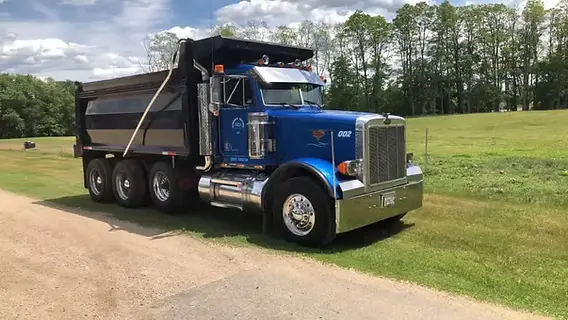
The permit shelf around the harvest permit
MDOT publishes a wider set of permits in the 9/21/2024 Manual, and two of them touch earthmoving work directly enough to be worth naming.
The Tractor with Dirt Pan In-Tow Permit governs moving scrapers and pans on the highway. Its requirements are strict in a way that reflects what is being moved: the holder must have a 72-hour road use permit and an oversize permit, may move in a convoy of no more than three units with escorts front and rear, must equip the escort with flashing amber lights and radio contact with each unit, must display Over Size or Wide Load signs on all units and escorts, must use four-lane roadways where possible, must pull off the highway at sufficient intervals to let traffic pass, and may move only during daylight hours. Its cost is based on size and weight.
That is a materially different risk from hauling a load of stone, and it is one many dirt contractors take on without changing anything about how they are insured. Moving owned earthmoving equipment on a public road under permit is a highway exposure attached to a piece of equipment whose value and repair path have nothing in common with a dump body.
The Manual also sets out a Special Heavy Haul Blanket Permit with a published axle table, whose bands are defined by axle count: five axles from 80,000 to 95,000 pounds, six axles from 80,000 to 117,000, seven axles from 80,000 to 142,000, and eight axles or more from 80,000 to 150,000, each with its own steering, tandem and triaxle allocations and minimum spacings. That is a heavy-haul program rather than an aggregate one, and it belongs on the oversized and overweight side of a mixed fleet.
Around all of it sit the general conditions that apply to any Mississippi permit: movement is prohibited on all posted bridges; a copy of the permit must be carried in the vehicle at all times; electronic permits and permit numbers shown on phones and tablets are accepted; permits are not transferable between owners or vehicles; and movement is not allowed after 12:00 noon on days preceding or on New Year’s Day, Memorial Day, Fourth of July, Labor Day, Thanksgiving Day and Christmas unless otherwise permitted.
Read together, the Mississippi picture is consistent. Capacity is purchased, tied to a named truck, bounded by road class, conditioned on the operator’s standing with the department, and backed by an insurance certificate the department itself holds. The questions worth asking on a Mississippi aggregate account follow directly from that structure.
- Which units hold current Harvest Permits, with issue dates, since each is a $25.00 annual authorization tied to one vehicle and non-transferable.
- Whether any route assumes an Interstate leg, given that the Special Interstate Agriculture Vehicle Permit expressly excludes gravel, sand, fill dirt and asphalt.
- How dispatch identifies low-weight roads and posted bridges, since avoiding them is stated as the permit holder’s duty.
- Whether MDOT is named as certificate holder at the stated $500,000 single limit minimum, and whether that filing is maintained rather than filed once.
- Any open assessments or penalties, which block permit issuance across the fleet rather than for the offending unit alone.
- Covering and securement practice, measured against § 63-5-55 and the federal cargo securement rules the Manual incorporates.
- Whether the operation also moves its own earthmoving equipment under a Tractor with Dirt Pan In-Tow Permit, which is a separate highway exposure on a separate class of equipment.