Motor carrier classes by state

Missouri dump trucking insurance for aggregate and construction haulers

Missouri has a frost law. It names the thaw on the face of the statute, it has been in force since 1939, and it contains no date, no duration and no percentage reduction. What it contains instead is a sign. A Missouri aggregate hauler cannot read a season off the statute book, cannot plan a spring around a published start date, and has to learn the restriction the way the statute intends — by finding a notice posted at a convenient and public place along the road.

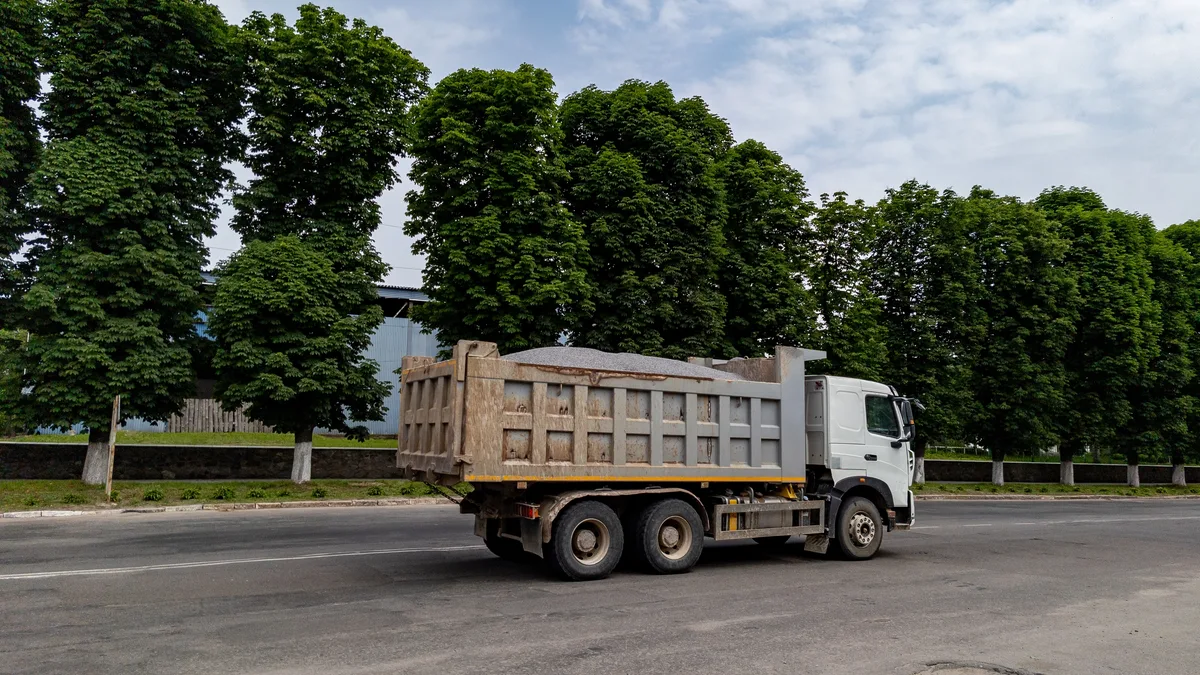
Loaded dump truck on a paved road — Missouri Dump Trucking Insurance from Truck Guard Insurance

Most states that restrict weight in the thaw do it with a calendar. They publish a window, they publish a percentage, and an operator can price a season in February. Missouri does neither. RSMo 304.210 lets the state highways and transportation commission cut the maximum weights in section 304.180 whenever, by reason of thawing of frost, or rains, or new construction, the roads are in a soft condition — by an amount and in a manner left entirely to the commission’s judgment, noticed by posting.

That posture runs through the rest of Missouri’s weight law. A county cannot post its own road alone; the county highway engineer needs a state division engineer’s approval first. The relief Missouri does grant to a heavy hauler is not bought with a permit but attaches by statute — a flat two-thousand-pound margin off the Interstate that nobody applies for, and a solid-waste allowance defined by where the load is going rather than by what is in the body. And the two numbers most associated with Missouri weight law, 22,400 and 44,800 pounds, appear three separate times doing three unrelated jobs, none of them a baseline.

The material below rests on RSMo Chapter 304 read at all 94 of its 94 sections, on the transportation department’s own rules at 7 CSR 10-25, and on the land reclamation rules at 10 CSR 40-10. That last division matters more than an operator expects, because Missouri regulates aggregate at the pit and hands the truck to a different agency under a different title of the code.

Hauling rock, fill or debris in Missouri? Tell us which counties the routes cross and what the trucks are registered for — the posting regime and the destination-keyed allowances decide more of a Missouri account than the permit file does.

Start a Missouri quote

A frost law that names the thaw and fixes no date

RSMo 304.210 is a single sentence and it has stood since 1939. It provides that “Whenever by reason of thawing of frost, or rains, or due to new construction the roads are in a soft condition, the maximum weights on all vehicles mentioned in section 304.180, including trucks, tractors, trailers and semitrailers and other vehicles therein mentioned may be limited by the state highways and transportation commission to such an amount and in such manner as will preserve the road under such conditions; and said commission shall give due notice thereof by posting notices at convenient and public places along said road or roads or parts thereof which are subject to said regulations and reduction of weights.”

Read what the sentence delegates. The trigger is a condition — soft roads — not a date. The magnitude is whatever “will preserve the road under such conditions,” which is a standard rather than a number. The geographic scope is “said road or roads or parts thereof,” which can be a segment. And the notice is physical. Nothing in the section commits the commission to a season, to a schedule, or to any particular reduction, and a sweep of all 94 sections of Chapter 304 for frost, thaw, season and soft condition returns this section as the only frost provision the chapter contains.

Note also that new construction sits in the trigger alongside thaw and rain. In Missouri law a newly built road is a weaker road, not a stronger one, and it is grounds for cutting weights rather than for allowing them. An operator hauling to a job on a road the same project just rebuilt should expect the restriction to point at the fresh pavement.

Three further instruments in the same chapter work the same way, by sign rather than by schedule. RSMo 304.180.4 lets the commission set maximum weight and speed limits where it finds a state highway bridge in such condition that use by vehicles of the statutory weights will endanger the bridge or its users, with notice “by posting signs at a conspicuous place at each end of any such bridge.” RSMo 304.260 gives the commission a broader route-level power: it “may exclude the use of such tractors or the use of trucks of any particular weight from the use of certain designated roads or types of roads, by the posting of signs along or upon such roads or any part thereof.” And RSMo 304.220 does the same at county level, on terms worth their own section below.

The commercial consequence for an aggregate fleet is that Missouri route risk is a field-intelligence problem rather than a research problem. There is no publication to consult that fixes when a road closes to weight, because the statute never promised one. What can be planned is the exposure: which routes have no alternate, which contracts have no weather clause, and how a season prices if a haul road is posted for six weeks the statute never named.

A county cannot post its own road by itself

RSMo 304.220.1 puts the county posting power in the hands of a named officer and then puts a state officer above it. Whenever the county highway engineer of any county — or, in a county with no highway engineer, such other officer as the county commission designates — finds that a county road or bridge is in such condition that use by vehicles of the weights specified in section 304.180 will endanger the road or bridge or its users, that engineer “may with the approval of the division engineer of the state transportation department whose division includes the area in question establish maximum weight limits for vehicles using such road or bridge in such amounts as will preserve the road or bridge and provide a reasonable margin of safety to the users thereof.” Notice is given by posting signs at convenient and public places along the road, and in conspicuous places at each end of a bridge.

The approval clause is the separator. A Missouri county road does not get posted because a commission voted; it gets posted because a county engineer found a condition and a state division engineer signed off on the finding. That is a materially different administrative posture from a delegation model, and it means the fastest route to understanding a posting is often the district office rather than the courthouse.

Subsection 2 makes operation over a posted limit unlawful “unless the person shall have the express permission of the officer empowered to establish such limit.” That is a personal dispensation from the officer who set the limit, not a permit issued through a process — there is no application, no fee and no form recited in the statute. An operator with a genuine need to cross a posted county road is negotiating with an individual, and whatever is agreed exists only as that officer’s permission.

Subsection 3 supplies the consequence, and it is doubled: “Any person who shall violate the provisions of this section shall be guilty of a class C misdemeanor, and shall be liable in a civil action for any damages to the road or bridge.” The civil limb is the commercially significant half. A single crossing of a posted county bridge that cracks a deck is a road-repair claim against the operator, not a fine, and it sits well outside what a citation history would ever suggest.

Missouri’s delegation on the municipal side runs the opposite direction from most states, and RSMo 304.180.4 states it in one clause: “The governing body of any city or county may grant authority by act or ordinance to the commission to enact the limitations established in this section on those roadways within the purview of such city or county.” The local government hands its power up to the state by ordinance rather than the state reaching down. Separately, RSMo 304.200.4 keeps a municipal permit channel open: “The officer in charge of the maintenance of the streets of any municipality may issue such permits for the use of the streets by such vehicles within the limits of such municipalities.”

Relief defined by where the load is going

RSMo 304.184 is the most unusual weight instrument in the Missouri chapter, and its distinguishing feature is that it does not describe a truck or a commodity’s density. It describes a destination. In full, it provides that “Notwithstanding any other provision of law to the contrary, any truck, tractor-trailer or other combination engaged in transporting solid waste, as defined by section 260.200, between any city and a solid waste disposal area or solid waste processing facility approved by the department of natural resources or department of health and senior services, may operate with a weight not to exceed twenty-two thousand four hundred pounds on one axle or a weight not to exceed forty-four thousand eight hundred pounds on any tandem axle.”

Three qualifiers bound it and each is a real gate. The material must be solid waste as section 260.200 defines it. The movement must run between a city and the facility. And the facility must be one approved by the department of natural resources or the department of health and senior services — an unapproved site, or a private fill nobody permitted, is outside the section entirely.

Two limits close it. The section “shall not be construed to permit the operation of any motor vehicle on the interstate highway system in excess of the weight limits imposed by federal statute,” so the allowance is an off-Interstate instrument. And no qualifying vehicle “shall exceed the width and length limitations provided in section 304.190,” which points the reader back into the commercial-zone section for its dimensional envelope. The section was enacted by L. 2005 H.B. 487 merged with S.B. 225 and is stamped effective August 28, 2005.

A destination-defined weight allowance with no permit, no fee and no application is a rare instrument shape, and it is the one an operator most often fails to claim. A demolition or transfer-station fleet running to an approved facility is entitled to it by the terms of the statute; the same trucks running the same material to an unapproved location are not. That distinction lives on the ticket rather than in the cab, and it is worth confirming in the records before it is confirmed at a scale.

For a mixed operation, the practical point is that Missouri makes the same equipment lawful at two different axle weights on two different runs on the same day. Where a fleet hauls rock in the morning and debris to an approved facility in the afternoon, the governing regime changes with the destination, and nothing about the truck signals which one is in force.

  • Commodity gate — solid waste as defined by RSMo 260.200.
  • Movement gate — between any city and the disposal area or processing facility.
  • Approval gate — the facility must be approved by the department of natural resources or the department of health and senior services.
  • Allowance — 22,400 pounds on one axle, 44,800 pounds on any tandem axle.
  • Limits — no Interstate application above federal weights, and no relief from the section 304.190 width and length limitations.

We place Missouri dump and aggregate accounts, including transfer-station and demolition fleets running the RSMo 304.184 destination allowance and operations affiliated with a permitted pit.

Get a Missouri quote

The same two numbers, doing three unrelated jobs

Missouri uses 22,400 and 44,800 pounds three separate times, and none of the three is a statewide default. Confusing them is easy and expensive, because each carries its own eligibility test and its own geography.

The first is metropolitan. RSMo 304.190 provides that no motor vehicle, unladen or with load, operating exclusively within the corporate limits of cities of seventy-five thousand inhabitants or more, or within two miles of those limits, or within the commercial zone of the city, shall exceed fifteen feet in height — and that “No motor vehicle operating exclusively within any said area shall have a greater weight than twenty-two thousand four hundred pounds on one axle.” The zone itself is defined by formula: the area within the city together with territory extending one mile beyond the corporate limits and one mile additional for each fifty thousand population or portion thereof, with special extensions of twenty-five miles for a city not within a county — reaching through an adjoining charter county and through an adjacent charter county of more than two hundred fifty thousand but fewer than three hundred fifty thousand inhabitants — and twelve miles for a city of at least four hundred thousand but not more than four hundred fifty thousand inhabitants, whose boundary the statute then describes freeway by freeway. Subsection 4 adds that a commercial zone is never reduced by a loss of population, and that the section does not apply to interstate highways beyond two miles of a corporate limit unless federal weight limits inside commercial zones rise.

Note the word “exclusively” in both subsections. The commercial-zone cap binds a vehicle operating entirely inside the zone. A truck that works the zone in the morning and runs a state route out of it is not inside the exception, and the cap is a ceiling on the in-zone operator rather than a general urban rule. Subsection 6 carries a narrow interstate-commerce variant of the same figures for a first class home rule municipality in a county of between eighty thousand and ninety-five thousand inhabitants on the Missouri-Kansas line.

The second is vocational. RSMo 304.180.14 allows local log trucks and local log truck tractors, as defined in RSMo 301.010, to operate at not more than twenty-two thousand four hundred pounds on one axle or forty-four thousand eight hundred pounds on any tandem, with the front steering axle capped at fifteen thousand pounds or the manufacturer’s gross vehicle weight rating, and a total of up to one hundred nine thousand six hundred pounds. The allowance is withdrawn on the Interstate system, and withdrawn outside the radius from the forested site specified in RSMo 301.010 unless the operator holds an extended distance local log truck permit. That is a registration class Missouri built for one commodity, and a fleet whose Missouri work includes it is running a materially different weight package on the same chassis — so a Missouri operator running both rock and timber is holding two weight packages and, frequently, two underwriting conversations — one of them belonging to log hauling.

The third is the solid-waste destination allowance in RSMo 304.184 described above. Same two numbers, third unrelated regime, and the only one of the three keyed to where the truck is going rather than to where it is operating or to what class it is registered in.

Twenty thousand pounds, and two thousand more nobody applies for

The Missouri baseline in RSMo 304.180.1 is federal-shaped: no vehicle or combination may be moved or operated on a highway with a greater weight than twenty thousand pounds on one axle, and none on a state highway with more than thirty-four thousand pounds on any tandem axle. The steering-axle rule in the same sentence is narrower than operators usually assume — the twelve-thousand-pound steering cap, measured against the manufacturer’s rating, binds only “combination of vehicles operated by transporters of general freight over regular routes as defined in section 390.020.” It is a rule about a class of carriage, and an aggregate hauler is not in it.

Missouri defines its own terms with unusual precision. A tandem axle is a group of two or more axles arranged one behind another with the distance between the extremes more than forty inches and not more than ninety-six inches. An axle load is defined in subsection 2 as “the total load transmitted to the road by all wheels whose centers are included between two parallel transverse vertical planes forty inches apart, extending across the full width of the vehicle.” Both definitions decide cases at the scale, and both are worth checking against the actual suspension geometry rather than against what a spec sheet calls a tandem.

Subsection 3 carries the bridge table to eighty thousand pounds, and it departs from the familiar shape in one visible place: the two-axle column runs to forty thousand pounds from eleven feet onward rather than stopping at thirty-four thousand. Subsection 5 preserves the federal ceiling over all of it, providing that nothing in the section permits axle, tandem or gross loads in excess of those permitted under P.L. 97-424 as codified in Title 23 of the United States Code.

The provision an aggregate operator uses every working day is subsection 6: “Notwithstanding the weight limitations contained in this section, any vehicle or combination of vehicles operating on highways other than the interstate highway system may exceed single axle, tandem axle and gross weight limitations in an amount not to exceed two thousand pounds. However, total gross weight shall not exceed eighty thousand pounds, except as provided in subsections 9, 10, 12, 13, and 14 of this section.” The margin applies to all three measures at once, requires no permit, no application and no fee, and disappears the moment the wheels touch the Interstate. That is a genuinely different relief mechanism from a permitted overweight operation, because there is nothing to produce, nothing to revoke and nothing to renew.

The named exceptions above eighty thousand pounds run to other commodities. Subsection 9 allows eighty-five thousand five hundred pounds for milk moving from a farm to a processing facility, or for livestock, off the Interstate. Subsection 10 allows grain or grain coproducts “during times of harvest” to run as much as ten percent over the subsection 3 table, again off the Interstate. Subsection 8 allows an idle reduction technology weight increase capped at five hundred fifty pounds, on production of proof that the system is fully functional. Subsection 7 gives the crane, concrete pump truck and well-drillers’ equipment operator a choice of instrument — the commission “shall issue a single-use special permit, or upon request of the owner of the truck or equipment shall issue an annual permit” — and lets those vehicles operate on state-maintained roads and highways at any time on any day, which is a timing exemption rather than a weight one.

What is not on that list is the point of the list. Across all 94 sections of RSMo Chapter 304, read in full, there is no commodity-named weight provision for aggregate, sand, gravel, rock, crushed stone, fill or spoil. Missouri legislates commodity exceptions freely — milk, livestock, grain and grain coproducts, harvested forest products, solid waste, farm products, utility restoration equipment — and aggregate is not among them. That negative is scoped to Chapter 304 and to nothing wider; the aggregate law exists, and the section below is where it lives.

One engineer issues the permit, and the license plate sets its outer date

RSMo 304.200.1 centralizes the permit power in a single officer and states it discretionarily: “The chief engineer of the state department of transportation, for good cause shown and when the public safety or public interest so justifies, shall issue special permits for vehicles or equipment exceeding the limitations on width, length, height and weight herein specified, or which are unable to maintain minimum speed limits.” Duration is bounded by the registration rather than by a calendar: permits issue “only for a single trip or for a definite period, not beyond the date of expiration of the vehicle registration,” and must designate the highways and bridges the permit authorizes.

That last clause has a practical consequence fleets discover at renewal. An annual permit taken out shortly before a registration expires is not an annual permit — it dies with the plate. Sequencing the registration renewal ahead of the permit application is worth more than it sounds.

The fee schedule is in the rule rather than the statute, at 7 CSR 10-25.020(4)(B), and it is a seventeen-item list. Single trip oversize permits are fifteen dollars; single trip oversize permits in excess of sixteen feet wide, sixteen feet high or one hundred fifty feet long are fifteen dollars plus a two hundred fifty dollar movement feasibility fee. Single trip overweight permits up to and including one hundred sixty thousand pounds gross are fifteen dollars plus twenty dollars per each ten thousand pounds in excess of legal gross weight. Above one hundred sixty thousand pounds the same computation applies plus a bridge and roadway analysis fee of four hundred twenty-five dollars for moves of zero to fifty miles, six hundred twenty-five dollars for fifty-one to two hundred miles, and nine hundred twenty-five dollars for over two hundred miles.

Two items on that list belong specifically to construction and quarry work. Item 13 prices a project permit at one hundred twenty-five dollars. Item 14 prices a highway crossing permit at two hundred fifty dollars — the instrument for running equipment across a state highway between two sides of a job or a pit. Other annual blanket items include three hundred dollars for an overweight well drillers, concrete pump truck or crane permit, four hundred dollars for a multiple-commodity annual blanket oversize permit, and three hundred dollars for a thirty-day blanket permit. A permit amendment costs two dollars, and single trip permits may only be amended within two business days of the permit start date.

Fees are waivable and, for one class of applicant, absent. Subsection (4)(E) allows the Motor Carrier Services director or a representative to waive permit fees when a federal or state declaration of disaster is in effect “or at the discretion of the Motor Carrier Services director during other special or unusual circumstances,” and subsection (4)(C) provides that fees “shall not be required for permits covering the movement of vehicles and loads owned and operated by governmental subdivisions or agencies.”

Payment runs through one of two routes only, and one of them is an account rather than a security. Subsection (4)(D) requires proper arrangement for payment “either by use of escrow accounts, which must be in effect prior to permit application request … or by payment of the fee at the time of application,” and section (5) governs the account: it may be established with the department, the account holder is responsible for all charges filed against it, it remains open as long as there is a positive or zero balance, and it “is nontransferable and shall be used for payment only.” It is a prepayment mechanism for permit fees, not a road-damage security, and the distinction is easy to lose in a submission.

The financial responsibility layer is where Missouri’s permit regime does its real work, and it is asymmetric in a way worth naming. On the truck side, 7 CSR 10-25.020(2)(A) requires an applicant for an oversize or overweight permit to carry combined single limit automobile liability of at least $750,000 for a routine move and $2,000,000 for super heavy and large loads, effective during all of the applicant’s permitted operations. Subsection (2)(B) then forces the freight onto a separate policy: the required automobile policy “shall not include coverage of the cargo transported under the permit, and instead, any cargo transported by the applicant under a permit issued under this administrative rule shall be insured under a separate insurance policy” — which is a rule-level instruction to carry motor truck cargo as its own contract rather than as an endorsement. Subsection (2)(D) leaves road damage to discretion: “Permits issued for excessive overweight may require additional financial responsibility to protect the state in regard to excessive damage to the state highway system and its facilities.” No bond is required of the truck at all, which is the opposite of how Missouri treats the pit.

The permit conditions themselves transfer the risk in full. Under 7 CSR 10-25.020(3)(A) the permittee agrees to assume full responsibility for injury to persons or damage to public or private property including the state highway system and its facilities caused by the movement, agrees to hold harmless the Missouri Highways and Transportation Commission, the Missouri Department of Transportation and the Missouri State Highway Patrol “from any and all claims, judgments, damages, or expenses of any kind,” and “as a condition to the issuance of a special permit, agrees to indemnify” the same bodies for sums they may be required to expend in defending claims arising out of the movement. That is a contractual indemnity accepted by taking the permit, and it should be read before a certificate is issued rather than after a claim.

Every rule figure above carries the publisher’s own currency hedge, which travels with it: under section 536.021.8, RSMo, “no rule…shall become effective prior to the thirtieth day after the date of publication of the revision to the Missouri code of state regulations,” and “Therefore, some of the rules published in the current version of the CSR may not be effective.” The 7 CSR 10-25 chapter as published carries the secretary of state’s date stamp of 2/28/25.

Only a certified officer may pull a truck onto a scale at random

Missouri narrows its own enforcement in a way few states do, and it did so by statute rather than by policy. RSMo 304.230.1 provides that beginning January 1, 2009, only law enforcement officers approved by the Missouri state highway patrol under section 304.232, members of the patrol, commercial vehicle enforcement officers, and commercial vehicle inspectors appointed under that section have authority to conduct random roadside examinations or inspections for size and weight.

A local officer without that certification cannot run a random weight check on a passing dump truck. What such an officer may do is stop a vehicle with a visible external safety defect that could cause immediate harm to the traveling public, and in the course of that stop the officer is required to identify to the driver the defect that caused it. Probable cause of illegal or criminal activity unrelated to the size and weight sections is preserved separately.

That changes the shape of a Missouri citation history. Weight enforcement is concentrated in a certified population rather than distributed across every jurisdiction a route crosses, so an account with a thin size-and-weight record has not necessarily been running light — it may simply be running roads where certified officers are thin on the ground. Read the record against the geography before reading it as a compliance signal.

The load-containment rule sits in a different chapter and is drafted disjunctively, which is the whole finding on it. RSMo 307.010.1 requires that all motor vehicles, trailers and semitrailers carrying goods, material or farm products “which may reasonably be expected to become dislodged and fall from the vehicle … as a result of wind pressure or air pressure and/or by the movement of the vehicle” shall “have a protective cover or be sufficiently secured” so that no portion can become dislodged and fall while being transported.

The operative words are “or be sufficiently secured.” Missouri gives the operator an election rather than a mandate, and it names no commodity at all — no dirt, no sand, no gravel, no freeboard distance and no tailgate-condition rule. Its only detailed carve-out is for cotton trailers as defined in RSMo 301.010, excused where the trailer travels at speeds less than seventy miles per hour from field to field or from field to market and return, nothing falls off, and the goods are immobilized, transported in a sided vehicle with walls of adequate strength, fully contained and firmly immobilized by structures, dunnage, dunnage bags, shoring bars or tiedowns, “or otherwise secured in accordance with federal law.” Violation is a class C misdemeanor. The section is stamped effective August 28, 2025, with its history closing at A.L. 2025 H.B. 169 merged with S.B. 28, so this is recently amended law.

For an operator that means the containment question in Missouri is evidentiary rather than prescriptive. There is no statutory tarp rule to point at, so a fleet arguing that a load was sufficiently secured is arguing on the facts — which makes the securement practice, the training record and the equipment condition the whole of the defense.

Aggregate is regulated at the pit and handed off at the gate

Missouri has substantial aggregate law. It is simply not in the motor vehicle title, and that split is the finding. Read at all 94 of its 94 sections, RSMo Chapter 304 contains no aggregate, quarry or crushed-stone provision in any operative sense. The material lives in RSMo Chapter 444 and in 10 CSR 40-10, administered by the land reclamation program within the department of natural resources, and it regulates the site rather than the movement.

The chapter puts haul roads into statute by name, as an exclusion. RSMo 444.765(1) provides that for underground mining, “areas of disturbance encompassed by the actual underground openings for air shafts, portals, adits and haul roads in addition to disturbances within fifty feet of any openings for haul roads, portals or adits shall not be considered affected land,” with the exclusion lost where a site exceeds the excluded areas by more than one acre. And the definition of surface mining in subsection (21) removes fill haulage from the permit regime categorically: surface mining excludes excavations to move minerals or fill dirt within the confines of the real property where excavation occurs, or to remove them in preparation for construction at the site of excavation, and then adds that “No excavation of fill dirt shall be deemed surface mining regardless of the site of disposition or whether construction occurs at the site of excavation.” A Missouri fill-dirt operation is outside the mining permit regime by definition.

RSMo 444.770.1 requires a surface mining permit and reaches even the smallest gravel operator, “including any operator involved in any gravel mining operation where the annual tonnage of gravel mined by such operator is less than five thousand tons.” Subsection 2 exempts gravel removal at the request of a property owner for the primary purpose of managing seasonal gravel accretion on property not used primarily for gravel mining, and exempts a political subdivision contracting for excavation to obtain sand and gravel “solely for the use of such political subdivision,” each on conditions including notification to the department and, for the accretion exemption, annual tonnage below two thousand tons with a site limitation of one thousand tons.

Costs are stated. RSMo 444.772 sets the permit fee at eight hundred dollars, the site fee at four hundred dollars and the acre fee at ten dollars with a maximum of three thousand dollars beginning August 28, 2007, and provides that for a gravel operator mining under five thousand tons a year “the total cost of submitting an application shall be three hundred dollars.” On top of that, 10 CSR 40-10.025 charges an annual geologic resources fee of seventy-five dollars per permit, seventy-five dollars per site, and eight dollars per acre for the first three hundred acres and four dollars per additional acre, capped so that the geologic resources portion for any permit shall not exceed three thousand five hundred dollars. That rule was filed May 14, 2024 and took effect January 30, 2025.

Where the site meets the road, the rules give the road authority a veto. 10 CSR 40-10.050(2) provides that the distance from a public road, street or highway right-of-way to the beginning of excavation shall be twenty-five feet plus one and one-half times the depth of unconsolidated material, with a minimum allowable distance of fifty feet “unless a variance is granted by the commission” — and the variance “shall be approved by the authority having jurisdiction over the road.” Unconsolidated material may be left at a slope of no more than forty degrees, but the excavation must still stand back the greater of the two distances. Subsection (3) requires an adequate safety barrier at the perimeter where the excavation is at or within fifty feet of a public road right-of-way and no other adequate barriers exist, and fixes it at “a minimum of three feet (3') high.” 10 CSR 40-10.020 requires the permit map to show “The approximate location of public roads located in or within one hundred feet (100') of the proposed permit area.”

The security asymmetry between the two sides of the operation is the part worth carrying into a submission. The pit is bonded hard: RSMo 444.778.1 requires a bond signed by the operator as principal and by a corporate surety licensed in the state, “in the penal sum of eight thousand dollars for each permit up to eight acres and five hundred dollars for each acre thereafter that is to be mined,” plus an additional four thousand five hundred dollars per acre where topsoil has been removed and will be revegetated, with a certificate of deposit or irrevocable letter of credit available in lieu of surety, and small gravel operators at five hundred dollars per acre. The bond remains in effect until the acreage is reclaimed, approved and released, cannot be canceled by the surety except after not less than ninety days’ notice, and a loss of the surety’s license gives the operator sixty days to substitute. 10 CSR 40-10.030(1) restates the schedule by commodity, naming limestone, barite, traprock, granite, tar sand, clay, sandstone, oil shale, sand and shale, and initially excuses in-stream sand and gravel operators “due to the lack of reclamation responsibility.” Against all of that, the truck side carries an insurance floor and an indemnity and no bond at all.

Nothing in the land reclamation program permits, routes, meters or prices a load once it leaves the site, and nothing in Chapter 304 reaches back inside the fence. There is no bridging instrument between the two, and an operator who holds both a mining permit and a fleet of trucks is holding two unrelated regulatory relationships with two unrelated agencies. The practical consequence for coverage follows the same seam: what happens inside the permit area is answered by general liability, what happens between two Missouri points is answered by auto liability, and an operator can carry a clean record on one while an exposure builds on the other.

Reciprocity that stops at the second Missouri point

Missouri’s reciprocity apparatus lives in the rules rather than the statutes, and it draws the interstate and intrastate line in terms. 7 CSR 10-25.050(4) provides that “Vehicles operating solely in interstate commerce on the highways of Missouri are not required to pay Missouri motor vehicle registration fees. Vehicles operating or moving in solely intrastate commerce between two (2) points in Missouri or carrying any merchandise or passengers between two (2) points in Missouri will be required to pay the full Missouri motor vehicle registration fees required for the operation.”

For an aggregate hauler that sentence is decisive, because aggregate moved from a Missouri pit to a Missouri job is carriage between two Missouri points. The reciprocity layer is inapplicable to it by its own terms, regardless of where the truck is plated. Subsection (3) adds the eligibility condition: reciprocal privileges granted under RSMo 301.271 “can only be granted to an owner who is not a resident of Missouri, who has properly registered the vehicle desired to be operated within the jurisdiction where the owner is a resident.”

The trailer rule in the same section carries an operational condition that catches small fleets. Trailers registered in any member jurisdiction may be operated in combination with any motor vehicle properly registered under a reciprocity agreement, but “To register any number of trailers with the commission, a person or corporation must have at least one (1) tractor registered with the commission.” A trailer-only registration is not available on its own.

The multistate instruments themselves are adopted by rule and named. 7 CSR 10-25.030 administers apportioned registration under the International Registration Plan, describing it as a registration reciprocity arrangement under which the operator of a fleet based in one member jurisdiction registers once and apportions fees by actual distance traveled in member jurisdictions, receiving apportioned plates and a cab card. 7 CSR 10-25.071 administers the application for an International Fuel Tax Agreement license, the companion fuel-tax compact.

What Missouri does not have is a weight-specific cross-border instrument. Swept across the entire transportation rules title — 33 of 33 chapters in 7 CSR, spanning divisions 10, 60 and 265 — and across all 94 sections of RSMo Chapter 304, there is no reciprocal recognition of another state’s overweight permit, no designated cross-border heavy corridor, and no neighboring state’s permit honored in Missouri. The reciprocity is registration and fuel tax reciprocity, and that is the whole of it. That negative is scoped to those two fully enumerated bodies and asserts nothing about any other title of Missouri law.

One further point of vocabulary avoids a common error. The commercial zone in RSMo 304.190 is an intrastate geographic construct built out of city population and mileage, not an interstate corridor. It changes what a truck may weigh inside a metropolitan area; it does not carry anything across a state line.

What a Missouri dump and aggregate submission should show

Missouri decides most of its questions from the route and the destination rather than from a permit file, so the submission questions follow the work.

  • Counties crossed on the regular haul routes, since a county posting under RSMo 304.220 arrives with no published schedule and carries civil liability for road damage on top of the misdemeanor.
  • Whether any run qualifies under RSMo 304.184 — solid waste as defined by RSMo 260.200, moving between a city and a facility approved by the department of natural resources or of health and senior services.
  • Whether the fleet works exclusively inside a commercial zone of a city of seventy-five thousand or more, which brings the 22,400 pound axle cap and the fifteen-foot height limit in RSMo 304.190 into force.
  • Interstate versus non-Interstate mileage, because the two-thousand-pound margin in RSMo 304.180.6 exists only off the Interstate system and applies to all three measures at once.
  • Registration renewal dates against permit terms, since RSMo 304.200.1 caps a permit at the expiration of the vehicle registration.
  • Permit classes actually used — project permit at $125 and highway crossing permit at $250 under 7 CSR 10-25.020(4)(B) — and whether an escrow account is in effect before application.
  • Combined single limit automobile liability against the permit floors of $750,000 routine and $2,000,000 super heavy, and confirmation that cargo sits on a separate policy as 7 CSR 10-25.020(2)(B) requires.
  • Any land reclamation permit held by an affiliated pit, its bonded acreage under RSMo 444.778, and whether any excavation sits within fifty feet of a public road right-of-way.
  • Whether any unit runs as a local log truck under RSMo 301.010, which unlocks a different axle and gross package and withdraws it outside the forested-site radius.
  • Load securement practice and training records, since RSMo 307.010 states a disjunctive standard and names no commodity, making the question evidentiary rather than prescriptive.

Coverage lines a Missouri dump and aggregate account usually carries

The state minimum is a licensing threshold. The program an operator actually needs is built from these lines:

  • Trucking Auto Liability — Primary liability coverage for bodily injury and property damage caused by your truck while under dispatch.
  • Physical Damage — Collision and comprehensive coverage for the tractor, trailer, and attached equipment you own or finance.
  • Motor Truck Cargo — Coverage for the freight you haul against loss or damage in transit.
  • Trailer Interchange — Coverage for non-owned trailers you pull under written interchange agreements.
  • General Liability — Coverage for premises and operations liability away from the truck — terminal yards, customer docks, and non-driving exposures.
  • Workers Compensation — Statutory coverage for driver and yard-employee injury, structured for trucking payrolls and interstate operations.
  • Non-Trucking (Bobtail) Auto Liability — Liability coverage for the tractor when operated off-dispatch — bobtailing home or running personal errands.
  • Pollution Liability — Coverage for cargo-related pollution events and upset/overturn spills not covered by standard auto liability.

Why Truck Guard Insurance for a Missouri dump and aggregate account

We write dump and aggregate hauling as a named class rather than as an exception to general trucking, and we read each account against the weight and permit regime of the state it operates in. For a Missouri operator that means starting from what the trucks are actually licensed and configured to carry, sizing physical damage to bodies and hoists rather than to a chassis value, and treating pit, stockpile and job-site work as its own exposure rather than an extension of the highway auto form.

If the operation also runs freight under separate authority, the Missouri trucking insurance page covers the state’s broader motor carrier picture, and the dump trucking insurance page covers the class mechanics that apply wherever the operator runs.

Missouri dump trucking insurance questions

Does Missouri have a spring thaw weight restriction?

It has a frost law, and it names no season. RSMo 304.210 lets the state highways and transportation commission limit the maximum weights in section 304.180 whenever, by reason of thawing of frost, or rains, or new construction, the roads are in a soft condition — to such an amount and in such manner as will preserve the road, with notice given by posting notices at convenient and public places along the affected roads. There is no date range, no duration and no percentage reduction anywhere in the section, and a full-text reading of all 94 sections of Chapter 304 finds no other frost provision. The operative instrument is a posted sign.

Can a Missouri county post its own roads for weight?

Not on its own. Under RSMo 304.220.1 the county highway engineer — or, in a county without one, the officer the county commission designates — must find that the road or bridge is in a condition that endangers it or its users, and may then establish maximum weight limits only with the approval of the division engineer of the state transportation department for that area. Notice is by posted signs. Operating over a posted limit without the express permission of the officer who set it is a class C misdemeanor, and the violator is also liable in a civil action for any damages to the road or bridge.

What is the solid waste weight allowance and who qualifies for it?

RSMo 304.184 allows any truck, tractor-trailer or other combination engaged in transporting solid waste as defined by section 260.200, moving between any city and a solid waste disposal area or processing facility approved by the department of natural resources or the department of health and senior services, to operate at up to 22,400 pounds on one axle or 44,800 pounds on any tandem axle. It does not permit operation on the interstate highway system above federal weight limits, and it does not relieve the width and length limitations in section 304.190. The relief is keyed to the destination rather than to the vehicle or the commodity’s density, and it requires no permit and no fee.

Is there a general overweight tolerance in Missouri?

Yes, off the Interstate. RSMo 304.180.6 provides that any vehicle or combination operating on highways other than the interstate highway system may exceed the single axle, tandem axle and gross weight limitations by an amount not to exceed two thousand pounds, with total gross weight still capped at eighty thousand pounds except under the named subsections. It applies to all three measures at once and requires no permit, no application and no fee. It disappears entirely on the Interstate system.

Does Missouri give aggregate haulers a commodity weight exception?

Not in the motor vehicle chapter. Read at all 94 of its 94 sections, RSMo Chapter 304 carries commodity-named weight provisions for milk, livestock, grain and grain coproducts, harvested forest products, solid waste and several equipment classes, and none for aggregate, sand, gravel, rock, crushed stone, fill or spoil. That is a statement about Chapter 304 and not about Missouri law generally: aggregate is regulated at the site, under RSMo Chapter 444 and 10 CSR 40-10, by the land reclamation program within the department of natural resources.

What does a Missouri oversize or overweight permit cost?

The fee schedule is in 7 CSR 10-25.020(4)(B). A single trip oversize permit is $15. A single trip overweight permit up to and including 160,000 pounds gross is $15 plus $20 per each 10,000 pounds in excess of legal gross weight; above 160,000 pounds the same computation applies plus a bridge and roadway analysis fee of $425, $625 or $925 depending on distance. A project permit is $125 and a highway crossing permit is $250. Fees are not required for vehicles owned and operated by governmental subdivisions or agencies, and may be waived by the Motor Carrier Services director during a declared disaster or other special or unusual circumstances.

How much liability insurance does a Missouri permit require?

7 CSR 10-25.020(2)(A) sets a schedule of minimum limits of combined single limit automobile liability at $750,000 for a routine move and $2,000,000 for super heavy and large loads, effective during all of the applicant’s permitted operations. The rule also directs that the automobile policy shall not include coverage of the cargo transported under the permit, and that cargo shall be insured under a separate policy. There is no mandatory bond on the truck side, though subsection (2)(D) allows the state to require additional financial responsibility on permits issued for excessive overweight.

Who can stop my trucks for a weight check in Missouri?

A narrower group than in most states. RSMo 304.230.1 provides that only law enforcement officers approved by the Missouri state highway patrol under section 304.232, members of the patrol, commercial vehicle enforcement officers, and commercial vehicle inspectors appointed under that section may conduct random roadside examinations or inspections for size and weight. A non-certified officer may still stop a commercial vehicle with a visible external safety defect that could cause immediate harm, and must identify that defect to the driver during the stop.

Sources

Every figure on this page was read at the source below on August 11, 2026, with the effective date of the version read. Treat each as current as of that date rather than as permanent.

Get a Missouri dump trucking insurance quote

Send the declared or registered weights alongside the axle configurations, and tell us where the material moves from. We will size the program against the work the trucks actually do rather than against a statutory floor.

Start a quote Call 317-942-0549