Motor carrier classes by state

North Dakota dump trucking insurance for aggregate and construction haulers

North Dakota writes its axle limits twice. The same spacing that permits 19,000 pounds per axle on a state highway permits only 17,000 on an Interstate, and the gross ceiling above them is not a property of the truck at all — it is a property of the particular road, and on local roads it is a property of whether that road has been designated.

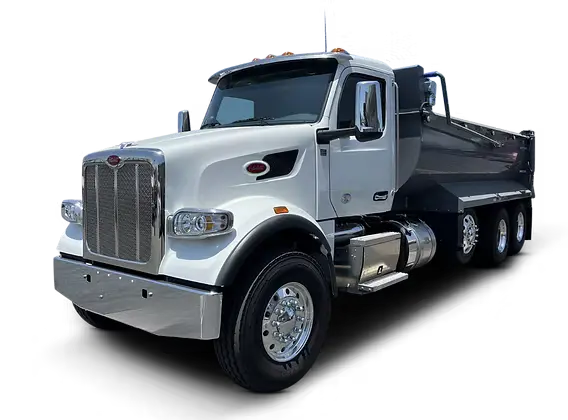
Dump truck raising its bed to unload gravel — North Dakota Dump Trucking Insurance from Truck Guard Insurance

The exposures that define dump and aggregate hauling everywhere — the short cycle, the off-highway portion of every trip, the raised-body and overturn severity that runs ahead of frequency — belong to the class and are covered on the dump trucking insurance page rather than repeated for each state.

What North Dakota contributes is a pair of parallel weight statutes and a restriction system that is declared by order rather than fixed by calendar. Sections 39-12-05 and 39-12-05.3 of the North Dakota Century Code set out two separate schedules — one for the Interstate System, one for everything else — and they diverge at exactly the axle spacing a loaded aggregate truck runs on. That divergence, not the seasonal restriction, is the first thing to establish about a North Dakota fleet.

The seasonal layer sits on top of it and is genuinely unusual in its shape. The NDDOT restriction table is five columns wide, and it does not simply step axle weights down. At the fourth step the gross ceiling itself moves, dropping from 105,500 pounds to 80,000 — so a truck that had been shedding axle weight suddenly loses a quarter of its total capacity in one increment.

Every figure below carries the statute or agency publication that sets it and the date that version applies. The Century Code text quoted is chapter 39-12 as published by the North Dakota Legislative Branch; the restriction table and the decision methodology are as published by the North Dakota Department of Transportation. North Dakota restrictions are set and lifted by order rather than annually by statute, so a figure without its instrument attached is not usable in the field.

Running the same trucks on state highways and Interstate lanes? Tell us which, because in North Dakota the per-axle allowance changes at that line and the gross ceiling changes with the road underneath.

Start a North Dakota quote

Two weight statutes, and the per-axle number changes at the Interstate line

North Dakota does not have one weight law with an Interstate exception. It has two full statutes that duplicate much of each other and then part company on the number that matters most to a loaded dump configuration.

North Dakota Century Code section 39-12-05 governs the Interstate System. It prohibits a single axle carrying a gross weight in excess of twenty thousand pounds or a wheel load over ten thousand pounds, caps a wheel at five hundred fifty pounds for each inch of tire width except on the steering axle, and limits steering axle weight to twenty thousand pounds or the axle rating established by the manufacturer, whichever is lower. Axles spaced forty inches apart or less count as one axle, and — this is the divergent clause — on axles spaced over forty inches and under eight feet apart, the axle load may not exceed seventeen thousand pounds per axle. The gross weight may not exceed eighty thousand pounds.

Section 39-12-05.3 governs every highway that is not part of the Interstate System, and it repeats the twenty-thousand-pound single axle, the ten-thousand-pound wheel load and the five-hundred-fifty-pound-per-inch tire rule verbatim. Then it sets the same spacing band at nineteen thousand pounds per axle, with a maximum of thirty-four thousand pounds gross weight on a tandem axle and a maximum of forty-eight thousand pounds gross weight on any grouping of three or more axles.

Two thousand pounds per axle is not a rounding difference on a tri-axle or a quad. A configuration loaded to the non-Interstate allowance is over on the Interstate allowance before it reaches the on-ramp, and nothing about the truck has changed. The forty-eight-thousand-pound cap on a group of three or more axles is the other clause that catches operators: it appears only in the non-Interstate statute, and it constrains the very axle groups that aggregate equipment is built around.

105,500 belongs to the road, not to the truck

The gross figure most associated with North Dakota is conditional in a way the number itself does not reveal. Section 39-12-05.3, subsection 2, provides that the gross weight on state highways may not exceed one hundred five thousand five hundred pounds unless otherwise posted, and that on all other highways the gross weight may not exceed eighty thousand pounds unless designated by local authorities for highways under their jurisdiction for gross weights not to exceed one hundred five thousand five hundred pounds.

Read carefully, that is three different ceilings on three different classes of road: state highways at 105,500 by default, local roads at 80,000 by default, and local roads at 105,500 where the local authority has affirmatively designated them. The statute adds that local authorities are encouraged to assess all roads under their jurisdiction and designate the roads for the appropriate weight limits allowed under the subsection — encouragement, not a duty, which means the designation map is uneven and is maintained by dozens of separate bodies.

For a dump operator that is the operative planning fact of the state. The final mile of an aggregate delivery is very often a county or township road, and whether that road has been designated decides whether the last mile of the trip is a 105,500-pound road or an 80,000-pound road. The load was legal when it left the pit either way; the question is whether it is still legal when it arrives.

There is a permit above the ceiling as well. Section 39-12-05.3, subsection 6, allows the director to issue a permit for a truck with a gross weight exceeding one hundred five thousand five hundred pounds and not exceeding one hundred twenty nine thousand pounds, at a monthly permit fee of one hundred dollars per month or seven hundred dollars annually. Separately, section 39-12-05.2 provides that if congressional action occurs authorizing a greater gross weight on the Interstate System than section 39-12-05 allows, a person may operate at most the weight allowed by that congressional action — and title 23 of the United States Code, section 127(u) permits a vehicle of 129,000 pounds or less on a restricted North Dakota Interstate segment where it complies with the federal single axle, tandem axle and bridge formula limits and is authorized to operate on that segment under North Dakota State law. The two provisions point at each other, which is a good reason to confirm the current position with the state before planning a lane on it.

Five tiers, and at the fourth one the gross ceiling itself moves

The NDDOT restriction table is the clearest single document in North Dakota trucking, and its fourth column is the reason it deserves reading rather than skimming. The published table sets out a legal column and four restricted tiers named for their single-axle allowance in tons.

The first three columns behave the way a load restriction table normally behaves: axle capacity comes down and the gross ceiling holds. Then at the 6-Ton tier the gross ceiling drops from 105,500 pounds to 80,000 — a reduction of about a quarter of total capacity in one step, on top of the axle reduction already applied. An operator whose trucks are configured to run at the state-highway ceiling is not merely trimming axle weight at that point. He is running a different vehicle.

That structure means a North Dakota restriction has to be read as two facts, not one. The tier name tells the driver what a single axle may carry. It does not tell him what the combination may gross, and between the 7-Ton and 6-Ton tiers those two answers move independently. A dispatcher who plans off the tier name alone will get the axle right and the gross wrong.

The tier also has to be paired with the road class from the previous section, because the 105,500-pound figure in the upper tiers is only ever available where the underlying road carries it. On an undesignated local road the operative gross is 80,000 in every tier, and the restriction table changes only the axle numbers.

  • Legal (unrestricted) — single axle 20,000 lb, tandem axle 34,000 lb, gross weight 105,500 lb.
  • 8-Ton — single axle 16,000 lb, tandem axle 32,000 lb, gross weight 105,500 lb.
  • 7-Ton — single axle 14,000 lb, tandem axle 28,000 lb, gross weight 105,500 lb.
  • 6-Ton — single axle 12,000 lb, tandem axle 24,000 lb, gross weight 80,000 lb.
  • 5-Ton — single axle 10,000 lb, tandem axle 20,000 lb, gross weight 80,000 lb.

We place North Dakota aggregate, sand, gravel and scoria accounts across tandem, tri-axle, quad and pup configurations, including operators running both Interstate lanes and designated local roads.

Get a North Dakota quote

The order is not effective until the signs are up

North Dakota does not publish a statutory season. It authorizes an order, and then makes the order wait for hardware. Century Code section 39-12-03, subsection 1, provides that whenever a highway will be seriously damaged or destroyed by reason of deterioration, rain, snow, or other climatic conditions unless the use of vehicles is prohibited or the weight of vehicles limited, the director or employees authorized by the director may act by order, and local authorities may act by ordinance or resolution.

The same subsection then requires that the director or employees making the order and the local authorities enacting the ordinance shall erect or cause to be erected and maintained signs designating the provisions of the order, that the signs must be erected and maintained at each end of the portion of highway affected, and that the order, ordinance, or resolution is not effective until the signs are erected and maintained. That is a condition on validity, not a notice courtesy, and it is written the same way for the state director and for a township board.

Subsection 2 handles the fast case. In instances of inclement weather, as determined by the local authorities, changes may be made to existing posted restrictions if the local authority gives public notice by publishing the inclement weather restriction on its website and a uniform county permit system or similar permit system within one hour after the initial determination of inclement weather, and, within five days of the first date of inclement weather, erects and maintains a sign at each end of the affected portion.

One hour of digital notice with the sign following inside five days is a materially different regime from a fixed statewide date announced weeks ahead. It means a North Dakota haul plan has a live-data dependency: the current order and its maps are published by NDDOT and mirrored on the state travel map, and a dispatcher working from last week’s printout is working from a document the statute has already superseded.

Probes, forecasts and a deflectometer decide the dates

Because the restriction is an order rather than a season, the interesting question is what evidence produces it. NDDOT publishes its method, and it is instrumented at both ends.

On the setting side, the department monitors temperature probes placed in the base layers of pavement sections, and treats those readings approaching 32 degrees Fahrenheit as the signal that planning for restrictions should begin. That is paired with long-range temperature forecasts showing low temperatures approaching the freezing point with daily highs in the upper 30s or 40s — the pattern that drives thaw down into the base rather than merely softening the surface.

On the lifting side the department uses a Falling Weight Deflectometer, which measures the strength of roadway bases directly by loading the pavement and reading the deflection. That is a structural measurement rather than a weather inference, and it is why North Dakota end dates are not symmetric with the start dates: the state can see the road recovering, and does not have to wait out a calendar.

NDDOT also publishes the observation that frames the whole exercise — that the most significant pavement damage occurs during the first four weeks after the onset of spring thaw. For an aggregate operator that is the practical rule of thumb behind the whole system. The heaviest enforcement attention, the tightest tiers and the greatest likelihood of a mid-week change all sit inside that first month, and it is the month in which a haul contract signed on annual average assumptions is most likely to break.

What underwriters ask a North Dakota dump operator

The permit catalog in section 39-12-05.3 is worth reading before the submission questions, because it shows what North Dakota is willing to relieve and what it is not. Subsection 4 authorizes ten percent permits, capped at 105,500 pounds, for a farmer’s farm vehicle or a motor carrier hired by a farmer moving agricultural products, and for a specific motor vehicle collecting and transporting solid wastes between July fifteenth and December first and for the general movement of products between December first and March seventh. Subsection 5 authorizes a further ten percent for potatoes or sugar beets between July fifteenth and December first. Subsection 3 allows the director and the highway patrol to exempt approved equipment up to 105,500 pounds on a nontransferable one-year permit.

Note where the winter permit in subsection 4 stops: March seventh, immediately ahead of the thaw window, which tells an operator plainly that the state does not intend the relief to run into the restriction season. Sand, gravel and fill are on none of those lists in their own right, so the questions asked at submission are about how the operation absorbs the restriction rather than how it permits around it:

An account that can answer those in road-class and tier terms is describing itself the way the statute and the order describe it, and that materially shortens the underwriting conversation on a class that otherwise looks undifferentiated from the outside.

The coverage consequences follow the shape of the year. A restriction window that lands hardest in its first four weeks compresses claims into a period when new seats are being filled and sites are softest, which raises the workers compensation question alongside the fleet question. And where a load is refused, short-delivered or damaged because a route turned out to be tiered differently than the dispatcher believed, the argument is about the material rather than the truck — that is motor truck cargo ground, and it is more common on aggregate than the class reputation suggests.

  • Interstate share of loaded miles. The seventeen-thousand-pound band in section 39-12-05 and the nineteen-thousand-pound band in section 39-12-05.3 apply to the same spacing, so the split between Interstate and state highway work determines what the fleet may actually load.
  • Designation status of the delivery roads. Whether the local authorities on the operator’s regular routes have designated their roads for 105,500 pounds, since undesignated local roads sit at 80,000 regardless of what the state highway leading to them allows.
  • Whether any unit runs above 105,500. The permit under section 39-12-05.3 subsection 6 reaches 129,000 pounds at one hundred dollars per month or seven hundred dollars annually, and a fleet using it is a different exposure from one that is not.
  • How the operation is monitored during an order. Because a local restriction can be changed with one hour of website notice and signs following within five days, the question is who in the office is watching the current order and how that reaches the driver.
  • Off-restriction work mix. What the trucks and the drivers do during the tiered weeks, since a change of material, site type or hauling radius is a change of exposure even where the equipment list is unchanged.

Coverage lines a North Dakota dump and aggregate account usually carries

The state minimum is a licensing threshold. The program an operator actually needs is built from these lines:

  • Trucking Auto Liability — Primary liability coverage for bodily injury and property damage caused by your truck while under dispatch.
  • Physical Damage — Collision and comprehensive coverage for the tractor, trailer, and attached equipment you own or finance.
  • Motor Truck Cargo — Coverage for the freight you haul against loss or damage in transit.
  • Trailer Interchange — Coverage for non-owned trailers you pull under written interchange agreements.
  • General Liability — Coverage for premises and operations liability away from the truck — terminal yards, customer docks, and non-driving exposures.
  • Workers Compensation — Statutory coverage for driver and yard-employee injury, structured for trucking payrolls and interstate operations.
  • Non-Trucking (Bobtail) Auto Liability — Liability coverage for the tractor when operated off-dispatch — bobtailing home or running personal errands.
  • Pollution Liability — Coverage for cargo-related pollution events and upset/overturn spills not covered by standard auto liability.

Why Truck Guard Insurance for a North Dakota dump and aggregate account

We write dump and aggregate hauling as a named class rather than as an exception to general trucking, and we read each account against the weight and permit regime of the state it operates in. For a North Dakota operator that means starting from what the trucks are actually licensed and configured to carry, sizing physical damage to bodies and hoists rather than to a chassis value, and treating pit, stockpile and job-site work as its own exposure rather than an extension of the highway auto form.

If the operation also runs freight under separate authority, the North Dakota trucking insurance page covers the state’s broader motor carrier picture, and the dump trucking insurance page covers the class mechanics that apply wherever the operator runs.

North Dakota dump trucking insurance questions

Why does North Dakota have two different per-axle limits for the same spacing?

Because it has two weight statutes. Century Code section 39-12-05 governs the Interstate System and limits axles spaced over forty inches and under eight feet apart to seventeen thousand pounds per axle. Section 39-12-05.3 governs every highway that is not part of the Interstate System and sets the same spacing band at nineteen thousand pounds per axle, with a maximum of thirty-four thousand pounds on a tandem and forty-eight thousand pounds on any grouping of three or more axles.

Can a North Dakota truck really gross 105,500 pounds?

On the right road. Section 39-12-05.3, subsection 2 allows a gross weight up to one hundred five thousand five hundred pounds on state highways unless otherwise posted. On all other highways the ceiling is eighty thousand pounds unless the local authority has designated that road for the higher figure. The statute encourages local authorities to assess and designate their roads, but does not require it, so the last mile of a delivery is where the answer is decided.

What are the five tiers in the NDDOT restriction table?

Legal, 8-Ton, 7-Ton, 6-Ton and 5-Ton. As published by NDDOT, single axle runs 20,000, 16,000, 14,000, 12,000 and 10,000 pounds across those columns; tandem axle runs 34,000, 32,000, 28,000, 24,000 and 20,000 pounds; and gross weight holds at 105,500 pounds through the 7-Ton tier before dropping to 80,000 pounds at 6-Ton and 5-Ton. The gross column is the one most often overlooked.

When does a North Dakota load restriction become legally effective?

When the signs go up. Century Code section 39-12-03, subsection 1 requires the director or the local authority to erect and maintain signs designating the provisions of the order at each end of the affected portion of highway, and states that the order, ordinance or resolution is not effective until the signs are erected and maintained. That condition applies identically to a state order and to a township ordinance, which makes the sign part of the instrument rather than a notice of it.

How quickly can a local restriction change in bad weather?

Within an hour on paper and five days on the road. Section 39-12-03, subsection 2 lets a local authority change existing posted restrictions in instances of inclement weather if it publishes the change on its website and a uniform county permit system or similar permit system within one hour after the initial determination, and erects and maintains a sign at each end of the affected portion within five days of the first date of inclement weather.

How does NDDOT decide when to impose and when to lift restrictions?

With instruments at both ends. NDDOT monitors temperature probes in the base layers of pavement sections, watching for readings approaching 32 degrees Fahrenheit, alongside long-range forecasts showing lows approaching freezing with daily highs in the upper 30s or 40s. To decide when restrictions can be lifted the department uses a Falling Weight Deflectometer, which measures the strength of roadway bases directly rather than inferring recovery from weather.

How long does the worst of the North Dakota restriction period last?

NDDOT states that the most significant pavement damage occurs during the first four weeks after the onset of spring thaw, and its monitoring is concentrated there. For a hauler that is the practical planning window: the tightest tiers, the greatest chance of a mid-week change to an order, and the highest enforcement attention all cluster in that first month, which is also when a contract written on annual averages is most likely to fail.

Is there a permit that lets a North Dakota truck exceed 105,500 pounds?

Yes, on non-Interstate highways. Section 39-12-05.3, subsection 6 allows the director to issue a permit for a truck with a gross weight exceeding one hundred five thousand five hundred pounds and not exceeding one hundred twenty nine thousand pounds, at one hundred dollars per month or seven hundred dollars annually, with vehicle weight determined by the formula in section 39-12-05, subsection 2. It is a permit above the ordinary ceiling, not relief from a posted restriction.

Sources

Every figure on this page was read at the source below on August 11, 2026, with the effective date of the version read. Treat each as current as of that date rather than as permanent.

Get a North Dakota dump trucking insurance quote

Send the declared or registered weights alongside the axle configurations, and tell us where the material moves from. We will size the program against the work the trucks actually do rather than against a statutory floor.

Start a quote Call 317-942-0549