Motor carrier classes by state

Rhode Island dump trucking insurance for aggregate and construction haulers

Rhode Island writes the price of an overweight load into the statute three separate times, and each time it changes the unit. One hundred pounds, five hundred pounds, one thousand pounds — the section you are found to have violated decides which divisor the fine is built on, and the same $125 token means two different things in two different sections of the same chapter.

Excavator loading debris into a dump truck — Rhode Island Dump Trucking Insurance from Truck Guard Insurance

The instinct on a small state is to assume the weight rules are borrowed. Rhode Island’s are not. Chapter 25 of Title 31 runs to forty-three sections, and the ones that matter to a loaded dump body are the enforcement sections rather than the limit sections — because the limits are a single sentence each while the penalty architecture takes three subsections in two different statutes and routes violations between them by cross-reference.

The limits themselves are quickly stated and this page states them once. R.I. Gen. Laws § 31-25-13(a) caps any one axle at 22,400 pounds. Section 31-25-14(a) caps a tandem at 36,000 pounds where the axle spacing does not exceed eight feet. Both were carried through the June 27, 2022 amendments unchanged. Neither number is what makes a Rhode Island file interesting, and an operator who plans against those two figures alone will still be surprised by the citation.

What is distinctive here is everything built around them: a floor rule that stops the bridge formula from ever reducing a tandem below 36,000, a covering requirement that stays legally in force on the empty return leg, a General Assembly that legislates individual streets by name rather than delegating them, a hard ninety-day annual ceiling on how long a town may keep a road posted, and a permit statute that was rewritten again in June 2025.

Running aggregate inside the Providence radius? Send the route list with the schedule. In Rhode Island a single street can be closed to your trucks by a town ordinance, by the state traffic commission, or by a standalone section of the general laws — and only one of those three is searchable the way an underwriter expects.

Start a Rhode Island quote

Same dollar figure, three different divisors

An axle violation and a gross violation are priced by different arithmetic in Rhode Island, and the difference is not marginal. Under § 31-25-14(d)(1), a carrier over the tandem limit is fined one hundred twenty-five dollars per one hundred pounds overweight or portion of it. Paragraph (d)(2) applies the identical rate to a single-axle violation of the 22,400 pound limit, and § 31-25-13(c) sends single-axle violations to § 31-25-14 to be priced. So both axle offenses are denominated in hundred-pound units.

The bridge formula is not. Paragraph (d)(3) routes a violation of the formula out of § 31-25-14 entirely and into § 31-25-16(c)(2) through (c)(4), where the units change. Section 31-25-16(c)(3) prices a vehicle over ten thousand pounds gross at one hundred twenty-five dollars per five hundred pounds overweight or portion of it — the same dollar amount as the axle rate, measured against five times as much weight. Subsection (c)(2) prices a vehicle of ten thousand pounds gross or less at one hundred dollars per thousand pounds. That is a third divisor.

Two surcharges then sit on top of the gross schedule. Section 31-25-16(c)(4) adds one thousand twenty-five dollars where the vehicle is operated in excess of 104,800 pounds gross, and (c)(5) adds two thousand five hundred dollars above 130,000 pounds — both in addition to the per-five-hundred-pound calculation, not instead of it. The June 29, 2025 amendment to § 31-25-16 is the most recent change to that section.

The practical reading is that a Rhode Island scale ticket has to be interpreted before it can be priced. A load that is legal on gross and heavy on one axle is exposed at the hundred-pound rate; the same total weight distributed badly enough to break the formula is exposed at the five-hundred-pound rate plus, above the thresholds, a flat surcharge. Loading discipline and axle distribution are not the same control in this state, and a fleet that manages only the first one is managing the cheaper half.

  • Single axle over 22,400 lb — $125 per 100 lb or portion, § 31-25-14(d)(2) by way of § 31-25-13(c).
  • Tandem over 36,000 lb — $125 per 100 lb or portion, § 31-25-14(d)(1).
  • Bridge formula exceeded — routed to § 31-25-16(c) by § 31-25-14(d)(3).
  • Gross over 10,000 lb GVW — $125 per 500 lb or portion, § 31-25-16(c)(3).
  • Gross of 10,000 lb or less — $100 per 1,000 lb or portion, § 31-25-16(c)(2).
  • Over 104,800 lb gross — an added $1,025, § 31-25-16(c)(4).
  • Over 130,000 lb gross — an added $2,500, § 31-25-16(c)(5).

The formula cannot take a tandem below 36,000 pounds

Section 31-25-14(b) applies the bridge gross weight formula W = 500 [(LN /(N-1)) + 12N + 36] to any group of two or more consecutive axles on all public highways, with an overall ceiling of eighty thousand pounds except as specified in §§ 31-25-1, 31-25-2 and 31-25-21. That much is conventional. Subsection (c) is not.

It reads: in any calculation using the formula in subsection (b) in which the tandem axle limit is less than thirty-six thousand pounds, thirty-six thousand pounds shall be considered the legal limit. That is a floor, and it points in the opposite direction from the reductions a short wheelbase usually produces. A tight tandem on a three-axle body is exactly the configuration the formula punishes, and Rhode Island has legislated the punishment away for that one axle group.

The same subsection closes by preserving grandfather rights in existence as of April 1, 1989, and by confirming that single axle limits are set by § 31-25-13 rather than by § 31-25-14 itself. That cross-reference is worth noting because it is the reason the single-axle figure and the single-axle penalty live in different sections.

One scope note, stated deliberately. Read in full, §§ 31-25-13 and 31-25-14 attach no percentage tolerance to either axle figure and set no separate reduced figure for the Interstate system — subsection (b) applies the formula "[w]ith respect to all public highways" as one rule. That statement is about those two sections, which are the sections that carry the axle limits. It is not a claim about the other forty-one sections of the chapter, several of which do carve out exemptions; § 31-25-14(b) names three of them by number, and § 31-25-2(a)(7) is where the natural gas allowance of up to 82,000 pounds gross actually lives.

The tarp stays on after the body is empty

Section 31-25-10(e) is an affirmative command, not a performance standard. No person shall operate a motor truck or other vehicle carrying or transporting any rubbish, refuse, or other debris or loose material on any highway without first securely fastening a covering on it to prevent the contents from falling to the highway. The subsection then adds the clause that changes the operating picture: the covering must remain in place and secured during travel on any highway until the contents have been properly cleaned and purged from the vehicle.

Read literally, and there is no other way to read it, the duty does not end when the load is tipped. It ends when the body is clean. A dump truck leaving a placement site with material still in the corners is inside the mandate on the way back, which means the empty leg is a compliance leg and a driver who rolls the tarp at the job site has created an exposure that will not appear on any load ticket.

Subsection (d) prices it: not more than one hundred dollars for a first violation, and not less than one hundred nor more than five hundred dollars for any subsequent violation. Subsection (c) supplies the only body-type exemption in the section, and it is narrow — lumber, wood, or sawmill wastes in a box type body with solid sides, provided the truck is not loaded higher than its side-boards. Aggregate is not in that carve-out. The section was amended most recently by P.L. 2024, ch. 77 and ch. 78, both effective June 12, 2024.

Sitting underneath all of it, § 31-25-9 bars moving any vehicle that has not been built or filled in a way that keeps its cargo from spilling, sifting out, leaking or otherwise getting away from it, with only two things allowed anyway — sand put down for traction, and water or another substance sprinkled while a roadway is being cleaned or maintained. Violations of that section are fined under § 31-41.1-4. So a spill event in Rhode Island can be reached by two independent provisions with two independent penalty routes, and the covering rule is the one that reaches the truck before anything has actually fallen off.

  • Cover before moving — § 31-25-10(e), for rubbish, refuse, other debris or loose material.
  • Keep it on until cleaned and purged — the duration clause reaches the empty return.
  • Load and covering securely fastened — § 31-25-10(a) and the second sentence of (e).
  • First violation — not more than $100, § 31-25-10(d)(1).
  • Subsequent violations — not less than $100 nor more than $500, § 31-25-10(d)(2).
  • Sideboard exemption — lumber, wood or sawmill wastes in a solid-sided box body only, § 31-25-10(c).

We place Rhode Island dump and aggregate accounts, including operators running named-corridor routes, blanket-permit equipment and mixed refuse and aggregate work on the same units.

Get a Rhode Island quote

Twelve streets that the legislature closed itself

Most states hand individual road restrictions to a highway department or a town council and leave them there. Rhode Island does that too, and then does something else on top of it: it has written twelve specific roads into the general laws as their own numbered sections, §§ 31-25-27.1 through 31-25-27.12, each with its own threshold, its own sign directive and its own exemption list.

Section 31-25-27.1 bars any motor vehicle over two tons gross from the Veterans Memorial Parkway in East Providence, directs the director of the department of revenue to post the signs, and exempts fire, police, corrections, ambulance, emergency, state, municipal and public transit vehicles, marked school administration vehicles, and delivery vehicles whose destination is addressed on the parkway. Section 31-25-27.3 bars a commercial motor truck or tractor over four tons from Hopkins Avenue as a through route, directs the department of transportation to post signs reading "Local Deliveries Only — No Through Trucking — 4 Ton Weight Limit," and fines a first offense fifty dollars with subsequent offenses not to exceed one hundred.

Section 31-25-27.11 is the one an aggregate hauler is most likely to meet, because it closes Limerock Road between Douglas Pike in Smithfield and Jenckes Hill Road in Lincoln to through commercial vehicles — and it defines commercial vehicle by rating rather than by cargo: a gross combination weight rating of 35,001 pounds or more, or a towed unit rated over 10,000 pounds, or a gross vehicle weight rating of 26,001 pounds or more, or a design capacity of sixteen or more passengers including the driver, or a hazardous materials placard required under 49 C.F.R. Part 172, Subpart F. The fine is fifty-five dollars for a first violation and one hundred ten for each one after.

The remaining named corridors run through Bristol, Warren, Coventry, East Providence, Pawtucket, North Smithfield, Smithfield and Middletown. The consequence for a fleet is procedural rather than dramatic: a route check that only queries municipal ordinances and state postings will miss a restriction that is sitting in the statute book, and the exemption in § 31-25-27.11(c)(1) for a truck delivering to or from a property within the bordering towns is the kind of detail that decides whether a haul is lawful or is a citation.

Ninety days a year is the ceiling, and the sign is the trigger

Section 31-25-25(a) lets a town bar vehicles from one of its roads, or cut the tonnage allowed on it, where deterioration, rain, snow or other climatic conditions would otherwise leave the road seriously damaged or destroyed. The power is bounded by a clock: ninety days, counted as a cumulative total across a calendar year rather than per event.

Subsection (b) then makes the whole thing conditional on hardware. Signs describing the ordinance have to go up at both ends of the stretch it covers and have to be kept up, and until that is done the ordinance has no legal force at all. An unsigned posting is not a lenient posting; it is not a posting.

Alongside that seasonal power sits a general one. Section 31-25-26 lets a local authority prohibit trucks or other commercial vehicles outright, or impose weight limitations, on designated highways under its jurisdiction, again by appropriate signs, with a carve-out that a suburban vehicle as defined in § 31-1-3 is not deemed a truck or commercial vehicle. That power carries no ninety-day ceiling because it is not a climatic power.

Section 31-25-27(a) gives the state traffic commission the same restriction authority for highways under its jurisdiction, effective when signs are erected. Subsection (b) prices posted bridge weight violations off the § 31-25-16 schedule — so a posted-bridge citation lands on the per-five-hundred-pound gross rate rather than the axle rate. Subsection (c) puts bridge weight restrictions and closures with the department of transportation acting through the state traffic commission, based on deficiencies documented in a bridge inspection or load rating, and leaves the Rhode Island turnpike and bridge authority holding that power for its own structures. Those amendments took effect July 8, 2021.

The permit statute was rewritten again in June 2025

Section 31-25-21 now carries its own fee schedule, and that is recent: the current text shows P.L. 2025, ch. 29, § 1 and ch. 30, § 1, both effective June 10, 2025, on top of the June 27, 2022 amendments. Subsection (c) sets a fee of forty dollars for each non-divisible single trip permit. Subsection (d) sets an annual fee of four hundred dollars that exempts the payor from single trip fees for non-divisible construction equipment loads, boats or marine assets of less than 130,000 pounds.

Subsection (e) then describes what a blanket permit actually buys, and the numbers are operational rather than nominal: a minimum overall length of fifty-five feet, a maximum overall length of eighty feet, a maximum width of twelve feet four inches, a maximum gross weight of 130,000 pounds and a maximum axle weight of 25,000 pounds, with a flashing amber light above the highest point of the vehicle visible front and rear and signs and red warning flags on all extremities. The specifically described vehicle must have been certified originally by the manufacturer to possess the braking and carrying capacity for the weight on the application. Movements above 130,000 pounds go back to a single trip non-divisible permit at the department’s discretion.

Subsection (f) restricts travel times for anything over eight feet six inches wide, eighty feet long, or 130,000 pounds: no travel on freeways and arterial roadways between 7:00 a.m. and 9:00 a.m. or between 3:00 p.m. and 7:00 p.m., Monday through Friday, plus a holiday schedule that removes whole weekends around Memorial Day, Victory Day, Labor Day, Dr. Martin Luther King Jr. Day and Columbus Day, and removes Wednesday through Sunday of Thanksgiving week. Subsection (g) excludes blanket permits from two named structures — the Blackstone River Viaduct 750 carrying I-295 over the Blackstone River, and Kingston Road Bridge No. 403 carrying I-95 over Kingston Road. Subsection (h) bars blanket-permit travel through lane-width reduction zones and puts the burden of locating them on the permit holder.

Divisible loads work differently. The proviso in subsection (a) bars both the department of transportation and local authorities from approving divisible-load permits above limits set by the director through the rules entitled "rules and regulations regarding overweight and oversize vehicle permits," and § 31-25-1(b) is the delegation that produces those rules. So the ceiling for a divisible overweight load is a regulatory number rather than a statutory one, while the nondivisible fee and the blanket-permit envelope are now statutory. Subsection (j) adds an enforcement consequence with real teeth: three findings of operating without a required permit or beyond permit limits within one year revokes permit privileges for up to thirty days, and further violations for up to ninety.

Reciprocity sits in subsection (b), and it is written as a power rather than a condition: the director of the department of transportation may enter into agreements with other states, the District of Columbia, and Canadian provinces providing for the reciprocal enforcement of the overweight or over-dimensional vehicle permit laws of those jurisdictions entering into the agreement. Nothing in it conditions a Rhode Island permit on what the applicant’s home state does. For a fleet whose haul radius crosses a state line inside a single shift, that is the provision to read before assuming an out-of-state plate changes anything.

Refuse bodies get an axle exemption and nothing else

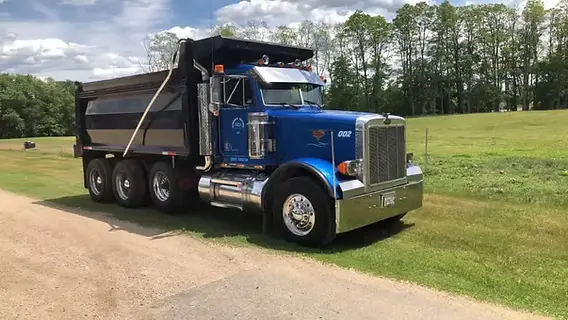
Section 31-25-29 is a body-type and use exemption, which makes it directly relevant to any operator running roll-off or refuse-bodied equipment alongside aggregate work. Notwithstanding any contrary provision of the chapter, a motor vehicle designed and used for the hauling of refuse is not subject to state axle weight restrictions when hauling refuse.

The section then spends most of its length taking things back. Nothing in it waives or modifies existing state gross weight restrictions for refuse vehicles or other size and weight restrictions. Nothing in it permits those vehicles to travel over any structure, highway or portion of highway that is weight restricted for the vehicle load. And to the extent that applying it to the national system of interstate and defense highways would cost Rhode Island federal highway funds, it does not apply to those highways at all.

So the exemption is real, narrow and conditional on cargo. It follows the refuse, not the truck. A mixed fleet that runs refuse in the morning and stone in the afternoon is inside the exemption for one of those movements and outside it for the other, on the same chassis and the same axles, and the fine for getting that wrong is the hundred-pound rate in § 31-25-14(d)(2).

There is no equivalent provision for aggregate. The chapter’s own index of sections — forty-three of them, § 31-25-1 through § 31-25-30 plus § 31-25-12.1 and the twelve corridor sections — carries no heading for a commodity-scoped haul program for sand, gravel, stone or spoil, and the two commodity treatments the chapter does contain run the other way: fluid milk products deemed nondivisible at § 31-25-21(a)(1), and refuse here. That is a statement about the section headings of chapter 31-25, which is the ground the index establishes.

Security for road damage is a permit condition, not a schedule

Rhode Island does not publish a bond table for posted-road access. What it publishes is a discretion. Section 31-25-23(a) lets the department of transportation or a local authority grant a permit, refuse one, cap the number of trips, fix seasonal or other time windows, or attach whatever operating conditions are needed to protect road foundations, surfaces and structures from undue damage. The same sentence adds the financial half: the issuing authority may require any undertaking or other security it deems necessary to compensate for injury to a roadway or road structure.

That is the financial-responsibility hook, and it is exercised case by case at the point of issue rather than published as a rate. Subsections (b) and (c) then tie the permit’s life to the vehicle’s registration: a permit for continuous operation may not run past the registration date of the subject vehicle, and on re-registration a new permit issues on re-certification of the braking and carrying capacity specified on the expired permit.

Money owed for damage that actually happens is a separate question, and the permit does not settle it. Under § 31-25-28, a person who drives a vehicle, object or contrivance over a road or a road structure carries the repair cost of whatever that movement breaks — and the section reaches both unlawful movements and movements that were over the chapter’s weight or dimension maxima but covered by a special permit. Where the driver had the owner’s permission, express or implied, the two of them answer for it together. Recovery runs as a civil action brought by whoever controls the road.

Two things follow for a submission. First, road and structure damage recovery here is a claim in court against the operating company and the driver together, not a citation, and it is not extinguished by having bought the permit. Second, because the security requirement in § 31-25-23(a) is discretionary and set permit by permit, the only reliable way to know what a given movement will be asked to post is to have asked — before the job is priced, not after.

  • Undertaking or other security — discretionary permit condition, § 31-25-23(a).
  • Permit life — cannot exceed the vehicle’s registration date for continuous operation, § 31-25-23(b).
  • Re-issue — requires re-certification of braking and carrying capacity, § 31-25-23(c).
  • Damage liability — attaches even to permitted movement, § 31-25-28(a).
  • Owner and driver — jointly and severally liable, § 31-25-28(b).

In a state this size, the route is the risk

A Rhode Island aggregate fleet does not accumulate exposure the way a long-haul operation does. The miles are short, the same corridors repeat every day, and the material risk concentrates at the two ends of the haul — the pit and the placement — plus a handful of posted structures in between. That shape has consequences for how a program should be built.

Weight enforcement is the recurring cost, and § 31-25-1(a)(1) sets its character: exceeding the chapter’s limits is a civil violation except where §§ 31-25-16 and 31-25-27 apply, where the statute says it shall be considered a violation. "Carrier" is defined broadly in both § 31-25-1(a)(2) and § 31-25-16(b) as any company or person who furthers a commercial or private enterprise by use of the vehicle, so the exposure does not stop at the driver.

The covering duty and the leakage rule are what generate spill and clean-up events, and those reach past a fine into third-party property and, where the material is not inert, into pollution liability. The named-corridor and posted-bridge restrictions are what generate routing failures. And the envelope in § 31-25-21(e) marks the line between routine bulk work and movements that belong under oversized and overweight underwriting instead of on a standard dump schedule.

Everything a crew does once the truck has stopped — in the pit, at the stockpile, at the tip — sits outside what a highway auto policy was built to answer, and lands instead on general liability. On the equipment side, a state that keeps the covering legally fastened until the body has been cleaned out turns tarp mechanism condition into a compliance item rather than a housekeeping one, and puts it alongside body and hoist wear at the center of any physical damage discussion.

  • Route list by name, checked against §§ 31-25-27.1 to 31-25-27.12 as well as against town ordinances and state postings.
  • Axle scale practice, since the hundred-pound denominator makes axle distribution the expensive failure.
  • Tarp system type and condition, given that § 31-25-10(e) keeps the duty alive on the return leg.
  • Permit class in use — single trip non-divisible, annual blanket, or a divisible-load permit written to the director’s rules.
  • Any permit revocation history, given the three-violations-in-a-year rule at § 31-25-21(j).
  • Refuse work run on the same chassis, which moves in and out of the § 31-25-29 axle exemption by cargo.
  • Posted-bridge exposure, priced off § 31-25-16 by § 31-25-27(b) rather than off the axle rate.

Coverage lines a Rhode Island dump and aggregate account usually carries

The state minimum is a licensing threshold. The program an operator actually needs is built from these lines:

  • Trucking Auto Liability — Primary liability coverage for bodily injury and property damage caused by your truck while under dispatch.
  • Physical Damage — Collision and comprehensive coverage for the tractor, trailer, and attached equipment you own or finance.
  • Motor Truck Cargo — Coverage for the freight you haul against loss or damage in transit.
  • Trailer Interchange — Coverage for non-owned trailers you pull under written interchange agreements.
  • General Liability — Coverage for premises and operations liability away from the truck — terminal yards, customer docks, and non-driving exposures.
  • Workers Compensation — Statutory coverage for driver and yard-employee injury, structured for trucking payrolls and interstate operations.
  • Non-Trucking (Bobtail) Auto Liability — Liability coverage for the tractor when operated off-dispatch — bobtailing home or running personal errands.
  • Pollution Liability — Coverage for cargo-related pollution events and upset/overturn spills not covered by standard auto liability.

Why Truck Guard Insurance for a Rhode Island dump and aggregate account

We write dump and aggregate hauling as a named class rather than as an exception to general trucking, and we read each account against the weight and permit regime of the state it operates in. For a Rhode Island operator that means starting from what the trucks are actually licensed and configured to carry, sizing physical damage to bodies and hoists rather than to a chassis value, and treating pit, stockpile and job-site work as its own exposure rather than an extension of the highway auto form.

If the operation also runs freight under separate authority, the Rhode Island trucking insurance page covers the state’s broader motor carrier picture, and the dump trucking insurance page covers the class mechanics that apply wherever the operator runs.

Rhode Island dump trucking insurance questions

What is the overweight fine for a Rhode Island dump truck?

It depends which limit was exceeded. An axle violation — single over 22,400 lb or tandem over 36,000 lb — is $125 per 100 pounds overweight or portion of it under § 31-25-14(d)(1) and (d)(2). A gross violation on a vehicle over 10,000 lb GVW is $125 per 500 pounds under § 31-25-16(c)(3). Bridge formula violations are routed to the § 31-25-16 schedule by § 31-25-14(d)(3).

Does the Rhode Island bridge formula ever reduce a tandem below 36,000 pounds?

No. Section 31-25-14(c) provides that in any calculation using the subsection (b) formula in which the tandem axle limit works out to less than 36,000 pounds, 36,000 pounds shall be considered the legal limit. It is a floor rather than a step-down, and it favors the short-wheelbase configurations the formula would otherwise penalize.

Do I have to keep a tarp on an empty Rhode Island dump truck?

Until the body is clean, yes. Section 31-25-10(e) requires a covering to be securely fastened before operating with rubbish, refuse, other debris or loose material, and states that the covering must remain in place and secured during travel on any highway until the contents have been properly cleaned and purged from the vehicle. The duty therefore reaches the return leg.

How long can a Rhode Island town keep a road posted for weight?

Ninety days in any one calendar year, in total. Section 31-25-25(a) caps the local seasonal power at that figure, and § 31-25-25(b) leaves the ordinance with no force until signs describing it are standing at both ends of the stretch and are being kept there. A separate power at § 31-25-26 lets a town prohibit commercial vehicles on designated highways without a day-count ceiling.

Are there Rhode Island roads closed to trucks by statute rather than by ordinance?

Twelve of them. Sections 31-25-27.1 through 31-25-27.12 name individual corridors in the general laws, each with its own threshold and exemptions — a two-ton limit on the Veterans Memorial Parkway in East Providence, a four-ton through-truck ban on Hopkins Avenue, and a through-commercial-vehicle prohibition on Limerock Road between Douglas Pike and Jenckes Hill Road, among others.

What does a Rhode Island overweight permit cost?

Section 31-25-21(c) sets $40 for each non-divisible single trip permit and § 31-25-21(d) sets a $400 annual fee that exempts the holder from single trip fees for non-divisible construction equipment loads, boats or marine assets under 130,000 pounds. Those figures come from the statute as amended by P.L. 2025, ch. 29 and ch. 30, effective June 10, 2025. Divisible-load ceilings are set by the director’s rules rather than by the statute.

Do refuse trucks get higher axle limits in Rhode Island?

When hauling refuse, yes. Section 31-25-29 exempts a vehicle designed and used for hauling refuse from state axle weight restrictions while hauling refuse. It does not waive gross weight limits or other size and weight restrictions, does not allow travel over weight-restricted structures or highways, and does not apply to interstate highways where doing so would cost the state federal highway funds.

Does a Rhode Island permit protect against road damage claims?

No. Section 31-25-28 puts the repair cost of whatever a movement breaks on the person driving it, and says so expressly for movements that exceeded the chapter’s weight or dimension maxima under a special permit. Where the driver had the owner’s express or implied permission, both answer for it together, and the road authority recovers by civil action. Section 31-25-23(a) separately lets the issuing authority require an undertaking or other security as a permit condition.

Sources

Every figure on this page was read at the source below on August 11, 2026, with the effective date of the version read. Treat each as current as of that date rather than as permanent.

Get a Rhode Island dump trucking insurance quote

Send the declared or registered weights alongside the axle configurations, and tell us where the material moves from. We will size the program against the work the trucks actually do rather than against a statutory floor.

Start a quote Call 317-942-0549