
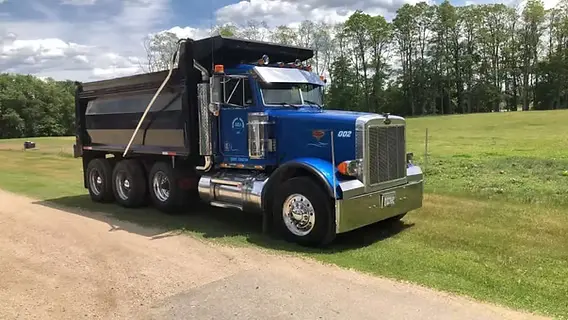

A contractor’s dump trucks and lowboy trailers are usually insured on a commercial auto policy, and the machines they carry are insured on a contractor’s equipment policy, which is a form of inland marine. Which insurers will write them depends on three things: whether you haul only for your own jobs or for others, how far the trucks run, and how heavy and how frequent the lowboy moves are. For-hire aggregate work is covered in sand and gravel hauler insurance.
Contractors ask this question because the answer is not obvious. A pickup fleet and a heavy hauling operation are different risks, and a policy built for one does not always fit the other.
Who writes insurance for a contractor’s dump trucks?
Two kinds of markets do. Commercial auto insurers that write contractors often take dump trucks that haul the contractor’s own materials to and from its own jobs, sometimes on the same policy as the pickups and service trucks. Trucking insurers write dump trucks that haul for other people, and the dump trucking insurance page covers that class.
The line between the two is whether you haul for hire. A contractor that delivers its own gravel to its own site is generally operating as a private carrier. A contractor that hauls gravel for another company and is paid for it is a for-hire carrier, and that brings operating authority, federal insurance filings and an underwriter who writes trucking. The federal definitions are in 49 CFR 390.5.
How is the lowboy trailer insured?
The trailer itself is listed on the auto policy for liability and, if you want it repaired or replaced after a loss, for physical damage. A lowboy is heavy and specialized, so list it as what it is. A trailer described vaguely on the schedule can lead to a dispute about its value after a loss.
Securement is part of the picture as well. The federal cargo securement rules in 49 CFR Part 393, Subpart I include requirements for heavy vehicles, equipment and machinery, and a securement finding at a roadside inspection can be written up against the operator. Keep chains, binders and tie-down points in good condition, and train whoever loads the trailer, because a shifted machine is both a liability claim and an equipment claim.
The bigger question is what you put on it. Moving heavy equipment on a lowboy brings permits, escort rules and route restrictions, and the page for oversized and overweight trucking insurance explains how heavy-haul programs handle them.
Is the equipment on the lowboy covered by the auto policy?
Usually not. The auto policy covers the truck and trailer and your liability for operating them. The excavator, loader or dozer on the deck is your own property, and a contractor’s equipment policy is the usual home for it. Check that it covers the machine while it is loaded, in transit and being unloaded, since some forms limit transit or require the machine to be secured in a particular way.
Pay attention to how each machine is valued. Equipment policies may pay the actual cash value of a machine, which accounts for wear and age, or a replacement or agreed value, and the difference matters when a machine is total. A schedule that was set years ago and never updated can leave a newer or rebuilt machine underinsured. Review the values at every renewal, and add machines you buy during the year as you buy them.
Rented and borrowed machines are a separate question. Rental agreements often make you responsible for the machine while you have it, and your equipment policy may or may not extend to it. Tell your agent whose equipment you move, not just your own.
When does a contractor become a trucking company?
When it starts hauling for others for pay. It happens gradually. A contractor with spare dump trucks takes a few loads for a neighbor’s project, then a few more, and before long a meaningful share of the trucks’ time is hauling for hire. The contractor’s policy was rated for its own work, and the insurer may never have been told.
That is the moment to call your agent. For-hire hauling across state lines brings operating authority, federal insurance filings and the liability schedule at 49 CFR 387.9. FMCSA explains who needs operating authority on its page about getting operating authority. Even inside one state it changes the risk the insurer agreed to cover. The article on interstate trucking insurance explains when the federal rules apply, and the page for new venture trucking insurance covers a carrier getting its own authority.
What do underwriters ask about dump trucks and lowboys?
They ask about weight, distance and use. Expect questions about the weight rating of each truck, what the dump trucks haul, how far they run from the yard, and how often the lowboy moves equipment and how heavy those moves are. They will ask who drives, what licenses those drivers hold and what their records look like.
Driver qualification matters more for heavy trucks than for pickups. The article on the 26,001-pound line explains the federal licensing thresholds that change at that weight.
What does general liability add on the job site?
It covers your operations, which is most of what a contractor does. A dump truck backing on a site is generally an auto exposure, but the work around it, such as spreading, grading and directing traffic on the site, is general liability territory. The boundary between the two forms is where claims get argued, and the article on loading and unloading insurance coverage explains how the forms divide that work.
Real-World Scenario: Picture a hypothetical site contractor that owns three dump trucks and a lowboy, all on its contractor’s auto policy. The lowboy moves the company’s own excavator between jobs, and one day it moves a rented loader for a subcontractor as a favor. On a highway ramp the loader shifts and damages the trailer and a passing car. The auto policy responds to the car. The question of who pays for the rented loader, and whether the favor was hauling for someone else, takes weeks to settle because nobody had told the insurer about borrowed equipment.
What do job sites ask a contractor’s trucks to carry?
General contractors and project owners commonly ask every company that brings trucks onto a site for a certificate of insurance. The request often goes beyond proof that a policy exists: additional insured status on the auto and general liability policies, a waiver of the insurer’s right to recover from the owner, specific limits and sometimes an umbrella. Each of those is a request your agent has to take to the insurer, and some take time to arrange.
Collect the insurance sections of your contracts before the season starts, and send them together. The strictest contract usually sets the program. A certificate that promises something the policy does not provide does not change the policy, and the gap tends to surface only after a claim, when it is too late to fix.
How should the policies be put together?
Place the trucks and the equipment at the same time, with an agent who reads both. The auto schedule should list every truck and trailer as what it is. The equipment schedule should list every machine, with its value, and say whether rented machines are covered. Then compare the two against your actual work: who you haul for, how far you go, and what you move.
Many contractors also carry an umbrella over the auto and general liability policies, often because job contracts require it. Check that the umbrella follows the auto policy that actually covers the dump trucks.
What should you do next?
List your trucks with their weight ratings, your trailers, the machines you move and whether any of your hauling is for other people. Then start a quote and send the list with your current policies. We will tell you whether your trucks, your lowboy and your equipment are insured where you think they are.